ACT Math Trigonometry: Every Topic You Need to Master
Trig has a weird reputation among ACT test-takers. Students grind through weeks of algebra and geometry prep, then treat trigonometry like a footnote — and pay for it come test day. Here's the thing: ACT trig isn't designed to be tricky. It covers a small, predictable set of ideas, and the students who learn those ideas cold turn trig into one of the most reliable sections they can score on.
How Trig Actually Shows Up on the ACT
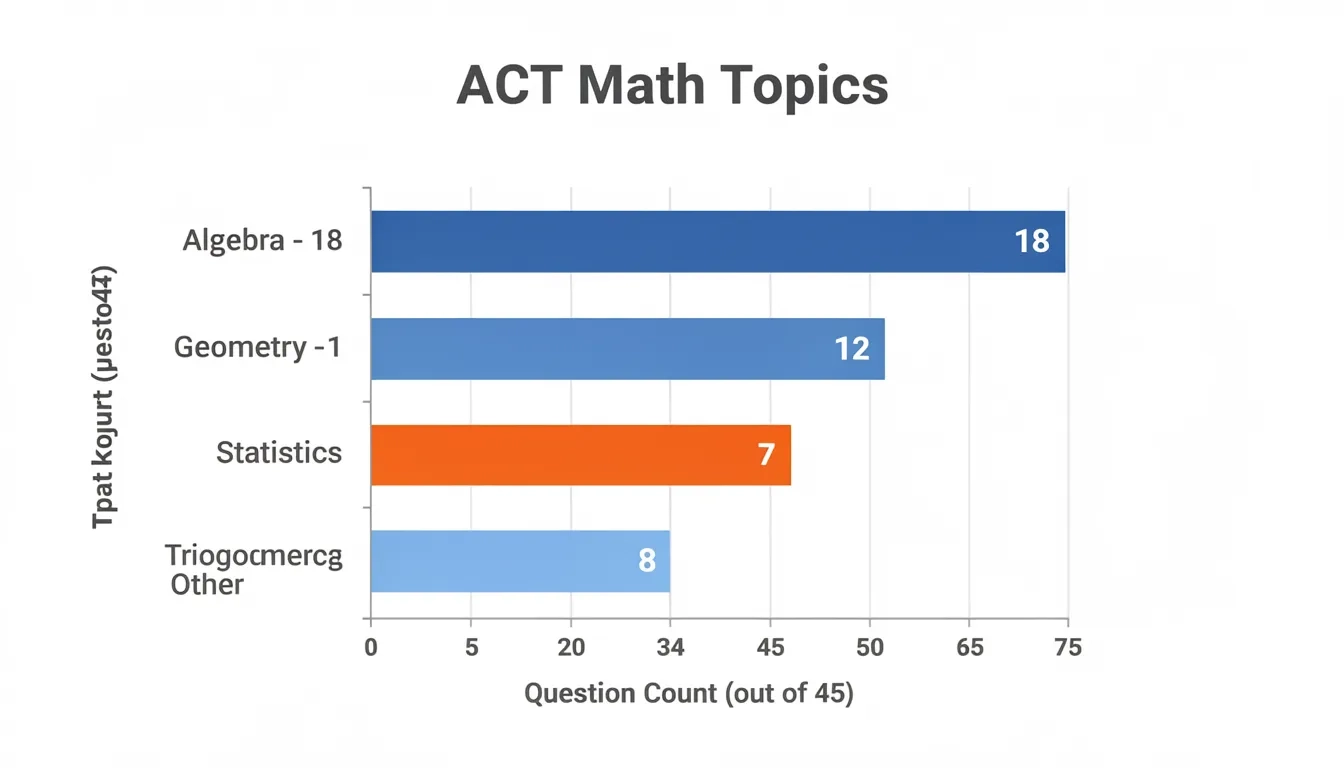
On the current Enhanced ACT format (45 questions, 50 minutes), trigonometry accounts for roughly 5–7 questions. That's around 11–16% of your total math score, and each question carries more weight than it did on the old 60-question format. According to PrepScholar's ACT trigonometry guide, these questions tend to cluster in the middle-to-hard difficulty range.
The five question types you'll actually encounter:
- Finding a trig ratio from a right triangle diagram
- Solving a word problem using angle of elevation or depression
- Finding a trig value when given one ratio and the angle's quadrant
- Reading amplitude or period from a trig graph
- Applying the law of sines or law of cosines to a non-right triangle
That's the full menu. Not exhaustive, not unpredictable. A student who knows each of these setups cold can walk out with 5+ correct trig answers without breaking a sweat.
SOHCAHTOA and Right Triangle Basics
SOHCAHTOA is the foundation — but it's also where most errors happen. The three ratios are:
- Sine = Opposite / Hypotenuse
- Cosine = Adjacent / Hypotenuse
- Tangent = Opposite / Adjacent
The mistake students make isn't forgetting the formula. It's forgetting that "opposite" and "adjacent" are relative to whichever angle you're working with. Switch angles without relabeling your triangle, and you'll pick the wrong ratio every time. Label the sides before you touch the calculator.
Special triangles save serious time on test day. The 30-60-90 triangle has sides in ratio 1 : √3 : 2. The 45-45-90 triangle goes 1 : 1 : √2. Spot these ratios in a problem and you can often skip the trig functions entirely.
If a right triangle has a hypotenuse of 10 and one leg of 5, you're looking at a 30-60-90. The other leg is 5√3. The test gave you the answer the moment you recognized the pattern.
A typical ACT problem gives you an angle, a known side, and asks for an unknown side. Set up the correct ratio, cross-multiply, and solve. The mechanics are simple — the skill is choosing sine vs. cosine vs. tangent correctly before you start.
Reciprocal Functions and Key Identities
Most students memorize SOHCAHTOA and stop there. The ACT also tests the three reciprocal functions, and questions about them are almost always straightforward if you've seen the definitions before.
- Cosecant (csc θ) = 1 / sin θ = Hypotenuse / Opposite
- Secant (sec θ) = 1 / cos θ = Hypotenuse / Adjacent
- Cotangent (cot θ) = 1 / tan θ = Adjacent / Opposite
The most common mix-up: students assume "cosecant" goes with cosine because of the "co" prefix. It doesn't — cosecant is the reciprocal of sine. (This one trips up enough people that it shows up on real tests specifically to catch the assumption.) Write the pairings down at the start of your math section if you need the anchor.
Two identities you need cold:
The Pythagorean identity — sin²θ + cos²θ = 1 — appears in simplification problems. When you see this expression anywhere, collapse it to 1 immediately and keep moving.
The tangent identity — tan θ = sin θ / cos θ — is your shortcut whenever a problem gives you both sine and cosine and asks for tangent. No additional formulas needed.
Together, Magoosh's ACT trig guide argues these two identities plus SOHCAHTOA handle the majority of what the test actually asks. That's roughly right, though quadrant rules and graphs close the gap.
Quadrants, Unit Circle, and Radians
The ASTC rule tells you which trig functions are positive in each quadrant. The mnemonic "All Students Take Calculus" maps to each quadrant in order:
| Quadrant | Positive Functions |
|---|---|
| I (All) | sin, cos, tan — all three |
| II (Students) | sin only |
| III (Take) | tan only |
| IV (Calculus) | cos only |
This comes up constantly in problems like: "If sin θ = 4/5 and θ is in Quadrant II, find cos θ." You use the Pythagorean identity to get cos θ = ±3/5, then apply the ASTC rule — cosine is negative in Quadrant II, so cos θ = -3/5. Four steps, all mechanical.
The unit circle is a circle of radius 1 centered at the origin. Every point on it has coordinates (cos θ, sin θ). That's the whole definition. The x-coordinate is cosine; the y-coordinate is sine.
You don't need to memorize every angle on the unit circle. Focus on 0°, 30°, 45°, 60°, 90°, and their counterparts in other quadrants. Those 6 reference angles, paired with ASTC, cover essentially every unit circle question the ACT tests.
Radian conversion: multiply degrees by π/180 to get radians. The most useful conversions to know by heart: 180° = π, 90° = π/2, 60° = π/3, 45° = π/4, 30° = π/6. When you see π in an angle measure, don't panic — just convert.
Reading Trig Graphs
Trig graph questions almost always ask about amplitude, period, or phase shift. The general form is:
y = A · sin(Bx + C) + D
- Amplitude = |A|
- Period = 2π / B
- Phase shift = −C / B (positive means shift right)
- Vertical shift = D
If you see y = 3 sin(2x), the amplitude is 3 and the period is 2π/2 = π. That's a one-line calculation.
Phase shift is where students lose points. For y = sin(x − π/3), the phase shift is +π/3 to the right — not left. The negative sign inside the argument moves the graph in the opposite direction. Sketch a quick graph if the question asks you to identify the shift direction; it takes 15 seconds and eliminates the sign error.
Graph questions on the ACT rarely go deeper than these four properties. If a problem shows you a graph and asks you to write the equation, work backwards: read the amplitude from the peak height, calculate the period from the graph, and identify any obvious vertical shift. You'll match the right answer without needing any additional formulas.
Law of Sines and Law of Cosines
Non-right triangles need one of two tools. The ACT sometimes provides these formulas in the problem — but even then, you need to know which one applies and how to set it up.
When to use each:
- Law of Sines (a/sin A = b/sin B = c/sin C): Use when you have a matching angle-side pair plus one more piece of information. Classic setups are two angles and a side, or two sides with a non-included angle.
- Law of Cosines (c² = a² + b² − 2ab · cos C): Use when you have three sides (SSS) or two sides with the included angle (SAS). Notice that when C = 90°, cos C = 0 and the formula collapses into the Pythagorean theorem exactly.
My honest take: these questions appear on maybe one or two test administrations per year, always at the harder end. If you're pushing for a 30+ on ACT Math, learning them is worth the 45 minutes of practice. If you're scoring below 25, lock down SOHCAHTOA and trig graphs first — the return per study hour is much higher there.
How to Build Your ACT Trig Study Plan
Not all topics deserve equal attention. EdisonOS's ACT trig guide recommends a tiered approach, and I agree with the logic:
Tier 1 — Highest return, master these first:
- SOHCAHTOA and right triangle labeling
- Reciprocal functions (csc, sec, cot)
- Pythagorean identity and tangent identity
- ASTC quadrant rule
Tier 2 — Learn these after Tier 1 is solid:
- Amplitude, period, and phase shift from trig graphs
- Radian-to-degree conversion
- Unit circle reference angles
Tier 3 — Worth knowing if you have time:
- Law of sines and law of cosines
- Inverse trig functions
- Double-angle or sum-difference formulas (appear rarely, mostly on 34–36 range questions)
A focused study session of around 3–4 hours on Tier 1 alone will cover the majority of trig questions that appear on any given test. That's not a lot of time for a meaningful score lift.
Bottom Line
- Trig is learnable fast. With 5–7 questions on the Enhanced ACT, a single focused weekend session on Tier 1 topics pays off more per hour than nearly anything else you could study.
- Label every triangle before computing. Identifying your reference angle and marking opposite, adjacent, and hypotenuse eliminates the most common SOHCAHTOA errors outright.
- Don't skip reciprocal functions. Csc, sec, and cot appear regularly, and students who've reviewed them for 20 minutes score points that everyone else drops.
- For graphs, just know two facts: amplitude = |A|, period = 2π/B. That handles most trig graph questions without any deeper formula work.
- The biggest trig mistake isn't missing the hard questions — it's leaving easy points behind because the basics were never reviewed. Start with SOHCAHTOA, work through the identities, and build up from there.
Frequently Asked Questions
How many trigonometry questions are on the ACT Math section?
On the Enhanced ACT format (45 questions, 50 minutes), trig accounts for roughly 5–7 questions — about 11–16% of the math section. These questions tend to appear in the middle-to-harder range, though basic right triangle problems occasionally show up earlier. Each question carries more weight than it did on the old 60-question format.
Do I need to memorize the full unit circle for the ACT?
No. Focus on the six reference angles: 0°, 30°, 45°, 60°, 90°, and 180°. Combined with the ASTC quadrant rule, those values cover essentially every unit circle question the ACT tests. Full memorization helps if you're aiming for a 34+, but it's not required to score well in the 26–30 range.
Will the ACT provide the law of sines and cosines formulas?
Sometimes, but not always. The ACT occasionally includes these formulas within the problem setup — but you still need to recognize which formula applies and set up the equation correctly. Students who've memorized them have a clear advantage on questions where they're not provided, which does happen.
I'm weak on trig. Should I prioritize it over algebra review?
Probably not, unless your algebra is already solid. Algebra and functions together make up roughly 30–35% of the ACT Math section, so gaps there cost more total points. Tighten up algebra first, then layer in trig. The exception: if you're already in the 26–28 range and trying to break 30, trig becomes one of the highest-leverage areas left to improve.
What's the most common trig mistake on the ACT?
Misidentifying opposite and adjacent sides. These labels change depending on which angle is your reference angle, and swapping angles mid-problem without relabeling the triangle produces the wrong ratio every time. Always identify the reference angle first, label all three sides relative to it, and then choose your trig function.
Are there trig identities beyond sin²θ + cos²θ = 1 that I need?
Rarely for most scores. The Pythagorean identity and tan θ = sin θ / cos θ cover the overwhelming majority of ACT identity questions. Double-angle formulas like sin(2θ) = 2 sin θ cos θ appear occasionally at the 34–36 difficulty level, but they're low-priority until everything else in Tiers 1 and 2 is locked down.