AP Chemistry: The Study Guide That Actually Gets You a 5
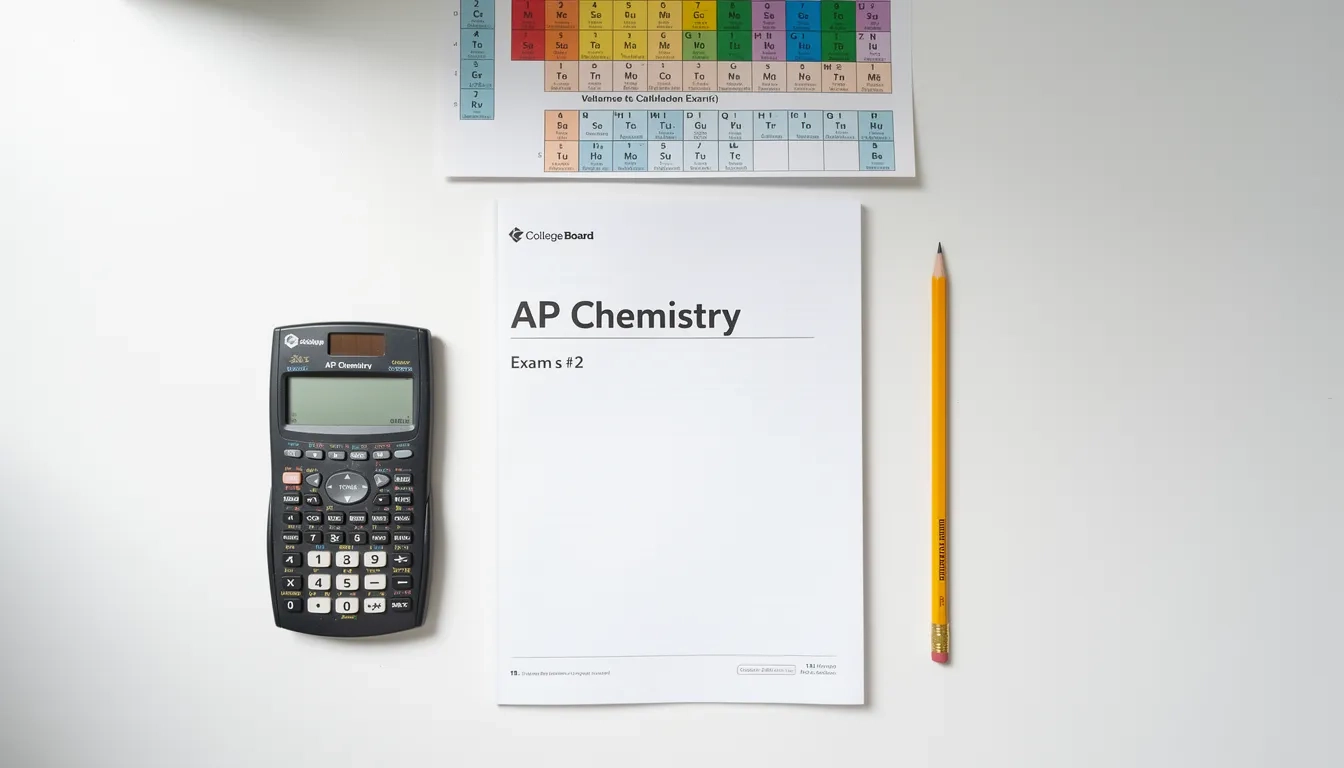
AP Chemistry has a reputation that's scarier than its actual score distribution. In 2024, 75.6% of students who took the exam scored a 3 or higher. But only 17.9% earned a 5. That gap — between passing and excelling — comes down almost entirely to how you handle two specific parts of the exam, and most students never figure out which two those are.
How the Exam Actually Works
AP Chemistry runs 3 hours and 15 minutes. Two sections, each worth exactly half your final composite score.
Section I is 60 multiple-choice questions in 90 minutes. Calculators have been allowed since 2023, along with a printed reference sheet containing equations and constants. Section II is 7 free-response questions in 105 minutes: three long-answer questions worth 10 points each and four short-answer questions worth 4 points each, totaling 46 raw FRQ points.
The exam now runs as a hybrid digital format through College Board's Bluebook app. Questions appear on a screen; you write answers by hand in an exam booklet. Toggling between a screen and a physical page under timed conditions is genuinely disorienting if you haven't practiced it. Add one mock session in this format to your prep, even an informal one.
No points are deducted for wrong answers anywhere on the exam. Guess on every question you skip before time is called.
The Score Map: What You're Targeting
From 2024 College Board exam data, here's how composite scores translated to final AP scores:
| AP Score | Composite Range | % of 2024 Test-Takers |
|---|---|---|
| 5 | 72–100 | 17.9% |
| 4 | 58–71 | 27.4% |
| 3 | 42–57 | 30.3% |
| 2 | 27–41 | 16.9% |
| 1 | 0–26 | 7.5% |
A 3 requires roughly 42 composite points. A 5 requires 72. That 30-point gap explains everything about why prep matters.
A 4 is genuinely achievable for most students who study consistently over several months. The jump from 4 to 5 is harder and requires strong command of both sections. Getting from a 3 to a 4 mainly comes down to FRQ execution — partial credit is available, and students regularly leave points behind through incomplete justifications rather than wrong knowledge.
One important floor to keep in mind: if you score well below 50% on MCQ, no FRQ performance will fully compensate. Aim for at least 30 correct answers out of 60 on multiple-choice as your baseline target.
Nine Units — Not Equal
AP Chemistry covers nine units. The exam does not weight them the same, and this matters enormously for how you allocate study time.
Unit 3 (Intermolecular Forces and Properties) carries 18–22% of the exam — the single largest share. Unit 8 (Acids and Bases) follows at 11–15%. Every other unit falls in the 7–9% range.
| Unit | Topic | Exam Weight |
|---|---|---|
| 1 | Atomic Structure & Properties | 7–9% |
| 2 | Molecular & Ionic Compound Structure | 7–9% |
| 3 | Intermolecular Forces & Properties | 18–22% |
| 4 | Chemical Reactions | 7–9% |
| 5 | Kinetics | 7–9% |
| 6 | Thermochemistry | 7–9% |
| 7 | Equilibrium | 7–9% |
| 8 | Acids & Bases | 11–15% |
| 9 | Thermodynamics & Electrochemistry | 7–9% |
Units 3 and 8 together can cover nearly a third of your exam. If you have limited time before test day, that's your starting point. No other two-unit pair comes close.
That said, don't dismiss the 7–9% units. Kinetics and Equilibrium show up repeatedly in long FRQs. A single 10-point free-response question on ICE tables is worth roughly ten MCQ questions — the weighting math shifts when partial credit enters the picture.
Free Response: Where the Exam Is Actually Won
The FRQ section separates 3s from 5s more than anything else in AP Chemistry. The reason is partial credit. A student who understands the process but makes an arithmetic error can still earn 7 of 10 points on a long question. That same student gets zero for a wrong MCQ answer.
The three long FRQs typically combine a quantitative calculation with a conceptual justification — calculate an equilibrium constant, then explain what happens when temperature changes. Both pieces matter and are scored independently.
The most common way students lose FRQ points isn't wrong chemistry. It's incomplete chemistry. "The boiling point is higher" earns nothing. "Water has a higher boiling point than ethane because hydrogen bonds require significantly more energy to break than London dispersion forces" earns full credit.
Justify at the molecular or atomic level, every time. This is the single most actionable piece of advice in this article, and it's also the thing most students skip under time pressure.
Other FRQ mechanics worth internalizing:
- Write the formula before substituting values. Correct setup earns partial credit even if the arithmetic is wrong.
- Include units throughout the calculation. A final answer of 8.3 when the expected answer is 8.3 kJ/mol may cost a point.
- Net ionic equations need states of matter. Include (aq), (s), (l), (g), remove spectator ions, and verify charge balance on both sides.
- Particulate diagrams are graded strictly. Representing NaCl as covalent molecules instead of ions earns zero credit. Atom ratios and charges must be exact.
Earning 41 of 46 available FRQ points (~89%) — combined with solid MCQ performance — is the threshold that puts students in the 4–5 score range.
Multiple Choice: Speed Is the Skill
The MCQ section rewards time management as much as chemistry knowledge. Sixty questions in 90 minutes is exactly 90 seconds per question. A few calculation-heavy questions can consume 3 minutes each and quietly derail your pacing if you don't have a plan.
Use a two-pass approach. On the first pass, answer everything you can answer immediately. Flag anything requiring significant calculation. Return with 15–20 minutes left and work through the flagged questions in order.
The reference sheet (periodic table, equations, constants) is available for the entire MCQ section. Using it efficiently means knowing where formulas live before exam day. Flipping through looking for the Nernst equation under pressure wastes the time you saved elsewhere.
Some MCQ questions are estimation traps. On questions about pH, Ka values, or concentrations, three of four answer choices often differ by orders of magnitude. Recognize the pattern, eliminate the implausible choices fast, and move on without calculating.
Since calculators are allowed on MCQ (as of 2023), mental math isn't the barrier it used to be. But rough estimation still helps you catch errors before you commit to an answer.
Building a Study Plan That Holds
Students who score 4 or 5 on AP Chemistry typically invest 80–120 hours of preparation. At 5 hours per week, that's about 16–24 weeks — most of the second semester if you start in January.
A structured timeline:
- Weeks 1–8: Cover all nine units systematically. AP Classroom (College Board's free platform) is the most direct resource. Barron's AP Chemistry is a strong backup for depth. Focus on understanding why reactions occur, not rote formula memorization.
- Weeks 9–14: Shift to timed practice. One full MCQ section per week under exam conditions. Work through FRQ questions from past College Board exams, then read the scoring guidelines immediately after each attempt.
- Weeks 15–16: Full practice exams under real conditions — timed, handwritten, no pausing. College Board publishes free-response questions and official scoring guides going back many years on AP Central. Print them. Sit down. Write real answers.
The most underused resource in AP Chemistry prep is College Board's FRQ scoring commentaries — the annotations explaining exactly why sample responses did or didn't earn credit. Reading three or four of these is worth more than two hours of passive content review.
The biggest time waster? Re-reading chapters you already understand. Check comprehension with problems first. If you're getting them right consistently, move on.
What Trips Up Even Prepared Students
Most AP Chemistry failures aren't from not knowing the material. They come from knowing it but losing points on execution.
Significant figures are a quiet but consistent point leak. The default expectation is three significant figures. Rounding an intermediate value to two sig figs and carrying that forward can cost a point on a question you otherwise aced.
Misreading question verbs is another trap (and it's sneaky). "Explain" means justify with reasoning. "Calculate" means show numerical work. "Identify" usually requires a single word or formula. Treating an "explain" question with a calculation answer earns partial credit at best.
Labs account for roughly a quarter of FRQ sub-parts. Questions about experimental design, identifying sources of error, or interpreting titration data draw directly from lab experiences. Students who treated labs as a break from real learning consistently leave 3–4 FRQ points on the table.
The highest-leverage habit is also the one students resist most: writing full FRQ answers by hand, then comparing line by line to the scoring rubric. Slow. Effective. Non-negotiable if you want a 5.
Bottom Line
- Units 3 and 8 cover up to 37% of the exam. If you only have two weeks left, start there and go deep.
- FRQ partial credit is where most score improvements happen. Show all work, justify at the molecular level, include units, and don't skip the states of matter on ionic equations.
- One full practice exam under real conditions — timed, handwritten, Bluebook-style — is worth more than five casual review sessions.
- Protect your significant figures on every FRQ answer. Three sig figs is the default. Getting the chemistry right and losing a point to rounding is the worst kind of mistake.
- The path to a 5 is 72 composite points — roughly 72% accuracy across both sections. Difficult, but achievable for a student who puts in 80+ focused hours starting before spring break.
Frequently Asked Questions
Is AP Chemistry really as hard as people say?
The reputation is somewhat inflated. In 2024, 75.6% of students scored 3 or higher, which is a solid pass rate compared to many other AP exams. The exam is math-intensive and demands written justifications in FRQs, but those are learnable skills. The difficulty is real; the impossibility is a myth.
What topics show up most on the AP Chemistry exam?
Units 3 and 8 carry the most weight at 18–22% and 11–15% respectively. Beyond that, Equilibrium and Kinetics appear heavily in long FRQs. ICE tables, Le Châtelier's principle, rate laws, acid-base equilibria, and Henderson-Hasselbalch calculations are tested far more often than other topics.
Myth: You need to memorize all the equations for AP Chemistry.
False. College Board provides a full reference sheet with equations, constants, and the periodic table during both sections of the exam. What you need is to know when to apply each equation and how to manipulate it. Memorizing the Gibbs free energy formula without understanding what each variable means won't help on a conceptual sub-question.
How should I handle a long FRQ I'm not confident about?
Start with the sub-parts you can answer. FRQ sub-parts are scored independently — you don't need to correctly solve part (a) to earn credit on part (c). Write a clear molecular-level justification for any conceptual sub-part, even if your quantitative answer is off. Partial credit exists everywhere in Section II.
How important are labs for the AP Chemistry exam?
More important than most students expect. Roughly a quarter of FRQ sub-parts connect to lab contexts — designing experiments, identifying error sources, interpreting data from titrations or spectroscopy. Reviewing your lab write-ups a few weeks before the exam is worth the time.
When do AP Chemistry scores come out, and what score do colleges want?
For the May 2026 exam, scores are expected in early-to-mid July 2026 through College Board accounts. Most universities award credit or placement for scores of 4 or 5 — but policies vary significantly. Some schools grant credit for a 3; selective programs may require a 5 to place out of their two-semester general chemistry sequence. Check each school's AP credit policy directly before the exam, since it affects whether a 4 is worth the same as a 5 for your specific goals.