AP Chemistry Study Guide: Exam Tips That Actually Move Your Score
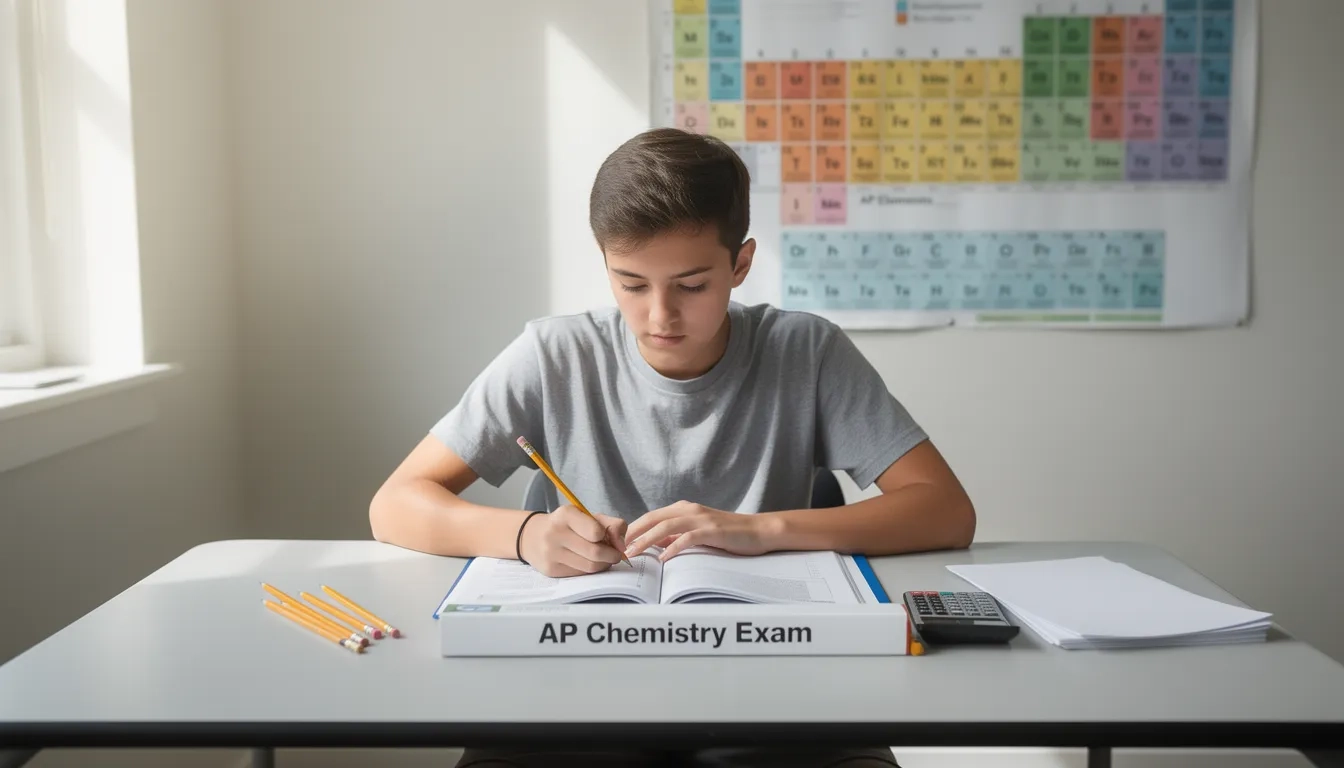
About 78% of students who took AP Chemistry in May 2025 scored a 3 or higher. That sounds encouraging — until you realize that nearly 37,000 of the 168,833 test-takers walked away with a 1 or 2. The gap between those groups rarely comes down to raw ability. It almost always comes down to knowing which units carry the most exam weight, and having a real plan for the free-response section.
Here's what actually works.
What the AP Chemistry Exam Looks Like
The exam runs 3 hours and 15 minutes, split cleanly into two halves, each worth 50% of your score.
Section 1 is 60 multiple-choice questions in 90 minutes. No calculator for the first portion. You get roughly 90 seconds per question — workable, but not comfortable if you're stopping to second-guess every other problem.
Section 2 is the free-response section: 3 long-answer questions worth 10 points each, plus 4 short-answer questions worth 4 points each. That's 46 total points up for grabs, and a calculator is allowed throughout. The 2026 exam runs in a hybrid digital format, meaning you'll type most responses but still work calculations on scratch paper. Worth knowing in advance so it doesn't feel strange on exam day.
The formula and equation sheet is provided. It includes standard reduction potentials, common constants (R = 8.314 J/mol·K, Faraday's constant, etc.), and core equations. You don't need to memorize it, but you need to know its layout cold so you're not hunting during the exam.
The Unit Breakdown: Where Your Time Should Actually Go
The writing's been on the wall in the College Board's own course data for years: not all 9 units carry equal weight. Here's the breakdown from the official course description:
| Unit | Topic | Exam Weight |
|---|---|---|
| 1 | Atomic Structure and Properties | 7–9% |
| 2 | Molecular and Ionic Compound Structure | 7–9% |
| 3 | Intermolecular Forces and Properties | 18–22% |
| 4 | Chemical Reactions | 7–9% |
| 5 | Kinetics | 7–9% |
| 6 | Thermodynamics | 7–9% |
| 7 | Equilibrium | 15–17% |
| 8 | Acids and Bases | 11–15% |
| 9 | Electrochemistry and Applications | 7–9% |
Units 3, 7, and 8 collectively account for up to 54% of the exam. That's not an accident — these units require the deepest conceptual reasoning and the most calculation-heavy problem types. If your study time is limited, you know exactly where to put it.
The Three Units That Define Your Score
Unit 3 (Intermolecular Forces) catches people off guard because it looks easy on the surface. London dispersion forces, hydrogen bonding, dipole-dipole interactions — it all seems like vocabulary memorization. Then the exam asks you to explain why water has a higher boiling point than hydrogen sulfide, or why iodine dissolves in hexane but not in water. Suddenly, you need to reason from first principles.
The reliable approach: always connect the IMF type to a specific observable property. Vague answers ("stronger IMFs mean higher boiling point") don't earn points. Specific ones ("I₂ has a larger, more polarizable electron cloud than Cl₂, resulting in stronger London dispersion forces and therefore a higher boiling point") do.
Unit 7 (Equilibrium) is where most exam points are won or lost. ICE tables appear constantly. Le Chatelier's Principle questions look simple but carry common traps — adding a catalyst does not shift equilibrium, for example, yet College Board chief reader reports flag this as one of the most repeated student errors across recent exams.
The Q vs. K comparison trips up even well-prepared students. Q < K means the reaction proceeds forward. Q > K means reverse. Write it on a sticky note if you need to. Drilling it until it's automatic is not optional.
Unit 8 (Acids and Bases) requires logarithmic fluency that goes beyond memorizing pH = −log[H⁺]. You need to work backwards from pH to concentration, and forward from Ka to pH via an ICE table, often in the same problem. The Henderson-Hasselbalch equation is nearly certain to appear in a buffer question. Buffers are predictable. Prepare for them specifically.
"AP graders do not infer meaning. If you did not clearly write it, you do not earn the point." — AP Chemistry FRQ scoring guidance
That's not harsh — it's clarifying. These exams have rubrics, not readers who guess at your intent.
FRQ Strategy: Where Most Students Leave Points Behind
My honest take: the FRQ section is where the score gap between a 3 and a 5 actually opens up. The MCQ section rewards broad coverage; the FRQ section rewards precision, completeness, and knowing how the rubric works.
Scoring is component-based. Each sub-part is graded independently. Miss the calculation in part (b), and you can still earn full credit on parts (c) and (d). Never leave a sub-part blank just because you got stuck earlier. An incomplete attempt sometimes earns a point; blank always earns zero.
Tactics that consistently move scores:
- Show your full setup. Write the formula, plug in values, then solve. If the final answer is wrong but the method is right, you often earn the setup point. Graders reward evidence of understanding.
- Include units on every calculated answer. "3.2" is wrong. "3.2 mol/L" might be right. This is an easy point to keep.
- Be specific in explanations. "The rate increases because there are more collisions" is too vague for credit. "The rate increases because higher reactant concentration raises the frequency of effective collisions between particles" earns it.
- Read each question fully before writing. Some students spend 8 minutes on part (a) and never reach part (f). Every part has independent points. Skim the whole question first.
One thing worth knowing: AP Chemistry gives a significant figures grace of one in either direction. A three-sig-fig answer? Two or four sig figs will also be accepted. Students sometimes waste time recalculating over a concern that doesn't actually cost them anything.
MCQ Approach: Getting Out of Your Own Way
The 60 MCQ questions test both conceptual understanding and quantitative reasoning. About a third involve calculations; the rest ask you to apply principles to new scenarios.
Process of elimination is genuinely useful here. AP Chemistry MCQs often include two answers that are clearly wrong, one that sounds right but has a subtle error, and one that's actually correct. Spot the two wrong ones first, and you've moved from 25% to 50% odds on questions you don't fully know.
Patterns to watch for:
- Conceptual questions about Le Chatelier's Principle, reaction spontaneity, and intermolecular forces almost always have one answer that's directionally wrong.
- Calculation questions sometimes include trap answers that correspond to common arithmetic mistakes — like forgetting to convert grams to moles, or dividing when you should multiply.
- Questions asking which statement is incorrect show up more regularly than students expect. Read carefully.
Pacing matters. If a question is eating 3 minutes, mark it and move on. Come back with fresh eyes.
A Study Plan That Reflects How the Exam Is Weighted
The biggest mistake students make is treating AP Chemistry like a cramming subject. It builds on itself. Electrochemistry without thermodynamics, or equilibrium without kinetics, makes no sense in isolation.
A realistic arc for the weeks before exam day:
- Weeks 8–6 before exam: Focus on Units 3, 7, and 8. These carry the most weight and take the most time to internalize. Work through one set of official past FRQs per week (available free at AP Central, along with scoring rubrics).
- Weeks 5–3 before exam: Move through Units 5, 6, and 9. Kinetics, thermodynamics, and electrochemistry form a conceptual triangle that appears together in long-answer FRQs most exam years. The E°–ΔG°–K relationship is tested on virtually every exam.
- Weeks 2–1 before exam: Full timed practice exams. Review every wrong answer — not just to see the right one, but to understand exactly why your instinct was wrong.
- Final week: Light review. Formula sheet layout, ICE table practice, sleep.
Spend 20 minutes specifically on the formula sheet layout. Students who've seen it before exam day find what they need in 10 seconds rather than 90.
The Mistakes That Are Easiest to Avoid
Some errors come from gaps in understanding. These come from going too fast:
- Forgetting unit conversions: The Nernst equation requires temperature in Kelvin. Students who plug in Celsius get a wrong answer that cascades through the rest of the problem.
- Confusing Kp and Kc: Only gases contribute to Kp. Pure solids and liquids are excluded from equilibrium expressions. Mixing these up is one of the most annotated errors in College Board chief reader reports.
- Flipping half-reactions in electrochemistry: Reduction at the cathode, oxidation at the anode. Under exam pressure, students flip this — and every downstream calculation follows the wrong direction.
- Treating the FRQ like an essay: Bullet-pointed, clearly labeled answers earn full credit just as well as dense paragraphs, often better. Precision matters more than length.
Most students who score a 2 didn't lack the ability to score a 4. They ran out of time, left FRQ sections blank, or wrote explanations that graders couldn't award points for. The content knowledge was often there.
Bottom Line
- Study Units 3, 7, and 8 first and deepest. They make up more than half the exam and dominate the most complex FRQ questions.
- Use official College Board materials. Past FRQ rubrics are free on AP Central and show exactly what earns each point — no third-party guide replicates that.
- Never leave an FRQ sub-part blank. Independent scoring means a stuck earlier answer doesn't kill your later credit.
- The single most effective pre-exam habit: score your own practice FRQs against the official rubric, out loud, explaining why each point is or isn't earned. It's uncomfortable. It works.
Frequently Asked Questions
Is AP Chemistry actually one of the hardest AP exams?
It has a difficult reputation, but the 2025 data shows a more nuanced picture. With a 78% pass rate (scores of 3 or higher), AP Chemistry actually outperformed AP Biology, AP Physics 1, and AP Calculus AB that year. The difficulty is real, but it rewards students who study the right units in the right order.
What percentage of students score a 5 on AP Chemistry?
According to College Board's 2025 score distribution, 17% of test-takers scored a 5 — roughly 28,700 students out of 168,833. That's an achievable target. It requires strong performance on both sections, not perfection, since the exam is curved.
What's the most effective way to prepare for the FRQ section?
Work through released FRQs from AP Central, then score your own responses against the published rubrics. The rubrics tell you exactly what language and reasoning earn each point. Doing this 4–5 times before the exam builds more exam-day confidence than any amount of passive reading.
Do I actually need to memorize the formula sheet?
No, but you need to know its layout. The AP Chemistry exam provides a reference sheet. Spending 20 minutes learning where each equation lives means you use it in seconds, not minutes, on a timed exam where that difference adds up.
Is there a myth about just "doing lots of practice problems"?
Yes. Practice without diagnosis stalls progress. A student who works 300 equilibrium problems and checks answers without reading the explanations often stays stuck at the same level. The diagnostic step — understanding the root of each specific error — is what actually builds score.
How important is significant figures on the AP Chemistry exam?
More forgiving than most students think. College Board awards a grace of one significant figure in either direction. A problem requiring 3 sig figs accepts answers with 2, 3, or 4 sig figs. That said, units are not forgiving — missing units on a calculated answer typically costs the point.
Sources
- AP Chemistry Score Distributions – College Board (2025)
- AP Chemistry Units: All 9 Units, Exam Weight & Study Strategy – TestPrepKart
- AP Chemistry FRQ: Tips To Ace Free Response Questions – MentoMind
- The Hardest AP Chemistry Units (and How to Master Them) – North American Tutors
- The Best AP® Chemistry Review Guide for 2026 – Albert.io