AP Chinese Language: Study Guide and Exam Tips for 2026
More than 53% of students who took the AP Chinese Language and Culture exam in recent years scored a perfect 5. That number sounds absurd.
It is — but not for the reason most people assume. The pass rate looks inflated because a large share of test-takers are heritage speakers: students who grew up speaking Mandarin at home, or near-native speakers with significant immersion behind them. For everyone else, this is a genuinely hard exam. But here's what most prep guides miss: even heritage speakers fail in predictable, specific ways that have nothing to do with speaking ability. Those are exactly the things worth fixing before you sit down at that computer.
What You're Actually Walking Into
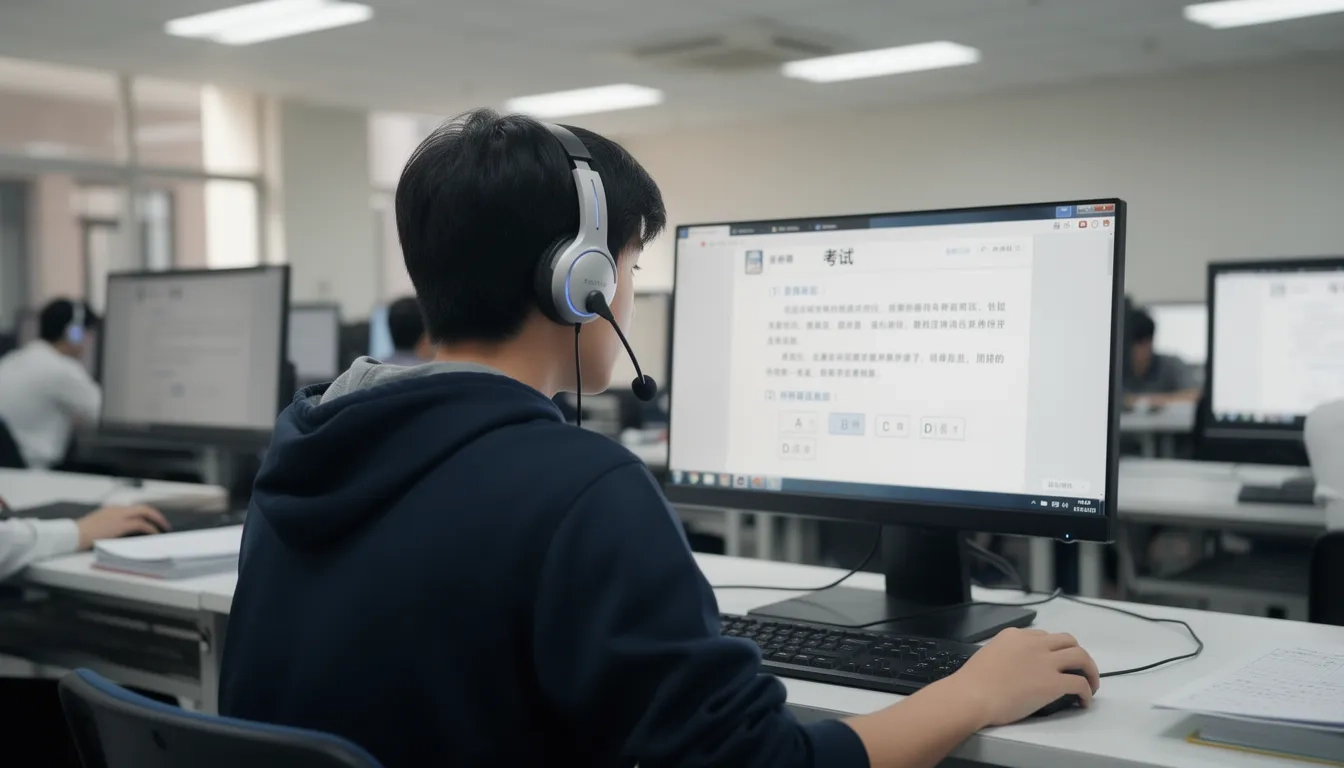
The AP Chinese exam is fully computer-based. No paper — you sit at a school computer with a headset, microphone, and keyboard, entering Chinese characters through Microsoft Pinyin IME. Students who haven't practiced this input method lose 3 to 4 minutes per writing task on slow character entry. Time you simply can't recover.
Total time: exactly 135 minutes. Four sections, each worth 25% of your score:
| Section | Task | Time | Weight |
|---|---|---|---|
| I-A | Listening Comprehension | ~20 min | 25% |
| I-B | Reading Comprehension | ~60 min | 25% |
| II-A | Writing (Story Narration + Email Reply) | ~30 min | 25% |
| II-B | Speaking (Conversation + Presentation) | ~10–15 min | 25% |
One useful feature: you can toggle between Simplified and Traditional characters at any point. If you read significantly faster in one script, use it consistently during the reading section.
The section sequence matters more than most students realize. Listening comes first when you're fresh. Speaking comes last — after 120 minutes of sustained cognitive work. Build stamina in your practice sessions. Running one timed section in isolation doesn't prepare you for how fatigued you'll be when the microphone turns on.
Note for 2026–27 test-takers: The College Board has announced that AP Chinese will transition to the Bluebook digital format beginning with the 2026–27 school year. If you're preparing for that cycle, confirm the updated interface with your school before exam day.
Listening Comprehension: Track Function, Not Every Word
Part A runs about 20 minutes with 25 to 35 questions. The audio spans short conversations, voicemails, public announcements, radio news clips, and longer dialogues. Most clips play only once. There is no rewind.
The trap isn't unfamiliar vocabulary. Students who've studied Mandarin seriously but only heard it at classroom speed often get caught flat-footed by authentic native pace. Real speakers talk fast, drop syllables, and interrupt each other. The Slow Chinese podcast (慢速中文) is a useful bridge — it's deliberately paced, which makes it ideal for building up from textbook audio before jumping into full-speed news or drama content.
The audio also spans registers. A casual voicemail between friends sounds nothing like a school announcement, which sounds nothing like a formal radio report. Train your ear across all of them.
One question format surprises students every year: the "rejoinder." You hear the opening of a conversation and choose the most natural continuation from four options. It's not traditional comprehension — it's testing whether you know how Chinese conversations actually flow. Wrong answers are grammatically plausible but conversationally off. Practice these separately because they require a different mental posture.
During the exam, track discourse function rather than chasing individual words. Ask: Is this person making a request? Expressing disappointment? Giving directions? The communicative intent usually points you to the answer even when a word or two slips by.
Reading Comprehension: Gist First, Details Second
Part B gives you 60 minutes and 30 to 40 questions. Materials are authentic and varied: formal emails, advertisements, news articles, short stories, social media posts, and public notices. You move between text types quickly.
Reading word-by-word is the single biggest time killer. Students who mentally translate each sentence consistently run out of time. Read each passage once for general meaning — identify the topic, tone, and main point — then return to answer specific questions.
You will encounter unfamiliar characters. That's by design. The exam tests whether you can infer meaning from context the way skilled readers do: surrounding words, sentence logic, and topic all give you real information. Don't let one unknown character derail an entire passage.
A habit worth building before exam day: when you read authentic Chinese, notice how texts are structured. Chinese expository writing reliably puts the main idea in the opening sentence of each paragraph. Titles and headers are never decorative. Practicing with BBC 中文网 articles — short, well-organized, and current — builds both reading speed and structural intuition at the same time.
Writing: Where Good Scores Become Great Ones
Part A gives you 30 minutes split across two typed tasks. Both reward linguistic complexity — the scoring rubric specifically rewards sophisticated grammar structures: 把-sentences, 被-constructions, conditional clauses, 不但...而且 (not only...but also) patterns. Simple grammar with basic vocabulary caps your score regardless of idea quality.
Task 1: Story Narration (15 minutes). Four sequential pictures. Your job is to write a cohesive story with a beginning, middle, and end — not describe what's visible in each frame. Students who score 5 invent details the images don't show: character names, motivations, a moment of tension, brief dialogue. Temporal connectors are expected: 首先 (first), 接着 (next), 后来 (later on), 最后 (finally). What separates 3s from 5s is whether the response builds a narrative arc or just labels images.
Graders read hundreds of these narrations. "A woman walks into a store. She buys something. She leaves." scores low. A story where that woman makes a decision, faces a small obstacle, and resolves it — even briefly — scores much higher.
Task 2: Email Reply (15 minutes). You receive a formal email and must answer every question or address every point it raises. Read the original twice. Count the questions explicitly. The rubric penalizes partial responses directly.
Match the formality of the original. An email opening with 您好 from a teacher or organization expects 您好 in return — not 你好. Close with 祝好 or 此致. These aren't stylistic flourishes; they're part of what graders are evaluating.
Speaking: Two Tasks, One Rule
Part B records your voice across two tasks. No human is present during the exam; graders score from the audio afterward.
Task 1: Simulated Conversation (about 4 minutes). Six prompts, 20 seconds each. Topics are conversational: making plans, responding to an opinion, discussing a book or event. Heritage speakers sometimes assume they have this one handled — then they slip into casual slang, trail off at 12 seconds, or fill silence with English. Don't.
Stay in Chinese for the entire 20 seconds. If you blank on a word, describe around it in Chinese. Self-correct in Chinese if you make an error. A fluent but imperfect 20-second response beats a polished 8-second one every time.
Task 2: Cultural Presentation (4 minutes of prep, 2 minutes of speaking). You're given a Chinese cultural topic and must explain it with analytical depth — not just describe what it is.
The difference between a 3 and a 5 here is usually one word: "because." Describing what a cultural practice involves earns partial credit. Explaining why it matters — what values it reflects, what social function it serves — is what scores a 5.
Before exam day, prepare templates for seven or eight cultural topics: Spring Festival, the concept of face (面子), the gaokao, filial piety, traditional Chinese medicine, food culture. For each, know the underlying cultural logic, not just the surface facts.
The Score Reality
In recent exam cycles, about 88.5% of AP Chinese test-takers scored a 3 or higher, with roughly 53% earning a 5. Both numbers are accurate. Neither means what it looks like at first glance.
The test pool is self-selected toward high proficiency. Heritage speakers and near-native students make up a large share of AP Chinese test-takers in a way that doesn't apply to most other AP exams. An 88.5% pass rate in AP Chinese is not comparable to an 88.5% pass rate in AP Chemistry. The populations are completely different.
For non-heritage learners: don't let the aggregate stats discourage you. For heritage learners: don't let them make you complacent. The writing tasks trip up plenty of fluent speakers — slow typing, casual register where formal language is required, incomplete email responses. These are learnable, fixable problems.
A score of 4 or 5 typically earns 6 to 8 college semester credits, bypassing introductory Mandarin entirely. For a student who prepares with structure and consistency, that's a real academic payoff.
A Realistic 6-Month Study Plan
This structure works for both heritage and non-heritage learners. Adjust the depth, not the order.
Phase 1 — Months 1 and 2: Foundation
- Install Microsoft Pinyin IME and type full Chinese paragraphs daily — this single step prevents the most common exam-day disaster
- Study vocabulary organized around the College Board's six cultural themes (Contemporary Life, Personal and Public Identities, Global Challenges, Science and Technology, Beauty and Aesthetics, Families and Communities)
- Build toward authentic reading: BBC 中文网 articles are short, well-organized, and appropriate for intermediate learners
- 15 minutes of Mandarin audio every day — podcasts, radio news, TV dramas with Chinese subtitles
Phase 2 — Months 3 and 4: Skill Building
- Take a full timed practice test and score yourself using the AP rubric — honestly
- Practice story narrations: four pictures, 15-minute timer, full narrative arc with temporal connectors
- Record 20-second speaking responses and listen back; count your English filler words and hesitation sounds
- Study AP Chinese student samples on AP Central — understand specifically what differentiated 5s from 3s in previous years
Phase 3 — Months 5 and 6: Stamina
- Run at least one complete timed exam sequence weekly (all four sections in order)
- Finalize seven or eight cultural presentation templates, focused on cultural significance over description
- Simulate the full 135-minute exam in one sitting at least twice — the fatigue is real and needs to be built for
- Final two weeks: light review only, no new vocabulary
The Mistakes That Actually Cost Points
Some of these are predictable. They happen anyway.
Not practicing Chinese typing until exam week. Students spend months on vocabulary, grammar, and listening while skipping daily IME practice. Typing is mechanical. It takes weeks to build, not days. Start in month one.
Answering only part of the email prompt. Students who read the original email once and start writing often miss a sub-question. The rubric deducts for this directly. Read it twice, count each question, answer all of them.
Story narrations that caption images instead of telling a story. Four image descriptions is not a story. A beginning, conflict, and resolution — even a brief one — is. Graders read hundreds of caption-style narrations and score them accordingly.
Cultural presentations without cultural significance. Knowing that Dragon Boat Festival involves boat racing is trivia. Knowing that it commemorates Qu Yuan and reflects a deep cultural value around loyalty — and connecting that to how Chinese organizational culture operates today — earns a 5.
Speaking English when you freeze. Say something in Chinese. Graders evaluate communicative fluency, not perfection. An imperfect Chinese sentence outscores a pause followed by "sorry, I forgot the word."
One last thing: the College Board's six cultural themes in the Course and Exam Description aren't just organizational labels. Every reading passage, listening clip, and free-response prompt draws from them. Knowing all six cold means you're never caught off guard by a topic on exam day.
Bottom Line
- Start with typing. Install Microsoft Pinyin IME from day one and practice daily. More scores are lost to slow character entry than any other single factor.
- Know the cultural themes cold. Prepare vocabulary, reading practice, and cultural presentation templates across all six College Board themes — not just the ones that come up in class.
- The writing tasks reward analytical thinking, not just fluency. For both story narration and the cultural presentation, the difference between a 3 and a 5 is almost always narrative arc or cultural significance — not grammar perfection.
- Heritage speakers: practice formal register explicitly. Fluent conversation does not equal a 5. The email reply and cultural presentation both test whether you can write and speak in appropriate formal Chinese.
- For non-heritage learners who prepare consistently over six months, a score of 4 is genuinely within reach. The aggregate pass rate tells you about the population who takes the test — not what you're capable of with structured preparation.
Frequently Asked Questions
Is AP Chinese actually hard for heritage or native speakers?
Easier than for non-heritage learners, but far from automatic. Heritage speakers consistently lose points on writing tasks — slow typing, casual register in formal contexts, and incomplete email responses are the most common failure modes. The cultural presentation also rewards analytical framing that casual conversation never develops.
What AP Chinese score earns college credit?
Most universities award credit for a 4 or 5, with some accepting a 3. A 4 or 5 typically earns 6 to 8 semester credits, bypassing introductory Mandarin courses. Policies vary significantly by school, so check each institution individually before relying on the exam for placement.
How is the AP Chinese speaking section actually scored?
Graders evaluate three dimensions: task completion (did you address the entire prompt?), delivery (continuous fluent speech with minimal pauses and no English filler), and language use (vocabulary range, grammatical sophistication, appropriate register). Pronunciation matters, but comprehensibility is weighted more heavily than tonal perfection.
Can you use a dictionary during the AP Chinese exam?
No. The exam is completely closed-resource — no dictionaries, notes, or reference materials. The reading section intentionally includes unfamiliar characters to test whether you can infer meaning from context. Practicing that skill before exam day is more useful than memorizing vocabulary lists.
How do non-heritage speakers prepare for the cultural presentation?
Build a library of seven or eight topic templates before exam day. For each one, know the historical background, the underlying cultural value or belief it reflects, and one or two specific modern examples that show why it still matters. The presentation doesn't need to be perfect — it needs to be organized, analytically grounded, and fill the full two minutes.
How does AP Chinese compare to the HSK exam?
AP Chinese is a U.S. college admissions credential administered by the College Board, testing reading, writing, listening, and speaking alongside cultural knowledge. HSK is China's national standardized proficiency test, scaled from levels 1 through 9. AP Chinese roughly aligns with HSK 3–4 proficiency, though the two exams serve different purposes and test different skills — doing well on one doesn't guarantee strong performance on the other.