AP European History: Study Guide and Exam Tips
The AP European History pass rate sits at roughly 59%, but only 13.7% of students earn a 5. That gap isn't about who read the most chapters. It's almost entirely about who understood what the exam rewards — and studied accordingly.
Most students treat AP Euro like a history class. The College Board grades it like a reasoning and writing test that happens to use European history as its raw material. Once you internalize that distinction, your whole prep strategy shifts.
What the Exam Actually Tests
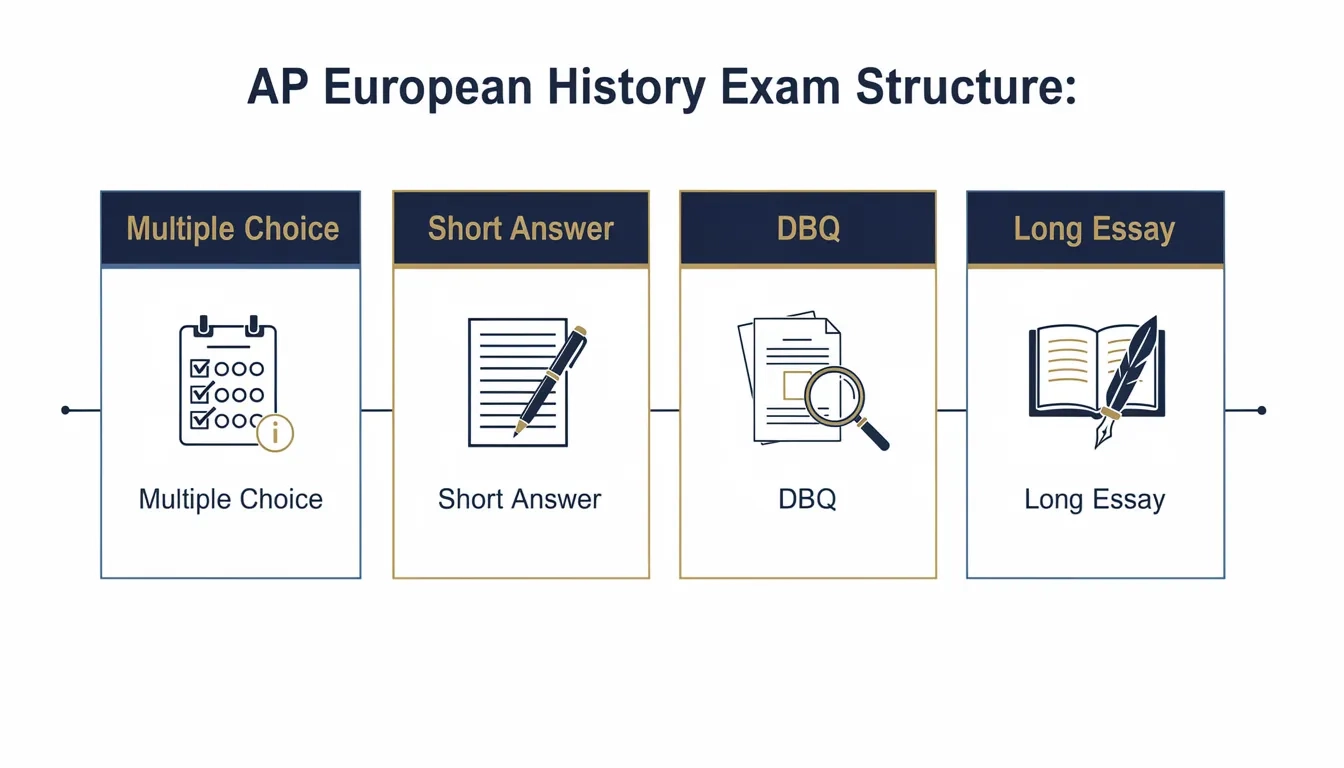
The AP Euro exam runs 3 hours and 15 minutes. It has four sections, each testing a different skill set at a different weight.
| Section | Questions | Time | Score Weight |
|---|---|---|---|
| Multiple Choice (MCQ) | 55 | 55 min | 40% |
| Short Answer (SAQ) | 3 | 40 min | 20% |
| Document-Based Question (DBQ) | 1 | 60 min + 15 min reading | 25% |
| Long Essay (LEQ) | 1 | 40 min | 15% |
The MCQ is your foundation. At 40% of your total score, it's the single largest chunk, and it rewards students who can read historical passages and identify causation, comparison, and continuity/change patterns quickly.
But the free-response sections together make up 60% of your grade. That ratio surprises students who assumed multiple choice was the main event. It isn't. Solid writers who deploy specific historical evidence consistently outscore students with stronger memorized content but weaker analytical skills.
The exam doesn't reward the student who knows the most facts. It rewards the student who can use facts to build a defensible historical argument under time pressure.
What the College Board calls "historical thinking skills" — causation, comparison, continuity and change over time — appear across every section. These aren't just vocabulary. They're the framework the graders use to evaluate every answer you write.
The Four Historical Periods You're Responsible For
AP Euro covers roughly 550 years of history, organized into nine units that cluster into four periods. Knowing where each unit falls helps you calibrate study time.
- 1450–1648: The Renaissance, the Reformation, the Age of Exploration, and the early rise of nation-states. Heavy on religious conflict and the slow fracturing of medieval Catholic unity.
- 1648–1815: Absolutism, the Scientific Revolution, the Enlightenment, and the French Revolution. Arguably the richest period for essay writing because the cause-and-effect chains are long and multi-directional.
- 1815–1914: Industrialization, nationalism, imperialism, and the emergence of modern political ideologies — liberalism, conservatism, socialism. This period rewards students who understand economic and social transformation.
- 1914–Present: Two world wars, totalitarianism, the Cold War, and contemporary European integration. The DBQ section historically draws heavily from 20th-century documents.
Each period gets roughly 10–15% coverage per unit. But students consistently underestimate the 1648–1815 period. The Enlightenment isn't just "philosophers had ideas" — it's the intellectual root system feeding the French Revolution, which connects to Napoleon, which reshapes 19th-century nationalism. Learning to trace those multi-generational connections is exactly what the LEQ rewards.
A common mistake: studying events in isolation. The exam wants you to explain why the Peace of Westphalia mattered to 18th-century absolutist rulers, or how the Congress of Vienna set the conditions for 1848. Build chains, not lists.
How to Dominate the Multiple Choice Section
Fifty-five questions in 55 minutes means one question per minute on average. In practice, you'll move faster on straightforward questions and spend more time on stimulus-based prompts that require reading a passage or analyzing a visual source.
Habits that separate students scoring 40+ from those plateauing in the low 30s:
- Circle the word "EXCEPT" whenever it appears. These questions flip the logic — you're hunting for the wrong answer — and students miss them at a disproportionate rate under time pressure.
- Rephrase the question in your own words before reading the answer choices. It takes three seconds and cuts misreading errors significantly.
- Never eliminate an answer just because you don't recognize the specific name or event. The choices test reasoning about historical context, not recall of obscure details.
- For political cartoons and images, scan the answer choices first to understand what the question is probing, then return to the image. This saves 30–40 seconds per image question.
The historian and educator Tom Richey, whose free YouTube content has become a staple of AP Euro prep, makes a point worth repeating: the MCQ tests historical thinking far more than date memorization. You don't need to know the exact year of the Treaty of Utrecht. You need to understand how it fit into the broader pattern of European balance-of-power politics.
Short Answer Questions: Earn Points Without an Argument
The SAQ section trips up strong writers. Why? Because strong writers want to argue. SAQs don't ask you to argue — they ask you to demonstrate specific knowledge, briefly and precisely.
Three SAQs in 40 minutes means roughly 13 minutes per question (experienced AP graders note that clean, tight answers score just as well as longer ones, so don't try to write miniature essays here). Each question has three parts (typically labeled a, b, and c), each worth one point.
The ACE method works well:
- Answer the specific question directly in your first sentence.
- Cite a concrete piece of historical evidence.
- Explain how that evidence connects to what was asked.
For SAQ 3, you choose between a prompt covering 1450–1815 or one covering 1815–present. Pick the period where your knowledge is sharpest. The scoring rubric doesn't penalize you for which period you select.
The SAQ explicitly does NOT require a thesis or conclusion. Students who write mini-introductions waste two to three minutes per question. Get in, state your evidence, get out.
The DBQ: Your Highest-Leverage Writing Task
The Document-Based Question is worth 25% of your total score. Single biggest individual component on the exam. It gives you seven primary source documents and asks you to build an argument using them.
The College Board scores the DBQ on a 7-point rubric:
| Point | What Earns It |
|---|---|
| Thesis (1 pt) | A historically defensible claim that goes beyond restating the prompt |
| Contextualization (1 pt) | Explain a broader historical context that preceded or influenced the topic |
| Evidence: Documents (2 pts) | Accurately use at least 3 docs (1 pt) or at least 6 docs (2 pts) |
| Evidence: Beyond Documents (1 pt) | Include specific outside evidence NOT in the documents |
| Sourcing (1 pt) | Analyze source/situation/audience/purpose for at least 3 documents |
| Complexity (1 pt) | Show nuanced understanding — multiple causes, counterargument, or cross-period connection |
The complexity point is the one students most often sacrifice (and the one most worth practicing specifically, since it follows a recognizable pattern). You don't need a novel — you need to do something like acknowledge a counterargument, explain regional variation, or connect your topic to a longer historical pattern outside the stated time period.
Use the 15-minute reading period aggressively. Most students skim the documents. Strong students use that time to categorize documents by perspective, identify which ones are outliers, and mentally draft their thesis. By the time writing starts, your argument should already be decided.
The most commonly lost point: the "evidence beyond documents" point. Students forget to include specific outside evidence mid-essay. Flag it explicitly in your outline before writing starts. One concrete outside example — a named person, event, or policy not in the documents — earns it.
The Long Essay: Pick Your Battle Wisely
The LEQ gives you three prompts. Same historical thinking skill, different time periods. You pick one and write for 40 minutes.
Choosing the right prompt matters as much as writing skill. A solid essay on your best period will outscore a technically polished essay on a period you barely covered. Read all three options before committing. The rubric doesn't reward students who pick the hardest question.
The LEQ is scored on 6 points: thesis (1), contextualization (1), evidence (2), and analysis/reasoning (2). The structure mirrors the DBQ but without any documents to lean on — you're working entirely from memory.
The most common LEQ mistake: overly broad thesis statements. "Industrialization changed Europe in many ways" earns zero points. A scoreable thesis takes a specific defensible position: "Industrialization accelerated class stratification in 19th-century Europe by creating a factory-dependent working class whose economic vulnerability drove the growth of socialist political movements."
Draft your thesis and a quick three-point outline before writing. Fifteen minutes of focused, evidence-backed writing beats 40 minutes of meandering prose.
Building a Study Plan That Actually Works
The students who score 4s and 5s consistently aren't studying harder. They're studying in a specific sequence.
Months before the exam:
- Read the College Board's Course and Exam Description (CED) PDF front to back. It's free on AP Central and lists every concept the exam can test. Use it as a master syllabus.
- For each unit, write down the major cause-and-effect chain and at least one named example you can cite in an essay. Don't try to memorize everything — build a skeleton first.
- Do one timed DBQ practice per month, starting at least three months out. The goal isn't perfection — it's building the muscle memory of argument construction under pressure.
Weeks before the exam:
- Shift from content intake to active retrieval. Flashcards for the specific examples you keep blanking on — treaties, thinkers, dates of major revolutions. Twenty minutes of active recall beats an hour of re-reading notes.
- Complete at least two full 55-question MCQ sets under timed conditions. Track not just what you got wrong, but whether it was a content gap or a question-misreading error. Those need different fixes.
- Write one full LEQ under timed conditions and score it yourself against the official rubric.
Albert.io's AP European History practice sets include explanations that address why wrong answers are wrong — not just which answer is correct. That distinction matters for the MCQ, where understanding the flawed reasoning in a wrong choice builds pattern recognition faster than noting the right answer alone.
The week before: Stop starting new content. Consolidate what you already know and do one final timed DBQ to keep the writing muscle warm.
Bottom Line
- Free-response sections make up 60% of your score and are far more trainable than memorization-based MCQ prep. Invest your time accordingly.
- Practice the DBQ at least three times before exam day, scoring each attempt against the official 7-point rubric. Know where every point lives in your essay before you walk in.
- Choose your LEQ prompt based on your strongest period, not the question that sounds most interesting.
- Build cause-and-effect chains across periods, not isolated fact lists. The exam tests those connections at every level.
- The single most underused free resource: the College Board's AP Euro Course and Exam Description. It tells you exactly what's on the test. Read it before anything else.
Frequently Asked Questions
How hard is it to earn a 5 on the AP European History exam?
Only about 13.7% of students who take the exam earn a 5, which puts it among the more challenging AP exams to max out. But that number reflects a large population of students who don't practice free-response writing systematically. Students who work from the official rubrics and practice DBQs under timed conditions regularly close that gap faster than raw content study alone would.
Do I need to memorize specific dates for AP Euro?
Not in the way most students fear. The MCQ tests historical reasoning and context, not date recall. You should know which century major events occurred in and understand the chronological order of key movements, but the exam won't ask you to name the exact year of a specific treaty. What matters far more is understanding why events happened and what they caused.
Is the DBQ harder than the LEQ?
They're different challenges. The DBQ gives you documents to work with, which provides evidence and structure — but it also requires you to source and analyze those documents for additional points. The LEQ gives you creative freedom but demands you supply all your evidence from memory. Most students find the DBQ more manageable because the documents scaffold the argument, though it has a stricter rubric to follow step by step.
What's the most reliable way to earn the DBQ complexity point?
The complexity point rewards essays that move beyond a single directional argument. Three approaches that consistently earn it: acknowledging a meaningful counterargument with specific evidence, explaining how outcomes differed across two regions of Europe, or connecting the essay topic to a longer historical pattern before or after the stated time period. You don't need to do all three — one well-executed move is enough.
How should I split study time across the four historical periods?
Equal time across periods is a fair starting point, but be honest about your gaps. The 1648–1815 period — Enlightenment, Revolution, Napoleon — generates a high proportion of essay prompts because the cause-and-effect chains are long and rich. If you're short on prep time, prioritize 20th-century content for MCQ practice and 18th-century material for free-response writing.
Is AP European History harder than AP US History?
Most students who've taken both rate AP Euro as moderately more difficult, primarily because the geographic and cultural scope is broader and the content is less familiar to American students. The exam formats are nearly identical, so analytical skills transfer well between them. Strong AP US History test-takers typically adapt to AP Euro faster than students without any prior AP history experience.