AP Human Geography: Study Guide and Score Tips for 2026
Only 17% of students who sat for the 2025 AP Human Geography exam scored a 5. That number sounds discouraging — until you realize the students who hit a 5 aren't geography prodigies. They learned what the test actually rewards. Then they prepared for that exam.
AP Human Geography carries an undeserved reputation as the "easy" AP, often taken sophomore year as a first dip into college-level work. That reputation does students a quiet disservice. The exam asks you to apply geographic models to specific places and scenarios, not just recall definitions. The gap between knowing the Demographic Transition Model and knowing how to deploy it in an FRQ is precisely where most students hemorrhage points.
What the AP Human Geography Exam Actually Looks Like
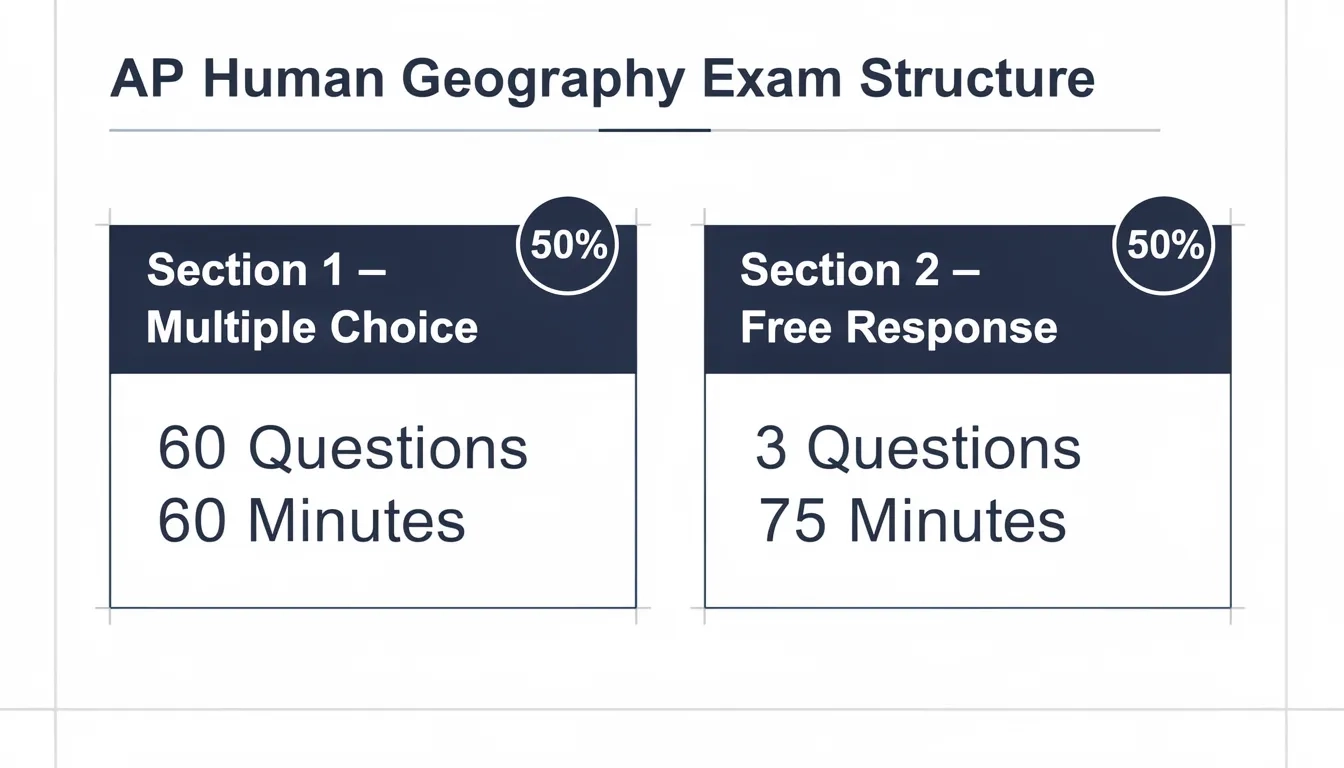
The exam runs 2 hours and 15 minutes, split into two equally-weighted sections.
Section 1 (Multiple Choice): 60 questions in 60 minutes. One minute per question sounds manageable until a stimulus-heavy question asks you to interpret a population density map before you can even start reasoning. College Board states that 30–40% of MCQ questions include an attached stimulus — a map, graph, table, satellite image, or infographic.
Section 2 (Free Response): 3 questions in 75 minutes. Each question carries 7 points. FRQ 1 has no stimulus, FRQ 2 has one stimulus, and FRQ 3 uses two stimuli. Since 2024, the entire exam is administered through the Bluebook app (the same platform used for the digital SAT), and you type your responses directly.
| Section | Questions | Time | Score Weight |
|---|---|---|---|
| Multiple Choice | 60 | 60 min | 50% |
| Free Response | 3 | 75 min | 50% |
| Total | 63 | 2h 15min | 100% |
The Seven Units and How Much Each One Matters
College Board divides AP Human Geography into seven units. Unit 1 is lighter in exam weight — it teaches geographic thinking skills you'll need across everything else. Units 2–7 are roughly equal in coverage.
| Unit | Topic | Exam Weight |
|---|---|---|
| 1 | Thinking Geographically | 8–10% |
| 2 | Population & Migration Patterns | 12–17% |
| 3 | Cultural Patterns & Processes | 12–17% |
| 4 | Political Patterns & Processes | 12–17% |
| 5 | Agriculture & Rural Land-Use | 12–17% |
| 6 | Cities & Urban Land-Use | 12–17% |
| 7 | Industrial & Economic Development | 12–17% |
No unit is safe to skip. Based on past College Board FRQs going back to 2001, urban geography (Unit 6), population and migration (Unit 2), and economic development (Unit 7) appear most frequently as FRQ topics. Spend extra time there, but don't neglect agriculture or political geography — they each show up in at least one FRQ almost every year.
The Models You Must Know Cold
The fastest road to points on this exam runs directly through geographic models. Memorizing their names is not enough. You need to describe them, apply them to real places, and explain where they break down.
Population and Migration Models:
- Demographic Transition Model (DTM) — the single most-tested model on the exam; know all five stages and which countries occupy each
- Ravenstein's Laws of Migration — gravity, distance decay, and step migration
- Push-pull theory — economic, political, and environmental drivers
Agriculture:
- Von Thünen's Model — concentric rings around a central market city, with intensive crops (dairy, vegetables) closest and extensive land uses (ranching, forestry) farthest out
- Green Revolution impacts on subsistence vs. commercial farming
Urban Geography:
- Concentric Zone Model (Burgess)
- Sector Model (Hoyt)
- Multiple Nuclei Model (Harris and Ullman)
- Bid-rent theory — how land prices determine land use by distance from city center
Development:
- Rostow's Stages of Economic Growth
- Wallerstein's World Systems Theory — core, periphery, and semi-periphery relationships
"Know a model well enough to draw it from memory, apply it to a real country, AND explain why it might not fit perfectly — because that's exactly how FRQ prompts are written."
A common mistake: students memorize the DTM's five stages but can't name a country in Stage 4 or explain why birth rates drop there. Depth wins over breadth every time.
FRQ Strategy: How to Actually Earn Each Point
Task verbs are the entire game on the FRQ section. Every sub-part begins with one of five command words, each demanding a different type of response:
- Identify — name it, no explanation needed (one sentence)
- Define — provide the specific meaning
- Describe — list relevant characteristics
- Explain — show how or why a relationship exists (causal chain required)
- Compare — address both similarities and differences explicitly
Each sub-part is worth exactly 1 point. Writing three sentences for an "Identify" sub-part wastes your limited 75 minutes and still earns only 1 point. Students who treat every sub-part like a mini-essay routinely run out of time and leave FRQ 3 half-finished.
Here's a practical sequence for the FRQ section:
- Read all three introductory statements before answering anything. Pick the most familiar topic and start there.
- For each sub-part, underline the task verb before you write.
- Write your answer, then re-read the sub-part to confirm you actually did what was asked.
- For stimulus-based parts, treat the stimulus as evidence to cite, not decoration to glance at.
Annotate the stimulus before writing. What geographic scale does it show? What pattern? What outlier? The College Board builds the points into the stimulus — students who skim it miss them.
Name real places in every response. A response about urban sprawl that mentions "a city in the Sun Belt" earns less than one citing Atlanta's expansion along I-285 into Gwinnett County. Geography is inherently spatial; vagueness costs points.
Multiple Choice: Reading Stimuli Under Time Pressure
The MCQ section trips up well-prepared students because stimulus questions eat time. Roughly 35 of the 60 questions include an attached map, graph, table, or photograph.
Read the question before studying the stimulus. Most students do the opposite — they stare at the map for 40 seconds, then read the question. If you read the question first, you know exactly what to look for, and you process the stimulus in 10–15 seconds instead of 45.
For map questions, check three things immediately:
- What does the legend show?
- What geographic scale are you looking at — city, region, national, global?
- Is the pattern a distribution, a gradient, or a discrete boundary line?
For graphs: axis labels and units first, then the overall trend, then any outliers. The answer almost always lives in the trend change or the outlier, not the middle of the distribution.
One practical point worth knowing: there's no penalty for wrong answers on AP exams. Never leave an MCQ blank.
Study Timeline: Six Weeks Is Enough
AP Human Geography has less raw content than AP World History or AP Biology. Six structured weeks beats a desperate month of cramming.
Weeks 1–4: Work through each unit over 3–4 days. For each unit: read notes, make flashcards (term on front, real-world example on back), then answer 10–15 practice MCQs on that content.
Week 5: Download past FRQs from College Board's website. Every FRQ from 2001 through 2024 is available with official scoring guidelines — free. Write full responses, then score yourself against the rubric. Do at least one FRQ per unit.
Week 6: Take at least one full timed practice exam. Use the Bluebook app's built-in practice tests so you're typing responses in the same interface you'll face on test day.
For video review, Heimler's History on YouTube covers every AP Human Geography unit in short, focused videos. The production value is deliberately low-fi (basically a teacher drawing on a whiteboard), but the conceptual explanations are among the clearest available.
One flashcard tip that changes everything: don't write "the spread of ideas" on the back of your "Cultural Diffusion" card. Write "the spread of Islam along trans-Saharan trade routes into West Africa during the 9th–11th centuries." Concrete examples stick; abstractions evaporate.
Scoring: What It Actually Takes to Hit a 5
About 68 composite points out of 100 is the approximate threshold for a 5, based on 2025 AP Human Geography score distributions. Since both sections are worth 50 points each, you need solid performance across the board — a perfect FRQ section won't save a weak MCQ performance.
Rough score benchmarks for 2025:
- Score 5: ~68+ composite points
- Score 4: ~53–67 composite
- Score 3: ~38–52 composite
In 2025, about 65% of test-takers scored a 3 or higher — a more forgiving pass rate than many AP exams. The 5 rate (17%) is where the real challenge sits.
One underrated move: before exam week, read 10 official scoring guidelines from past years. You'll notice the same types of phrases appear in the "earned the point" column over and over. The College Board signals exactly what language earns credit. That's not gaming the system — it's understanding what geographic reasoning actually sounds like when written clearly.
Bottom Line
- Start six weeks out, unit by unit. AP Human Geography isn't a course you can absorb in a long weekend.
- Learn models with real examples attached, not isolated definitions. The DTM, von Thünen, and urban models appear constantly across both sections.
- Practice FRQs using actual College Board rubrics — at least one question from each of the seven units before exam day. The College Board publishes every past FRQ with scoring guidelines; use them.
- On test day: read questions before studying stimuli, underline task verbs before writing any FRQ response, and never leave an MCQ blank.
- My honest take: a 5 on this exam is genuinely learnable. The students who get there aren't necessarily the ones who love geography. They're the ones who figured out that the exam is a specific, consistent skill test — and practiced that skill deliberately.
Frequently Asked Questions
Is AP Human Geography actually hard?
It's considered one of the more accessible AP exams in terms of raw content, but "accessible" doesn't mean easy to ace. The 2025 data shows only 17% scored a 5. Difficulty comes from applying concepts to unfamiliar scenarios and writing precise FRQ responses under real time pressure — not from memorizing an overwhelming amount of material.
Which AP Human Geography unit is most heavily tested?
No single unit dominates, but Units 2 (Population & Migration), 6 (Cities & Urban Land-Use), and 7 (Industrial & Economic Development) appear most frequently as FRQ topics based on past College Board exams. Budget extra practice time for those three while still covering the rest.
What is the Demographic Transition Model, and why does it matter so much?
The DTM describes five stages of population change, from high birth/death rates in Stage 1 to very low birth/death rates and possible population decline in Stage 5. It's the most-tested model on the entire AP Human Geography exam because it connects population, development, economic change, and migration patterns all at once. Know countries in each stage, not just the abstract descriptions.
Do colleges actually accept AP Human Geography credit?
Many do, though policies vary. A score of 3 typically satisfies a general social studies or geography distribution requirement at a range of universities. Selective schools often require a 4 or 5 for any credit at all. College Board maintains a searchable database of AP credit policies by institution — check each school individually before assuming credit will transfer.
How should I handle AP Human Geography FRQ stimulus questions?
Annotate the stimulus before you write anything. Note the scale, the pattern, and any outliers. Then re-read the sub-part question and treat the stimulus as evidence you're citing, not background decoration. Students who skip careful stimulus analysis consistently leave points on the table — the College Board embeds specific answer cues directly into the maps and graphs.
Is taking AP Human Geography as a sophomore a smart idea?
For most students, yes. The content load is manageable for a 10th grader, and it builds analytical reading and writing skills that pay off in harder APs later. The one caveat: a sophomore who doesn't study consistently will still score a 2 or 3. Age doesn't affect the scoring rubric.