AP Human Geography: Study Guide and Exam Tips for 2026
Most students walk into AP Human Geography assuming it's the "easy" AP — mostly memorizing terms, glancing at some maps, calling it a day. And honestly, that strategy gets you to a 3. Scoring a 4 or 5 requires something different: knowing which models to reach for and when, reading stimulus materials the way examiners expect, and writing free-response answers that hit rubric points instead of just sounding knowledgeable. Those are learnable skills. This guide covers exactly them.
What the 2026 Exam Actually Looks Like
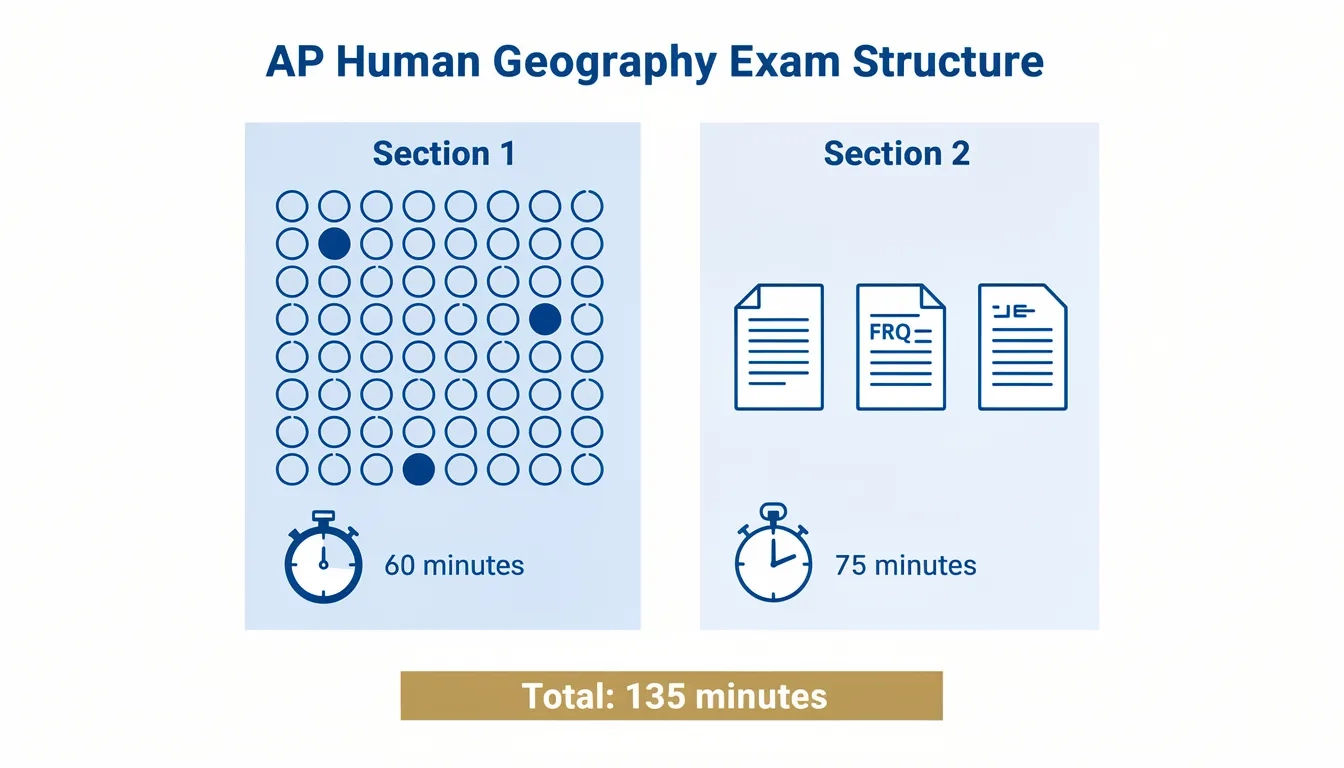
The exam runs 135 minutes total. Section 1 is 60 multiple-choice questions in 60 minutes — exactly one minute per question. Section 2 is 3 free-response questions in 75 minutes.
Both sections are worth exactly 50% of your total score. That framing matters. Students who treat the FRQ as a bonus round after the "real" exam consistently underperform. Three questions carry as much weight as sixty.
The 2026 exam is fully digital in the Bluebook testing app on a school-provided device. If you've only ever practiced on paper, get time with Bluebook before May 5th. Fumbling the interface while the timer runs is a genuinely avoidable mistake.
The three FRQ questions escalate in complexity. Question 1 has no stimulus material. Question 2 includes one source — a map, graph, satellite image, or text excerpt. Question 3 includes two sources. Harder questions show up later, so don't burn all your energy in the first 20 minutes.
The 7 Units and Where the Exam Actually Lives
All seven curriculum units appear on the exam, but they are not equally weighted. Here's the College Board's published breakdown:
| Unit | Topic | Approximate Exam Weight |
|---|---|---|
| 1 | Thinking Geographically | 8–10% |
| 2 | Population and Migration Patterns | 12–17% |
| 3 | Cultural Patterns and Processes | 12–17% |
| 4 | Political Patterns and Processes | 12–17% |
| 5 | Agriculture and Rural Land-Use | 12–17% |
| 6 | Cities and Urban Land-Use | 12–17% |
| 7 | Industrial and Economic Development | 12–17% |
On paper that looks balanced. In practice, Units 2, 5, and 6 — Population/Migration, Agriculture, and Cities — generate the most FRQ prompts year over year. Together they account for a disproportionate share of the analytical questions where you either nail the model or you don't.
Don't ignore Unit 1 entirely. Geographic thinking skills — scale analysis, spatial patterns, map interpretation — show up as the lens through which nearly every other question is framed. A question about agricultural land use is a Unit 5 content question, but it's asking you to analyze it using Unit 1 spatial thinking.
Models You Cannot Afford to Forget
Models are the vocabulary of AP Human Geography FRQs. You can describe urban sprawl in plain language, or you can write "the pattern matches the Burgess concentric zone model because commercial activity clusters near the CBD while residential density decreases outward." The second answer earns the point. The first, usually, does not.
These are the ones that appear with genuine regularity:
- Demographic Transition Model (DTM): Five stages from high birth/death rates to low or declining population. Know what each population pyramid looks like at each stage. Stage 4 countries like Germany are actually losing population, which surprises students who assume the model ends with stability.
- Ravenstein's Laws of Migration (1885): Ernest Ravenstein's empirical observations — still tested more than 140 years later (yes, from the 1800s; geography moves slower than you'd think). Most tested: migrants typically move short distances, migration proceeds in waves, and females dominate short-distance internal migration while males dominate long-distance flows.
- Von Thünen's Agricultural Land-Use Model: Concentric rings of agricultural activity around a central market city, with land use intensity declining outward. When an FRQ shows a map of farmland distribution and asks you to apply a model, this one answers roughly half those questions.
- Christaller's Central Place Theory: Walter Christaller's hexagonal market area framework explains why cities and towns are distributed across flat agricultural plains the way they are. Thresholds, ranges, and the K-values come up in both MCQ and FRQ.
- Urban Structure Models: Burgess's concentric zone model, Hoyt's sector model, and the Harris-Ullman multiple nuclei model all appear in FRQ stimuli. Know which real cities best fit each model and why.
- Rostow's Stages of Economic Growth: Usually paired with Wallerstein's World Systems Theory for a compare-and-contrast prompt.
The single most common FRQ mistake is naming a model without applying it to the scenario. "The DTM explains this situation" earns zero points. "This country is in Stage 2 of the DTM, evidenced by its rapidly declining death rate due to improved healthcare while birth rates remain high" earns the point. Specificity is the whole game.
Cracking the FRQ: Where Half Your Score Is Decided
The free-response section has 21 raw points on the table — three questions, each broken into seven sub-parts worth one point apiece. That structure matters because each sub-part is graded independently. You can skip one you don't know and still earn full credit on the other six. Never abandon an entire question because one part stumped you.
Task verbs are the most important words on the page. Not the topic, not the model — the verb. Here's what each one actually requires:
- Identify: Name it. One word or phrase is enough.
- Define: Give the specific meaning. Two sentences max.
- Describe: Provide relevant characteristics. You're painting a picture, not explaining causation.
- Explain: Show how or why something happens. "Because," "therefore," "which leads to" belong in your answer.
- Compare: Address similarities or differences explicitly. "Country A has X while Country B has Y" hits the mark. Describing each country separately without a direct contrast does not.
Students who lose points almost always answered a different question than what was asked. They explained when the verb said describe. They described when the verb said explain. Read the task verb before writing a single word.
Pacing is a skill in itself. Aim to finish each FRQ in 20 minutes rather than the 25 the math suggests. That leaves a 15-minute buffer to revisit anything you rushed. Spend the first 2 minutes of each question reading the intro context and underlining every task verb. That is not wasted time — it is the highest-leverage 2 minutes of the section.
Reading Stimuli Like a Geographer
Questions 2 and 3 include stimulus materials: maps, population pyramids, agricultural diagrams, graphs, or text excerpts. This is where underprepared students leave the most points behind. They skim the image, miss a key detail, and write an answer that doesn't connect back to what's actually shown.
Before answering any stimulus-based question, do this in order:
- Read the title and all labels first. A map of Senegal's rural population density in 1980 is a completely different analytical prompt than one showing Nigerian urban expansion in 2015 — even if they look similar.
- Identify the spatial pattern. Is there clustering? A center-to-edge gradient? Regional disparity?
- Connect what you see to a course model or concept. The stimulus almost always illustrates something you've studied.
Population pyramids deserve their own attention. They appear constantly and get misread constantly. Wide base, narrow top = young population, high birth rate, Stage 2 DTM. Nearly rectangular = aging population, Stage 4. Top-heavy or barrel-shaped = population decline, Stage 5. Know these shapes the same way you'd recognize a country's flag.
A Study Plan That Matches How the Exam Works
Most students study by re-reading notes. That approach has a fundamental flaw: recognition is not the same as recall. You can recognize the correct answer on a flashcard every time and still blank during an FRQ, because recognition is passive and free-response writing demands active retrieval.
Here's a structure that actually matches exam conditions:
6–8 weeks out:
- Build vocabulary flashcards for each unit using spaced repetition (Anki is free and works)
- Draw every major model from memory without looking — Von Thünen, DTM, all three urban models
- Practice identifying what concept a given stimulus type illustrates
3–4 weeks out:
- Start full FRQ practice using College Board's AP Central archive, which has questions and scoring rubrics going back to 2001
- After each practice FRQ, check the rubric word by word to see which specific terms and mechanisms earned points
- Identify your two weakest units and spend concentrated time there
Final 2 weeks:
- Take at least 2 full timed practice tests: 60-minute MCQ followed immediately by 75-minute FRQ, no break
- Review wrong answers by concept category, not by question number
- Collect one or two specific named real-world examples for every major concept: actual cities for urban models, specific countries at each DTM stage, real agricultural regions for Von Thünen
The day before: Review model diagrams once. Then stop. Sleep 8 hours. Memory consolidation happens during sleep, not during a midnight cramming session.
Common Misconceptions That Cost Points
"Longer FRQ answers are safer." Nope. Each sub-part earns one point from a specific, accurate statement or it earns nothing. Three sentences with the key mechanism beats a paragraph of context that buries it. Write clearly and stop.
"Unit 1 is just intro material." The geographic thinking frameworks from Unit 1 — spatial analysis, scale, map reading — are the analytical tools every other unit uses. FRQ prompts regularly ask you to "analyze at multiple geographic scales" or "explain the spatial pattern," which are Unit 1 skills applied to Unit 5 or 6 content.
"Knowing the model name is enough." The rubric rewards named examples relentlessly. "A city in Southeast Asia" earns no credit. "Bangkok" or "Ho Chi Minh City" earns the point. For every major concept you study, know at least one or two actual places that illustrate it.
Bottom Line
- Start FRQ practice early — at minimum 4 weeks before the exam, using real College Board rubrics to grade yourself. This single habit separates 4s from 5s more than any other study behavior.
- Know your models cold: DTM, Von Thünen, Christaller, Burgess/Hoyt/Harris-Ullman, Ravenstein, Rostow. Draw them. Apply them to real places.
- Read the task verb before you write anything. Identify, describe, explain, and compare are not interchangeable, and the rubric treats them as completely separate skills.
- Prioritize Units 2, 5, and 6 if time is tight — population, agriculture, and cities drive most FRQ prompts.
- The College Board's free archive of past FRQs with scoring guidelines is the best resource available. Most students never use it. Use it.
Frequently Asked Questions
Is AP Human Geography actually an easy AP exam?
It has a reputation as a manageable starting point for AP students, and the content is more accessible than AP Physics or AP Chemistry. But "easy to pass" and "easy to score a 5 on" are different things. The FRQ section requires precise model application and specific examples, which takes real preparation. Students who coast on reputation tend to land at a 2 or 3.
How many questions does the AP Human Geography exam have?
60 multiple-choice questions and 3 free-response questions. Each FRQ has 7 sub-parts worth 1 point each, making 21 raw FRQ points available. Both sections are weighted equally at 50% of the total score.
What models do I absolutely need to know for the FRQ?
At minimum: the Demographic Transition Model, Von Thünen's agricultural land-use model, Christaller's Central Place Theory, the Burgess/Hoyt/Harris-Ullman urban models, Ravenstein's Laws of Migration, the Gravity Model, and Rostow's Stages of Economic Growth. If you can draw and explain each one from memory and connect them to real-world examples, you're better prepared than most test-takers.
Do I need to write full essays for AP Human Geography FRQs?
No. Each sub-part is answered independently, and many require only one or two sentences. "Explain" prompts need more development, but even those rarely require more than three or four sentences. Long paragraphs waste time and often bury the specific point the rubric rewards.
Is it a myth that AP Human Geography is mostly memorization?
Mostly, yes. Vocabulary matters — you need the terminology — but the exam increasingly tests application, not recognition. Multiple-choice questions are stimulus-based, and FRQs require you to connect concepts to specific geographic scenarios. Pure memorization gets you a 2 or 3. Analysis and application get you a 4 or 5.
What should I do the week before the exam?
Take one more full timed practice test early in the week. Review your model diagrams and any vocabulary gaps mid-week. By the last 2 days, shift to light review only: flip through your model drawings, run through your real-world examples once. Don't cram new content 48 hours out. Sleep well the night before — that is genuinely one of the highest-yield things you can do.