Best AP Biology Study Resources for 2026: A Complete Prep Guide
288,132 students sat for the AP Biology exam in May 2025. Only 18.8% of them walked away with a 5. That gap between "took the class" and "aced the exam" isn't about intelligence — it's almost entirely about how people prepared.
The good news: the resources available in 2026 are genuinely excellent, and several of the best ones are completely free. What separates students who score well isn't access to secret materials. It's knowing which resources are worth your time, which units deserve the most attention, and exactly how the free-response section gets graded.
What the 2026 AP Biology Exam Actually Looks Like
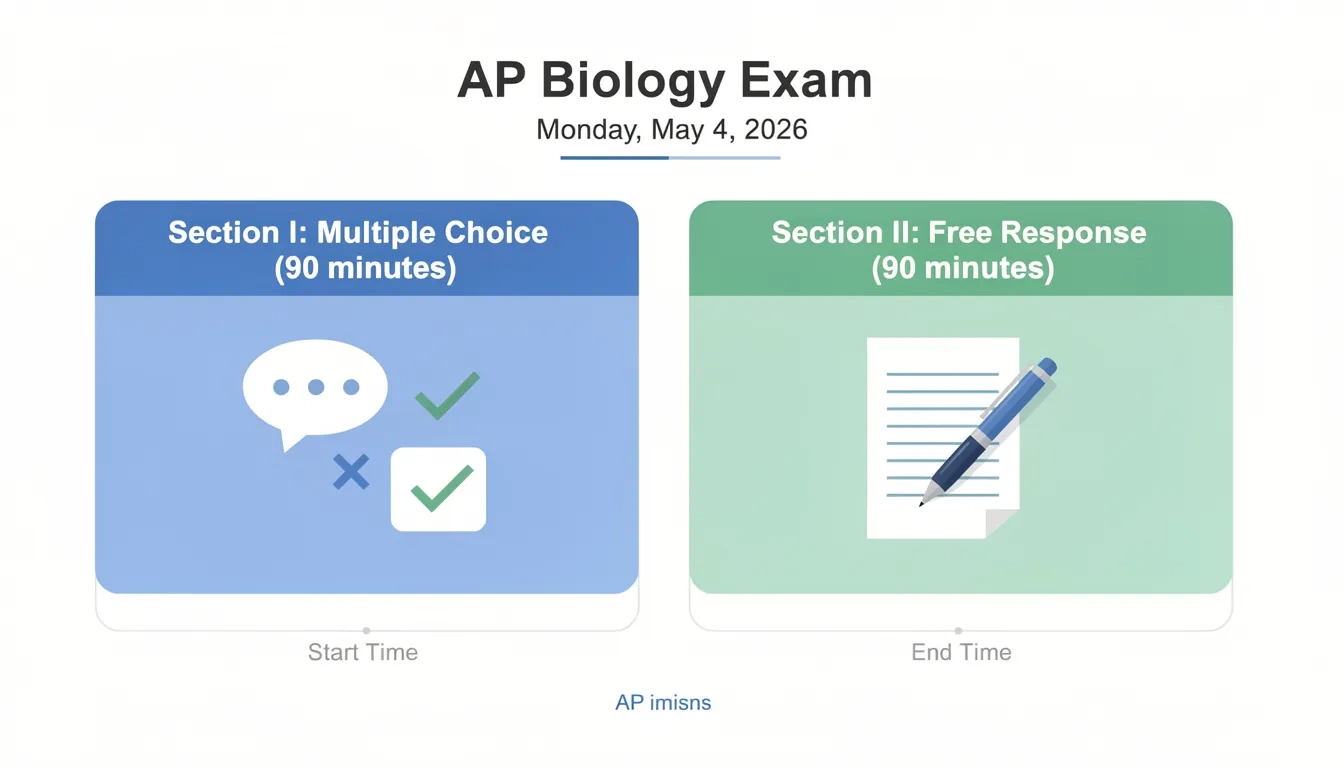
The exam runs on Monday, May 4, 2026, at 8:00 AM local time. Total time: 3 hours, split into two 90-minute sections.
Section I is 60 multiple-choice questions completed on the College Board's Bluebook digital platform. Section II is 6 free-response questions (2 long, 4 short) answered by hand in paper exam booklets. Each section counts for exactly 50% of your score.
To hit a 3, you need roughly 50% of the multiple-choice questions correct plus about half the available FRQ points. That sounds manageable — and it is — but most students who score 2s aren't bombing the MCQ half. They're losing points on the written responses, which require a different kind of preparation entirely.
The exam tests four big ideas: evolution, cellular processes, genetics and information transfer, and ecology. Every question maps back to one of these, and every free-response answer is evaluated against six science practices (more on this later).
The Best Free Resources — and How to Use Them
You can score a 5 without spending a dollar. The free resource tier for AP Biology is surprisingly strong, but most students use it the wrong way.
AP Classroom and College Board past FRQs are the most underused study tools in the entire AP ecosystem. The College Board publishes free-response questions with official scoring rubrics going back to 1999, all available at AP Central. The rubrics are the real prize. Reading them teaches you exactly what graders are looking for — which often differs significantly from what students think a good answer looks like. Prioritize questions from 2013 forward, since the exam's format changed substantially that year.
Bozeman Science (Paul Andersen's YouTube channel) covers nearly every AP Biology topic in video form. Each video runs 5–12 minutes and explains concepts at a depth that textbook summaries rarely reach. It's the strongest free option for visual learners who want to understand the why behind a biological process, not just memorize the steps.
Khan Academy's AP Biology section pairs short videos with embedded practice questions and progress tracking. It works best for targeted review — when you've hit a wall on meiosis or Hardy-Weinberg equilibrium, Khan can unstick you in about 15 minutes.
| Resource | Best For | Key Limitation |
|---|---|---|
| AP Classroom | Official FRQ sets organized by unit | Requires teacher access code |
| College Board past FRQs | Real rubric-based FRQ practice | MCQ practice is limited |
| Bozeman Science | Conceptual depth, visual explanation | No built-in quizzes or tracking |
| Khan Academy | Targeted weak-spot review with quizzes | Less exam-specific than CB materials |
| Amoeba Sisters | Quick, memorable concept overviews | Too simplified for FRQ preparation |
One thing worth noting (and most guides skip this): the College Board also posts sample student responses with scores for released FRQs. Reading a graded 9/10 response next to a 4/10 response for the same question is more instructive than doing three additional practice problems.
Prep Books Worth Buying
You don't need a prep book to pass. But if you want a structured review that organizes the full curriculum and gives you full-length timed tests to simulate exam conditions, a prep book earns its $25–$35 easily.
Barron's AP Biology Premium 2026, written by Mary Wuerth, M.S., is the strongest overall option. Six practice tests (two in print, four online), and content review that goes deeper than most competitors. It's the right fit for students who want to genuinely understand the material rather than pattern-match answers.
Princeton Review AP Biology Premium 2026 leans harder on test strategy. The content review is solid but a step shallower than Barron's; it compensates with better pacing guidance and question-dissection techniques. If you're a confident biology student who mostly needs to learn how to take this particular exam, Princeton Review is the smarter pick.
A third option that often gets overlooked: Campbell Biology (12th edition) as a reference supplement. It's a 1,400-page college textbook — nobody reads the whole thing. But for units where you're genuinely lost, like cellular respiration, meiosis, or molecular genetics, Campbell's explanations are unmatched by anything else on the market.
| Book | Practice Tests | Content Depth | Best Fit |
|---|---|---|---|
| Barron's 2026 | 6 (2 print + 4 online) | High | Students aiming for mastery |
| Princeton Review 2026 | 6 | Moderate | Test-strategy-focused prep |
| CliffsNotes AP Biology | 2 | Moderate | Budget option, quick overview |
| Campbell Biology 12e | None | Very High | Deep reference for hard units |
My honest take: buy Barron's, use it alongside free College Board materials, and don't bother buying a second book. The marginal return on a second prep book is low. More practice tests won't help if you're not analyzing your mistakes carefully after each one.
The Units That Deserve the Most of Your Time
Not all units are weighted equally on the exam, and most students study them as if they are. That's a costly mistake.
Units 3, 6, and 7 together cover more than 50% of exam questions. Unit 7 (Natural Selection and Evolution) alone accounts for 13–20% of the test. Students who spread study time evenly across all eight units are making a poor allocation decision.
| Unit | Topic | Exam Weight |
|---|---|---|
| 1 | Chemistry of Life | 8–11% |
| 2 | Cell Structure and Function | 10–13% |
| 3 | Cellular Energetics | 12–16% |
| 4 | Cell Communication / Cell Cycle | 10–15% |
| 5 | Heredity | 8–11% |
| 6 | Gene Expression and Regulation | 12–16% |
| 7 | Natural Selection | 13–20% |
| 8 | Ecology | 10–15% |
Unit 8 (Ecology) is chronically underprepped. Students grind through genetics and evolution, then run low on energy. But Ecology can be worth up to 15% of your score — and it has some of the most data-interpretation-heavy questions on the exam, exactly the type that separates 4s from 5s.
One counter-intuitive point: don't skip Unit 1 entirely. The chemistry-of-life concepts (water properties, macromolecule structure and function) show up repeatedly as context in questions about other units. A gap there creates cascading confusion elsewhere.
How to Study — The Strategy That Actually Works
The Marks Education tutoring team recommends budgeting roughly 20 hours of dedicated review: about 2 hours per unit across all 8 units, plus 4 hours of full-length practice testing. If you start in mid-March, that works out to 2–3 focused hours per week alongside regular coursework.
The biggest trap is passive study. Reading through notes, rewatching lecture slides, re-highlighting your textbook. None of these translate into the active recall the exam demands. The FRQs require you to construct an explanation from scratch — that skill only develops through practice, not consumption.
A four-step active study loop that works:
- After finishing a unit, attempt 2–3 released FRQs from that unit before checking any rubric.
- Compare your answers line by line against the official rubric.
- Log every missed point in a running mistake document, grouped by type (wrong mechanism, vague language, missing units on data, etc.).
- Review the mistake log weekly — not just the day before the test.
Spaced review beats cramming by a wide margin on retention. This isn't a motivational slogan; cognitive science has replicated this finding across hundreds of studies. Seeing a concept on Day 1, Day 4, and Day 12 burns it in far more durably than seeing it three times in one afternoon.
FRQ Mastery: Where Points Are Actually Won and Lost
The free-response section is where the exam is decided. Students who score 2s and 3s aren't usually failing because they lack content knowledge. They're failing because they don't know how the FRQs are graded.
Graders evaluate your response against a specific rubric checklist. They aren't assessing your overall grasp of biology — they're looking for particular mechanisms, keywords, and logical claims. A clear, specific bullet earns the point. A beautifully written but vague paragraph earns nothing.
Specific moves that translate into points:
- Match your answer to the question verb. "Explain" requires a causal mechanism ("because..."). "Describe" requires an observation. "Justify" requires evidence. These are not interchangeable, and graders hold you to the distinction.
- Use bullet points for short FRQs, not flowing prose. Graders read hundreds of responses under time pressure. Bullets make your scoring points obvious and easy to check off.
- For data-analysis questions, always include units, cite the graph or table by name, and make a directional claim. "The rate of photosynthesis increased from 2.1 to 4.7 μmol O₂/min as light intensity doubled" earns credit. "The rate changed" earns nothing.
- Show your work on calculations. Even if your arithmetic is wrong, a correctly set-up equation earns partial credit. Skipping the setup earns zero.
Budget 15 minutes per long FRQ and 10 minutes per short FRQ. If you're running over on one question, write abbreviated bullets for remaining parts rather than leaving them blank. A partial answer earns more than an empty box.
An 8-Week Study Timeline
Starting 8 weeks out gives you enough spacing between review sessions to build real retention. Here's how to structure it:
Weeks 1–4: Weighted content review. Work through Units 3, 7, 6, and 8 first (highest exam weight). Use Bozeman Science videos for conceptual grounding, then do College Board practice questions for each unit to apply what you watched.
Weeks 5–6: FRQ-focused practice. Pull released FRQs from 2013–2025 by topic. Score yourself honestly against the official rubric. Read sample student responses at different score levels — this calibrates your instincts faster than any other single activity.
Weeks 7–8: Full-length timed tests. Take at least two complete, timed practice exams under real conditions (no phone, no breaks mid-section). Use your errors to guide final review — not to start new content you haven't touched yet.
If you're starting 4 weeks out, that schedule still works — compress it, and prioritize FRQ practice over comprehensive content review. You can pass without revisiting every unit. You cannot pass if you haven't practiced writing graded responses under time pressure.
Bottom Line
- Start with the free tier: College Board FRQs with official rubrics, Bozeman Science for concepts, Khan Academy for targeted weak spots. These three together can carry most students to a 4.
- Buy Barron's 2026 if you want structure: six practice tests and deeper content review than the alternatives. Princeton Review is the better pick if test strategy is your gap, not content.
- Put your heaviest study hours into Units 3, 6, 7, and 8 — that's where 50%+ of your score comes from.
- Practice FRQs with real rubrics and real timing. This is the highest-return study activity available. Everything else supports it.
- 8 weeks of spaced review beats 2 weeks of cramming, not by a little — by enough to shift your score by a full band.
The 18.8% who scored 5 in May 2025 weren't operating with secret materials or supernatural focus. They practiced the right things, in the right order, over enough time for the knowledge to stick.
Frequently Asked Questions
Is AP Biology harder than AP Chemistry or AP Physics?
AP Biology carries a notably higher passing rate than either — 70.3% of students scored 3 or above in 2025, compared to roughly 56% in AP Chemistry and around 46% in AP Physics 1. That doesn't make it easy, but it does mean the content is more accessible to students who prepare methodically. Biology's challenge is breadth and application, not calculation-heavy problem sets.
Do I need to memorize every biological structure and pathway?
No — and this is probably the most pervasive misconception about AP Biology prep. The exam tests application and reasoning, not recall. You don't need to memorize every intermediate in the Krebs cycle by name, but you do need to explain what cellular respiration accomplishes and what happens when a step gets blocked. Understanding mechanisms earns far more points than memorizing terminology.
How many practice tests should I actually take?
At minimum, two complete timed practice tests in the final 2–3 weeks. Quality beats quantity here — two tests with careful error analysis are worth more than five tests where you move on without understanding your mistakes. For FRQs specifically, doing one real released FRQ per unit across the year builds skill more effectively than a testing blitz in the final week.
What's the best way to use Bozeman Science videos?
Watch a video on the topic you're studying, then immediately close the tab and write down everything you can remember — without referring back to the video. This retrieval practice converts passive watching into active learning. Paul Andersen, who runs the channel, recommends this approach himself, and it's grounded in what cognitive scientists call the "testing effect": the act of retrieving information strengthens memory more than re-reading or rewatching.
Is it true the AP Biology exam changed recently?
Yes. The exam shifted to its current format in 2013, with a stronger emphasis on data analysis, experimental design, and applying concepts rather than recalling facts. The 2026 exam also uses a hybrid format — MCQs on Bluebook (digital), FRQs on paper — which means you'll toggle between a laptop screen and a physical booklet on exam day. Practicing with both formats before May 4 is worth the time.
Can prep books replace studying in my AP Biology class?
No — and students who skip class and rely on prep books alone tend to underperform. Prep books are designed for efficient review of content you've already encountered. They're not built to teach foundational biology from scratch. The classroom builds your initial mental model; prep books tighten it and add exam-specific technique.
Sources
- The Best AP® Biology Review Guide for 2026 | Albert.io
- AP® Biology FAQ: Everything You Need to Know for 2026 | Albert.io
- AP Biology Exam – AP Students | College Board
- AP Biology Exam Score Distributions 2025 – College Board
- Studying for the 2026 AP Biology Test | Marks Education
- AP Biology — Bozeman Science
- AP Biology Premium, 2026 – Barron's (Amazon)
- AP Biology Test Prep Book | The Princeton Review