Best Free ACT Prep Resources 2026: A Complete Study Guide
The ACT that students took in 2024 and the one you're preparing for in 2026 are not the same test. ACT, Inc. launched the Enhanced ACT in spring 2025, cutting the exam from 215 questions to 131 core questions, shaving nearly an hour off the testing time, and making Science an optional paid add-on. Free prep materials published before 2025 may be calibrating you for a format that no longer exists.
The good news: the best free resources have caught up fast. Here's what actually works in 2026, and what to skip.
What Changed with the Enhanced ACT
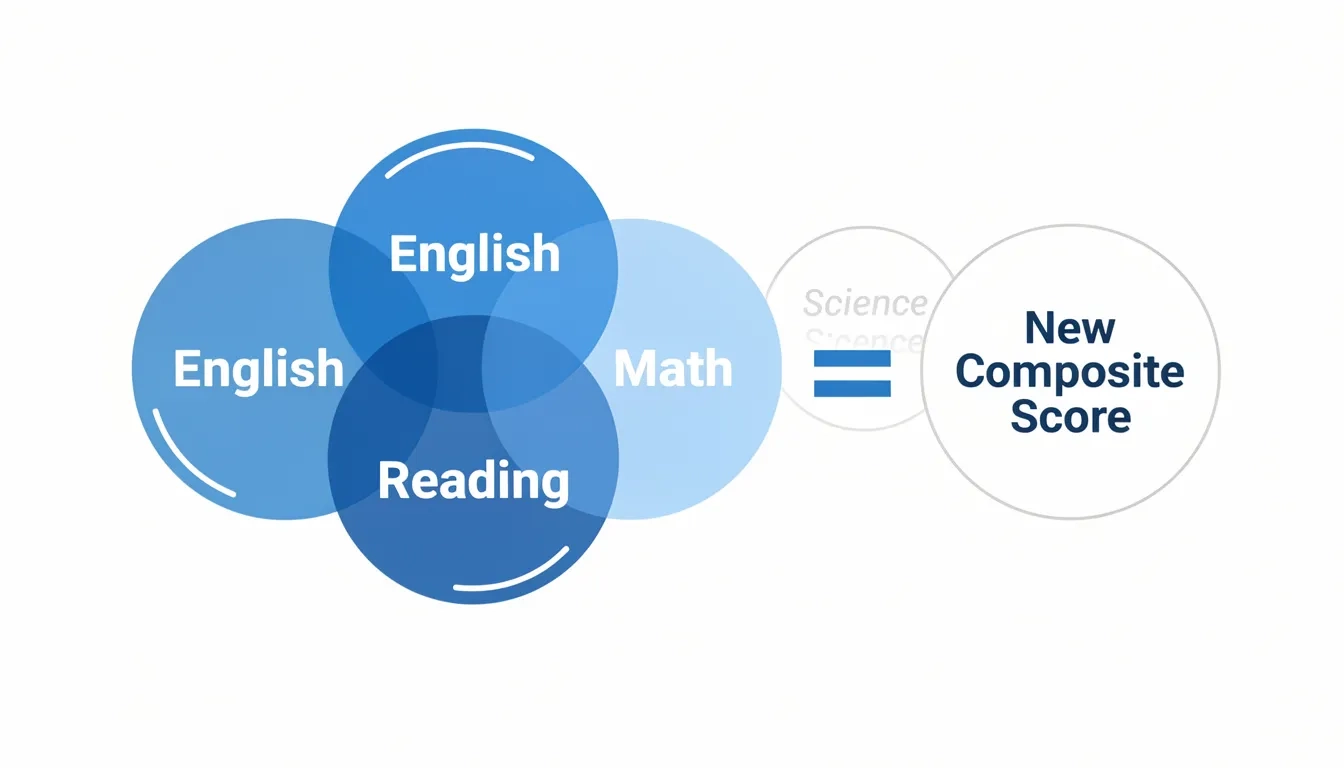
The biggest structural change is to the Composite score. It now averages only English, Math, and Reading. Science is removed from the calculation entirely. You pay $4 to add it on test day, and roughly 90% of U.S. colleges don't require it.
Each of the three core sections now carries exactly one-third of your Composite. Under the old format, a weak section cost you 25% of your score. Now it's 33%. If Reading has always been your Achilles' heel, that penalty bites harder than it used to.
The timing changes are less obvious from the headline but equally important. Students now get approximately 18% more time per question across every section. English goes from 36 seconds per question to 42. Reading jumps from 53 seconds per question to 67. Math also gets longer per question, and now offers four answer choices instead of five, which speeds up elimination meaningfully.
One subtle trap: ACT, Inc. embeds unscored field-test items throughout every section. English has 10 of them, Reading has 9, Math has 4.
They look identical to scored questions. Don't try to identify them. Just treat every question as counted — because most of them are.
| Section | Old Format | Enhanced ACT 2026 |
|---|---|---|
| English | 75 questions, 45 min | 50 questions, 35 min |
| Math | 60 questions, 60 min (5 choices) | 45 questions, 50 min (4 choices) |
| Reading | 40 questions, 35 min | 36 questions, 40 min |
| Science | 40 questions, 35 min (in Composite) | 40 questions, 40 min (optional, +$4) |
| Total (core) | 215 questions, ~175 min | 131 questions, ~125 min |
Official Free Resources: Start Here
ACT, Inc. offers two downloadable full-length PDFs reflecting the Enhanced format: "Preparing for the ACT 2025–2026" and "ACT Practice Test 2." Both include an answer key and a raw-to-scaled score conversion table. Download both before touching anything else. This is your foundation.
Two interactive online tests are also available through the MyACT portal. The online versions deserve more attention than most students give them. If you've only practiced on paper, the real test's on-screen interface can disrupt your rhythm — flagging questions, navigating between sections, and reading on a screen all feel different from working through a PDF.
QuizMe (quizme.act.org) is ACT.org's topic-based drill tool. It serves you real ACT questions sorted by content area. Use it after a full practice test, once you know exactly where you're weakest. The Question of the Day feature (via a free MyACT account) takes five minutes and builds consistency during weeks when long study sessions aren't possible.
The Kaplan partnership is the most underused freebie in ACT prep. ACT, Inc. worked with Kaplan to offer free live online prep classes through ACT.org — full instructor-led sessions, not previews of a paid course. ACT.org also provides free subject-specific sample video classes for English, Math, Reading, and Science. Spots for live sessions fill up, so check the schedule several weeks before your target test date.
The official ACT.org materials are the same source that every paid prep course is built on. Starting anywhere else is backwards.
The Best Free Third-Party Platforms
Most "free" ACT prep sites are lead-gen funnels. They give you one practice test, then a paywall three clicks deep. A few genuinely aren't.
Magoosh offers a free full-length practice test with detailed answer explanations — no credit card required. Their explanations are written by tutors, not auto-generated from answer keys, and the difference is noticeable. For students who get a question right but aren't sure why, Magoosh's explanations actually teach the underlying reasoning rather than just confirming the correct letter.
Test-Ninjas publishes over 50 hours of free content, including problem sets and study guides, with no paywall on the core materials. Almost Fun has approximately 400 free questions written in casual, accessible language — a genuinely different tone from traditional prep materials, which some students find more sustainable over a long prep stretch. Union Test Prep provides seven-plus free full-length exams, sortable by section for targeted drilling.
| Platform | Free Full Tests | Question Bank | Explanations | Signup Required |
|---|---|---|---|---|
| ACT.org | 2 PDFs + 2 online | QuizMe (topic drills) | Basic | Yes (free) |
| Magoosh | 1 full test | Limited free tier | Detailed | Yes (free) |
| Test-Ninjas | Multiple | 50+ hrs of content | Yes | Yes (free) |
| Union Test Prep | 7+ | Section-by-section | Basic | No |
| Almost Fun | None | ~400 questions | None | No |
For most students, the right combination is official ACT.org tests as your primary practice, Magoosh for answer explanation quality, and Union Test Prep for additional volume in weak sections.
Khan Academy: Useful, But Not in the Way You Might Think
Here's something most roundup lists skip: Khan Academy has no official ACT partnership. College Board partnered with Khan Academy to build free, structured SAT prep — that's a real collaboration with shared question banks. ACT, Inc. did not. What Khan Academy labels as ACT-relevant content is really their general math, grammar, and reading curriculum pointed in the right direction.
That said, it remains useful for one specific purpose: foundational skill repair. If your ACT Math score is stuck because algebra or geometry feels shaky, Khan Academy's structured lessons will build those foundations more thoroughly than ACT-specific drills will. The same applies to grammar — their modules cover comma usage, subject-verb agreement, and modifier placement, which are exactly the concepts ACT English tests.
The mistake is treating Khan Academy as a standalone ACT tool. Use it as the weightroom, not the game tape. Build the underlying skills there, then apply them on official ACT practice tests where the question style actually matches what you'll see on test day.
One practical note: Khan Academy's math curriculum is organized by topic, not by ACT section. Work backward from your practice test results. Find the question types you're missing, identify the underlying math concept, and look that concept up on Khan Academy.
YouTube and Mobile Apps Worth Bookmarking
Magoosh's YouTube channel has nearly 100 free videos covering strategy and content across every ACT section. Short, well-organized, and practical for 10-minute sessions between longer study blocks. SupertutorTV, run by Brooke Hanson (a perfect ACT scorer turned full-time tutor), goes deeper on pacing strategy and test-day psychology than most prep channels do — and the production quality makes it easier to actually sit through.
For mobile practice, the Pocket Prep app offers a free tier with a question bank and 14 days of daily questions. Not a replacement for full timed tests, but solid for commute-length drilling. Magoosh's mobile app pairs with their web platform and includes 200-plus flashcards covering commonly tested vocabulary and grammar patterns.
Three YouTube channels worth saving:
- SupertutorTV — pacing, section-specific question breakdowns, test-day mental approach
- Magoosh ACT — nearly 100 videos, section-specific content and strategy walk-throughs
- Best ACT Prep — 56 dense, no-filler videos focused on core concepts and mechanics
The dividing line between channels worth watching and channels worth skipping: do they work from actual ACT question patterns, or just general academic content with "ACT" in the title? SupertutorTV and Magoosh both work from real question types. That matters more than production values.
A Free 8-Week Study Plan
Students who see the biggest score gains with free resources aren't the ones who accumulate the most materials. They're the ones who use fewer resources more deliberately.
- Week 1 — Baseline test. Take one full official ACT.org practice test under timed conditions. Score it. Identify your two weakest sections.
- Weeks 2–3 — Targeted drill. Use QuizMe on ACT.org and Union Test Prep for your two weak sections. Use Khan Academy for any foundational math gaps you identify.
- Weeks 4–5 — Strategy layer. Watch SupertutorTV or Magoosh YouTube specifically for your weak sections. Take one timed section-length drill from Union Test Prep to test your progress.
- Week 6 — Second full test. Take "ACT Practice Test 2" from ACT.org under real timed conditions. Compare to Week 1. Less than two points of improvement in a section means revisit the strategy, not just add more volume.
- Weeks 7–8 — Final refinement. Use Magoosh's free test or Test-Ninjas for a third full practice. Prioritize accuracy over speed — pacing follows accuracy once your error rate drops.
I'll push back on advice you'll hear elsewhere: 6–8 weeks of structured work beats 6 months of unfocused studying. Starting prep a year out without a clear plan rarely produces better composite scores than a shorter, intentional sprint. The biggest driver of improvement is consistent wrong-answer review, not total hours logged.
Mistakes That Waste the Most Prep Time
A few patterns show up consistently in students who plateau:
- Using pre-2025 tests for timing calibration. Old forms like Form 67C still circulate online and some sites label them as current. The English section has 75 questions (the Enhanced ACT has 50) and Math has five answer choices (now four). Use them for content review, not pacing practice.
- Skipping Science without checking your school list. About 90% of colleges don't require it, but Georgetown, Boston University, and the U.S. military academies still do. Verify your list before you register.
- Reviewing right answers instead of wrong ones. Getting 70 out of 100 correct isn't the goal — understanding why you missed 30 is. Most score improvement comes from fixing patterns in wrong answers, not reinforcing strengths.
- Treating every platform as equally useful. Official ACT.org PDFs are your primary source. Third-party platforms are supplemental. Using them in the wrong order wastes time.
- Trying to identify field-test items mid-exam. ACT, Inc. designed them to be indistinguishable from scored questions. The attempt just burns focus that belongs on actual scored work.
Bottom Line
Free ACT prep in 2026 is genuinely sufficient. You don't need to pay.
- Start with both official ACT.org practice test PDFs. Take them timed before using anything else.
- Use QuizMe and Khan Academy for targeted weak-area work; use Magoosh or SupertutorTV YouTube for section strategy.
- Follow the 8-week framework above, and spend as much time analyzing wrong answers as you do completing new questions.
- If Georgetown, Boston University, or a military academy is on your list, practice the Science section and budget the $4 add-on fee.
The resources are more than enough. Having a plan is the part most students skip.
Frequently Asked Questions
Is Khan Academy good for ACT prep?
Khan Academy has no official partnership with ACT, Inc. — that relationship belongs to College Board for the SAT. It's solid for building foundational math and grammar skills, but won't cover ACT-specific question types or pacing strategy. Use it to fill content gaps, then practice on official ACT materials.
How many official free ACT practice tests exist in 2026?
Four. ACT, Inc. offers two downloadable PDFs ("Preparing for the ACT 2025–2026" and "ACT Practice Test 2") plus two interactive online tests through the MyACT portal. All four reflect the Enhanced ACT format with 131 core questions.
Should I bother with the optional Science section?
About 90% of U.S. colleges don't require a Science score, so most students can skip it and save the $4. But Georgetown, Boston University, and the U.S. military academies still require it. Check each school's admissions requirements before you register for the test.
Do old ACT practice tests still count for prep?
Yes, with a caveat. Pre-2025 tests are solid for content practice across all sections — the underlying knowledge hasn't changed significantly. But the English section had 75 questions (now 50) and Math had five answer choices (now four). Don't use them for timing practice; your pacing expectations will be miscalibrated.
What's the best free resource for ACT Math specifically?
The official ACT.org PDFs for practice questions, Khan Academy for foundational algebra, geometry, and pre-calculus, and Magoosh's free YouTube videos for problem-solving strategy. That combination covers both content gaps and approach.
How long should I actually prep?
For most students targeting a two-to-four point composite gain, six to eight weeks of structured studying outperforms longer, unfocused prep. The biggest driver of improvement is consistent wrong-answer review — not total hours. More time only helps if you're doing something different with it.
Sources
- Free ACT Practice Tests and Prep | ACT.org
- Free ACT Practice Materials to Support the Enhanced ACT | ACT Counselor Blog
- ACT Changes 2025–2026: New Format & What to Expect | Test-Ninjas
- The 15 Best Online Resources for Free ACT Prep | Magoosh
- ACT 2025 Changes: What's New in the Enhanced ACT | Learner
- How to Use Khan Academy for ACT Prep | PrepScholar