Best College Majors for Creative Students in 2026
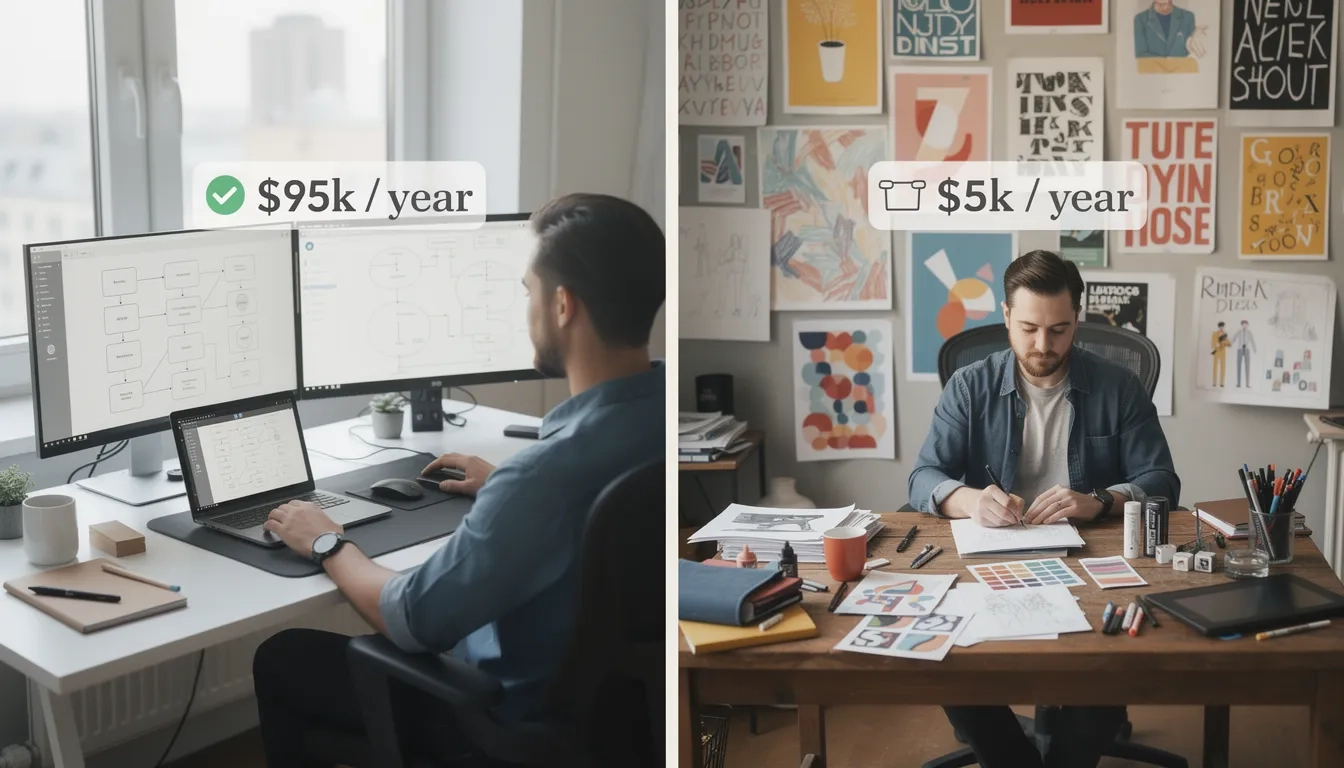
Two students graduate with creative degrees in the same spring. One negotiates a $112,000 offer at a tech company. The other settles for $42,000 doing production work at a small print shop. Same graduation year, same general interest in "making things look good," completely different outcomes.
The difference isn't talent. It isn't school prestige, either. It's which corner of the creative economy they entered — and whether their major put them at the intersection of creativity and something the market will pay a premium for.
Why "Creative Major" Is Too Vague
The phrase covers a massive salary range. UX designers earn a median of $98,090, with senior roles in big tech regularly clearing $142,701. Graphic designers earn $58,910 at the median. Both are "creative." That's a 70% gap between two majors students often consider interchangeable.
Georgetown's Center on Education and the Workforce published a detailed major payoff report in October 2025 that tracked earnings and employment outcomes across all bachelor's degree fields. For arts and humanities graduates, prime-age median earnings fall between $58,000 and $73,000 — but 14 of the 19 arts and humanities majors they tracked push above $65,000. The spread matters as much as the average.
What drives the gap? Almost always, it's whether creative skills sit alongside technical or business competencies. The majors that hold their value in 2026 are the ones that put you at that intersection, not in a silo.
The Top Creative Majors at a Glance
Here's how the major fields compare on the two things that matter most when picking a degree: earning power and career durability.
| Major | Median Salary | Job Growth (2024–2034) | Core Skill Blend |
|---|---|---|---|
| Marketing / Advertising | $138,730 | Above average | Creative + analytics + strategy |
| UX/UI Design | $98,090 | ~3× faster than avg | Design + psychology + tech |
| Architecture | $82,840 | Average | Design + engineering + project mgmt |
| Film & Video Production | $82,510 | 8% | Storytelling + technical production |
| Game Design | $62,000–$120,000 | 5% | Art + programming + narrative |
| Industrial / Product Design | $62,650 | Average | Form + function + manufacturing |
| Graphic Design | $58,910 | –2% (2022–2032) | Visual communication |
Salary data from U.S. Bureau of Labor Statistics, 2024.
UX/UI Design: The Clearest Bet Right Now
The BLS projects employment for web and digital interface designers to grow about three times faster than average occupations through 2034. Over 14,500 positions are expected to open annually across the decade. The global UI/UX design market is projected to hit $26.7 billion by 2027, growing at a compound annual rate of 17.2%.
Why does UX pay so much more than traditional design? Because it's a different job. A graphic designer asks whether something looks right. A UX designer investigates why 34% of users abandon a checkout flow before completing a purchase — then fixes the underlying cause. One is aesthetic craft; the other is applied behavioral research with business consequences.
Carnegie Mellon's Human-Computer Interaction Institute is widely considered the gold standard for this type of degree, weaving together cognitive psychology, interaction design, and data-driven evaluation. But strong UX programs exist at dozens of schools, and the degree matters less than what you build during it.
There's a real tension worth knowing: bootcamps now produce UX graduates in 12 weeks, flooding the entry-level market. Only 49.5% of UX designers in 2024 secured positions within three months of searching. The four-year degree alone doesn't open doors automatically. What separates candidates is whether their portfolio cases show research process and business impact, not just polished mockups.
What Strong UX Programs Teach
- Cognitive psychology and user research methodology
- Prototyping in Figma (now required in 67% of design job listings)
- Usability testing and A/B framework basics
- Systems thinking for complex product flows
Architecture: Slow Burn, High Ceiling
Architecture is unusual among creative majors: the degree structure nearly guarantees employment, but patience is the price.
The five-year Bachelor of Architecture is more like a dual credential than a standard undergraduate experience. Students learn structural engineering, building codes, environmental systems, and project management alongside design. Earning licensure afterward (which requires completing required internship hours and passing the ARE examination) typically takes another three to five years post-graduation. That barrier keeps the field from flooding the way design has.
The non-obvious move: architectural skills travel far outside building design. Firms like Gensler — the largest architecture and design company in the world by revenue — regularly place B.Arch graduates into experience design, workplace strategy, and retail spatial consulting roles. The spatial reasoning and systems thinking baked into the program are useful wherever physical or digital environments intersect with human behavior.
The downside is concrete: early-career salaries lag behind education cost, and the total timeline from first year of school to licensed architect can span a decade. If you need strong income immediately post-graduation, this path will test your patience.
Game Design and Film Production: Two Different Gambles
These majors both attract students with deep passion for the medium. They reward that passion very differently.
Game design sits inside a $250 billion global industry but produces uneven career outcomes. The BLS groups game designers with special effects artists and animators, projecting 5% growth through 2034. That average hides the real dynamic: AAA studios hire selectively and cut hard during downturns. The indie market is more open but financially brutal for most newcomers.
The students who land jobs fastest are almost never pure visual artists. They're the ones who can also script in C# or Unreal Blueprint, understand level design from a player psychology angle, or have shipped a real project through Steam or itch.io. Programs at DigiPen Institute of Technology and NYU's Game Center are built around this hybrid model (rather than splitting art and programming into separate tracks that never talk to each other). If you go in as a pure concept artist competing against global portfolios, the math gets hard fast.
Film and video production has a different shape. The BLS projects 8% growth through 2032 — but most of that growth isn't in Hollywood. It's in corporate content teams, YouTube channels, branded video for tech companies, and internal communications at large organizations. A graduate who can independently shoot, edit, and deliver a polished short-form video is useful to far more employers than most students realize going in.
The median film producer salary sits at $82,510, but the distribution is wide: many graduates settle into $38,000–$50,000 corporate video work while a smaller cohort moves into commercial and narrative production at $150,000+. The degree provides a skill foundation; what you do with it determines where you land.
Marketing and Advertising: The Highest Ceiling
Here's a clear stance: if you're a creative person who can also think analytically, marketing is the strongest major on this list.
Marketing and advertising managers earn a median of $138,730 — higher than any other creative field by a significant margin. The career ladder is legible. Creative directors, brand strategists, and senior content leads at major companies almost universally came through marketing or communications programs. The path is well-worn.
What makes marketing unusual is that its impact shows up directly in revenue metrics. A well-run brand campaign moves sales numbers. That legibility to company leadership translates into compensation and advancement in ways that more aesthetically focused roles often don't match.
Adobe's 2024 hiring manager survey found that the top differentiating skills across all creative hiring categories were industry software proficiency, basic data and analytics understanding, and project management competency. A marketing graduate who arrives understanding both brand positioning and funnel analytics is difficult to turn down.
The smartest students pair marketing with a minor in design, psychology, or data analytics. You don't need a double major — you need enough cross-literacy to run a campaign, measure it, and iterate on it. That combination is genuinely rare at the entry level.
Graphic Design: The Honest Conversation
Graphic design is the most popular creative major. It's also the one where the gap between student expectations and market reality is widest.
The BLS median sits at $58,910. Employment projections show a slight decline from 2022 to 2032, though roughly 22,800 positions still open annually through turnover. The underlying pressure is real: AI tools are automating meaningful chunks of what was once billable production work, and 36% of companies have already replaced at least one design task with AI-generated output according to Colorlib's 2026 industry survey.
"The graphic design students who thrive are the ones who move quickly toward art direction or brand strategy — treating the degree as a launching pad, not a destination."
That career shift typically takes five to eight years. It's not out of reach, but it requires deliberate effort from day one: building ancillary skills in copywriting, brand strategy, or motion design; positioning yourself as a creative thinker rather than a production artist; and seeking creative director-track roles early.
Go in with eyes wide open. If you love the craft and have a plan for where you're headed in ten years, graphic design can absolutely work. If you expect the degree alone to provide financial stability, you'll be surprised.
What Actually Moves the Needle
Across all these majors, three factors separate graduates who land strong first jobs from those who struggle.
Portfolio over pedigree. Adobe's hiring managers consistently ranked portfolio quality and software proficiency above school name in every category they surveyed. In creative hiring, showing beats telling. Build real, client-quality work by sophomore year — not just class projects.
Internships double your odds. The National Association of Colleges and Employers found that students who completed creative internships received job offers at nearly twice the rate of those without one. A single real internship at a design agency, production company, or tech UX team beats three elective courses. Most schools run department-specific career fairs in October — that's your deadline.
Hybrid skills compound. Arts graduates who add digital literacy — basic analytics, project management tools, AI-assisted workflows — earn 30–50% more than peers with purely artistic training. You don't need to become a developer. You need enough fluency to collaborate with one effectively.
A practical decision framework:
- Pick a field where creativity sits alongside tech or business, not in isolation from it
- Secure an internship before junior year — treat this as non-negotiable
- Build a portfolio with at least three pieces that solve real user or business problems, not just aesthetic exercises
- Add a minor or certificate in data, business, or a second technical area
The students who win in creative fields aren't the most talented. They're the ones who build skills that compound — where creative work becomes more valuable the more context it's embedded in.
Bottom Line
- UX/UI Design offers the best combination of salary ($98,090 median), job growth, and remote opportunity for creative students willing to learn research methods alongside visual craft.
- Marketing and Advertising has the highest earnings ceiling of any creative path at $138,730 median for managers — the strongest pick if you're equally comfortable with creative work and analytical thinking.
- Architecture and Film reward deep passion but come with real trade-offs: a decade-long credentialing timeline for architecture, and a wide earnings distribution for film where outcomes depend heavily on hustle and network.
- Game Design is viable if you build hybrid skills (design plus programming or systems) early — pure artists face stiff global competition.
- Graphic Design is a reasonable choice only with a clear plan to move toward art direction or strategy; treat the degree as a starting point, not an end state.
- No matter which major you pick: internships before junior year, a portfolio solving real problems, and at least one non-artistic technical skill will outweigh school prestige in almost every hiring conversation.
Frequently Asked Questions
Does it matter which school I attend for a creative major?
In most creative fields, portfolio quality matters more than school name. Adobe's hiring manager data consistently shows that software proficiency and demonstrated work outrank institutional prestige. That said, schools with strong industry connections — particularly in game design and film — can accelerate internship access and your first job search.
Is graphic design still worth pursuing with AI automating design tasks?
It depends entirely on where you aim. Graphic design as a career path for production work is genuinely under pressure — 36% of companies have already replaced at least one design function with AI tools. But graphic design as a foundation for art direction, brand strategy, or creative leadership remains solid. The risk is staying a production artist; the opportunity is moving toward strategic creative roles quickly.
What's the real difference between a UX design major and a graphic design major?
Graphic design centers on visual communication — creating assets that look right. UX design centers on behavioral research — understanding why users act the way they do and designing systems that improve outcomes. UX graduates need skills in user research methodology, data interpretation, and systems thinking in addition to visual competency. The salary gap ($98,090 vs. $58,910 at the median) reflects that added analytical dimension.
Can creative majors actually earn competitive salaries, or is financial stability a myth?
Marketing and advertising managers earn $138,730 at the median. Senior UX designers at technology companies average $142,701. Art directors earn $105,180. These are not outlier numbers — they represent the middle of working professionals in those fields. The careers that pay well share one trait: creative skill paired with measurable business impact. Pure aesthetic roles earn less; applied creative roles earn well.
Should I double major in a creative field and something like business or computer science?
A double major isn't necessary, and it can spread you thin during the years you should be building portfolio work. A minor or certificate in data analytics, business fundamentals, or a programming language delivers most of the hybrid-skill benefit in a fraction of the time. Spend the hours you'd spend on a second major building real-world projects instead.
When should I start thinking about internships?
Sophomore year is the target, not junior year. Most department-specific career fairs run in October, and the strongest internship positions at agencies and tech companies close early. Students who wait until junior year are competing for the same spots with students who already have one internship on their resume — a gap that's harder to close than most realize until they're already in the process.
Sources
- Creative Careers with Large Projected Job Growth, 2024–34 – U.S. Bureau of Labor Statistics
- Web Developers and Digital Designers – Occupational Outlook Handbook, BLS
- The Major Payoff: Evaluating Earnings and Employment Outcomes Across Bachelor's Degrees – Georgetown CEW
- UX Designer Career Statistics for 2026 – One Hour Digital
- 85+ Graphic Design Statistics & Trends (2026 Edition) – Colorlib
- Best College Majors for Creative People (2026) – MajorMatch
- Top 20 Best Majors for Creative People (2026 Guide) – Best Degree Programs