Double Major vs. Major and Minor: Which Path Actually Wins?
The choice sounds like a scheduling detail. It's not. A 2024 analysis cited by multiple higher-education researchers found that double majors are 56% less likely to experience sudden earnings shocks compared to graduates with a single field of study. Nobody mentions that number when advisors hand out the "what's your major?" worksheet during freshman orientation.
So let's actually think through this decision, because the difference between a double major and a major-with-minor is larger than most people realize — and the wrong call can cost you an extra semester of tuition or quietly close off career paths you didn't know you wanted.
What Actually Separates These Two Options
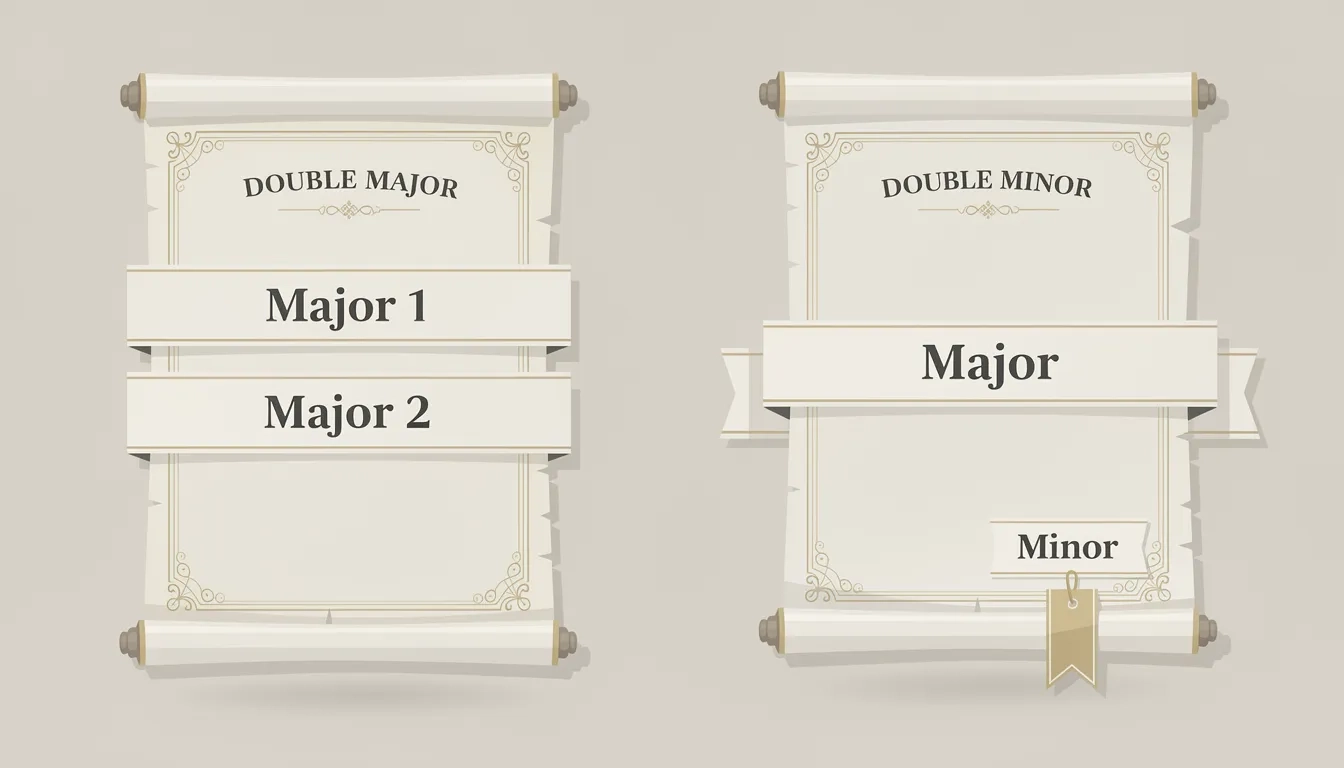
A double major means completing the full course requirements for two academic disciplines and graduating with a single degree that formally recognizes both fields. Both majors carry equal weight on your transcript and diploma. Most programs also require completing two senior capstone projects or theses, one per major.
A major with a minor gives you a primary field and a secondary one with lighter requirements. The minor shows up on your transcript, but it signals a supporting interest, not co-equal expertise.
Here's how the structures typically compare at most four-year universities:
| Structure | Typical Credit Hours | Capstone Requirements | Graduation Timeline Risk |
|---|---|---|---|
| Single Major | 36–45 credits | 1 capstone | Graduates on time |
| Major + Minor | 51–63 credits | 1 capstone | Fits in 4 years with planning |
| Double Major | 72–90 credits | 2 capstones | Often extends to 4.5–5 years |
One thing that surprises students: the two departments rarely talk to each other. You'll have an advisor in each major who doesn't know what the other requires. Scheduling conflicts between required courses — a Tuesday-Thursday lab that blocks a required seminar in your second major — are common and can cascade across multiple semesters.
The Credit Hour Math (and Where It Gets Tricky)
A minor typically requires 15–18 credit hours. That's five or six courses. At most schools, those slots fit comfortably into existing elective space, meaning the net addition to your four-year plan is manageable.
A double major is a different animal. You're typically looking at 30+ additional hours beyond your first major, and that assumes real overlap between the two fields. With disciplines that share few required courses — History and Chemistry, for instance — overlap can be near zero, pushing your total credit load into 90+ territory.
The overlap question is where students make their biggest planning mistake. Before declaring a second major, pull both course catalogs and manually map which courses might satisfy requirements in both programs. Schools like UC San Diego publish explicit policies governing how credit can be shared across majors. Most schools don't, and the policies are buried in department handbooks nobody reads until junior year.
Some disciplines have natural overlap that makes double majoring genuinely manageable:
- Economics + Mathematics: Econometrics, statistics, and calculus courses often satisfy requirements in both departments simultaneously.
- Computer Science + Statistics: Data science roles increasingly expect both, and the curricula share substantial ground.
- Psychology + Neuroscience: Often co-taught or sharing faculty, which reduces scheduling friction.
- English + Philosophy: Both rely on seminar-style coursework with few lab or studio requirements.
Fields with little overlap — Architecture paired with Biochemistry, say — are where double majoring becomes a genuine enrollment marathon.
What Employers and Grad Schools Actually Think
In competitive technical fields, a double major carries real signal. A Computer Science + Linguistics double major applying to natural language processing roles will stand out in ways a CS major with a Linguistics minor might not. The depth is visibly different on a resume, and in technical interviews.
For graduate and professional school applications, a double major demonstrates that you sustained rigorous work across two disciplines at the same time. Law school admissions offices have long valued STEM double majors because they show quantitative capability that a pre-law primary with a minor often doesn't convey as clearly.
A minor says "I found this interesting." A double major says "I took this seriously enough to do the full work." Those are different claims, and application readers know the difference.
That said, a minor isn't a weak choice. It's often the smarter strategic move. In fields where one discipline dominates hiring decisions — nursing, accounting, civil engineering — employers care primarily about your primary major credentials, licensure, and GPA. A focused minor in healthcare informatics or construction management can address a specific skills gap that appears on every job description in your target sector without requiring an extra semester.
The honest perspective from career counselors and hiring managers: both options are worth less than you think without internships. A double major with no professional experience is consistently outcompeted by a single-major candidate with two substantive internships.
When a Double Major Makes More Sense
There are specific scenarios where doubling up is the right call.
You're entering a field where two disciplines are genuinely co-required. Biomedical engineering. Computational linguistics. Science journalism. These roles live at the intersection of two bodies of knowledge, and employers hiring for them want candidates who've done real work in both — not survey-level exposure.
You're applying to competitive graduate programs in an interdisciplinary area. Cognitive science PhD programs, for example, routinely prefer applicants who've completed coursework in both cognitive psychology and computer science at a rigorous level. A minor suggests familiarity. Two majors suggests readiness to contribute to research from day one.
You have enough overlap that the second major is low marginal cost. If you're a Mathematics major whose required coursework already covers 60% of a Statistics major's requirements, the extra 12 credits for the second major is a reasonable trade.
Use this simple test: Can you map a realistic four-year course schedule that satisfies both majors' requirements without relying on summer school or perfect scheduling every single semester? If the answer is no, a minor is probably the better path.
When a Minor Makes More Sense
You want depth in a supporting area, not co-equal standing. A Biology major who wants to work in science policy doesn't need a Political Science degree. A minor in public policy signals the relevant knowledge without requiring four years of political theory coursework, campaign finance law, and legislative process seminars.
You want to protect elective time. This is the most underrated argument for the minor. Elective courses — the random philosophy seminar, the film theory class, the entrepreneurship elective — are where a surprising amount of professional and personal development actually happens in college. Double majors often lose most or all of this flexibility. Minors typically leave it intact.
You're not sure yet how deep your interest really goes. A minor can be declared junior year with 15 credit hours of remaining runway. A double major generally needs to be locked in by the end of sophomore year to stay on track. If you're genuinely uncertain about your commitment to the second field, start with a minor.
Here's a quick decision guide based on goals:
| Your Goal | Better Choice |
|---|---|
| Work at the intersection of two specific fields | Double major |
| Signal a supporting skill to employers in your primary field | Minor |
| Competitive grad school in interdisciplinary area | Double major |
| Protect GPA and elective time | Minor |
| Minimal course overlap between fields | Minor |
| Significant course overlap between fields | Double major |
| Secondary interest is still exploratory | Minor |
The Opportunity Cost Nobody Talks About
Here's the argument that rarely makes it into these comparisons: the real competition isn't between the two academic options — it's between those options and everything else you could do with that time.
Every extra course you take to satisfy a second major's requirements is a course you're not taking to build a side project, pursue an internship, conduct research with a professor, or lead a student organization. Research from university career services offices consistently shows that internship experience is the single strongest predictor of job offers at graduation — stronger than GPA, major choice, or any academic credential.
Stanford's advising office has noted this tension directly: students who build the most compelling professional profiles by senior year are often not the ones carrying the heaviest academic loads. They found a sustainable balance and used the freed-up time to build professional relationships and demonstrated skills.
A minor keeps that time available. A double major often doesn't.
My honest take: for most students in most fields, a well-chosen minor paired with substantive internships will produce better early-career outcomes than a double major pursued at the expense of professional experience. The exceptions — genuinely interdisciplinary fields, programs with high natural overlap, students who can do both without sacrificing GPA or experience — are real. But they're the exceptions, not the rule.
Bottom Line
- Map the overlap before deciding. If less than 30% of courses satisfy requirements in both programs, a double major will likely cost you a semester and most of your elective flexibility.
- Double major when the field demands it. Biomedical engineering, computational linguistics, cognitive science — these are real cases where co-equal depth matters to employers and graduate programs.
- Choose a minor when you're supporting your primary field. A minor signals focused, complementary knowledge without the scheduling risk or added tuition cost.
- Don't trade experience for credentials. Two substantive internships will almost certainly matter more to your first employer than a second major listed on your diploma.
- Decide by the end of sophomore year. Waiting until junior year to pursue a double major usually means paying for extra semesters. The clock on this decision runs faster than most students expect.
Frequently Asked Questions
Does a double major appear differently on a diploma than a major with a minor?
Yes. A double major lists both disciplines as co-equal majors on your diploma and official transcript. A minor appears on your transcript but is designated separately as a secondary area of study. Graduate admissions readers and employers understand the distinction — a double major signals full completion of both programs' requirements, while a minor indicates focused supplementary coursework.
Can a minor be added late without affecting graduation?
Usually yes, which is one of its biggest practical advantages. At most universities, declaring a minor in junior or even early senior year is possible if relevant elective courses already satisfy a portion of the requirements. A double major declared after the third semester almost always requires summer coursework or an additional semester to finish.
Is a double major worth pursuing if the two fields are unrelated?
Rarely. Unrelated double majors (Art History and Chemical Engineering, for example) produce minimal course overlap, meaning you're essentially completing two full degree programs at the same time. The result is usually a strained GPA, a delayed graduation, and less time for the internships and research experiences that actually drive career outcomes in both fields. A minor in the second area achieves the enrichment goal at a fraction of the cost.
Do employers actually look at a minor on a resume?
They see it, but few independently verify it. What matters more is whether you can articulate what you learned and why it's relevant. A minor you can speak to in an interview — "my economics minor gave me a working framework for thinking about pricing models, which I applied directly in this product role" — is worth far more than one you list and then fumble explaining.
Is a double major the same as a dual degree?
No. A double major produces one degree recognizing two fields of study. A dual degree means completing two separate degree programs and receiving two diplomas, often from different colleges within a university (like a BA and a BS simultaneously). Dual degrees typically require 150+ credit hours and five or more years of enrollment — a substantially heavier commitment than a double major.
Which option is better for medical school applications?
Neither definitively outperforms the other. Medical schools care primarily about prerequisite completion, research experience, clinical hours, and GPA. A Biology + Chemistry double major can be efficient if both programs' requirements cover MCAT subjects with high overlap. But a Biology major with a Chemistry minor accomplishes the same prerequisites with less scheduling pressure, leaving more room for the research positions and clinical volunteering that actually distinguish applicants.
Sources
- Should You Double Major or Minor? Everything You Need to Know - Scholarships360
- Double Major vs. Major/Minor: Similarities and Differences - Saint Leo University
- Double Major vs. Minor: Which is Right For You? - Colleges of Distinction
- Is Double Majoring Worth It? - Research.com
- Double Majors - UC San Diego Academic Advising