How to Take Notes in Lectures That Actually Stick
Most students take notes the same way they learned in middle school: open a page, write what the professor says, close the notebook. That habit isn't terrible, but a 2024 meta-analysis of 24 college studies involving 3,005 participants found that how you take notes predicts performance differences roughly equivalent to a full letter grade. The gap between an A student and a B student often isn't effort. It's method.
Why Note-Taking Has Two Completely Separate Jobs
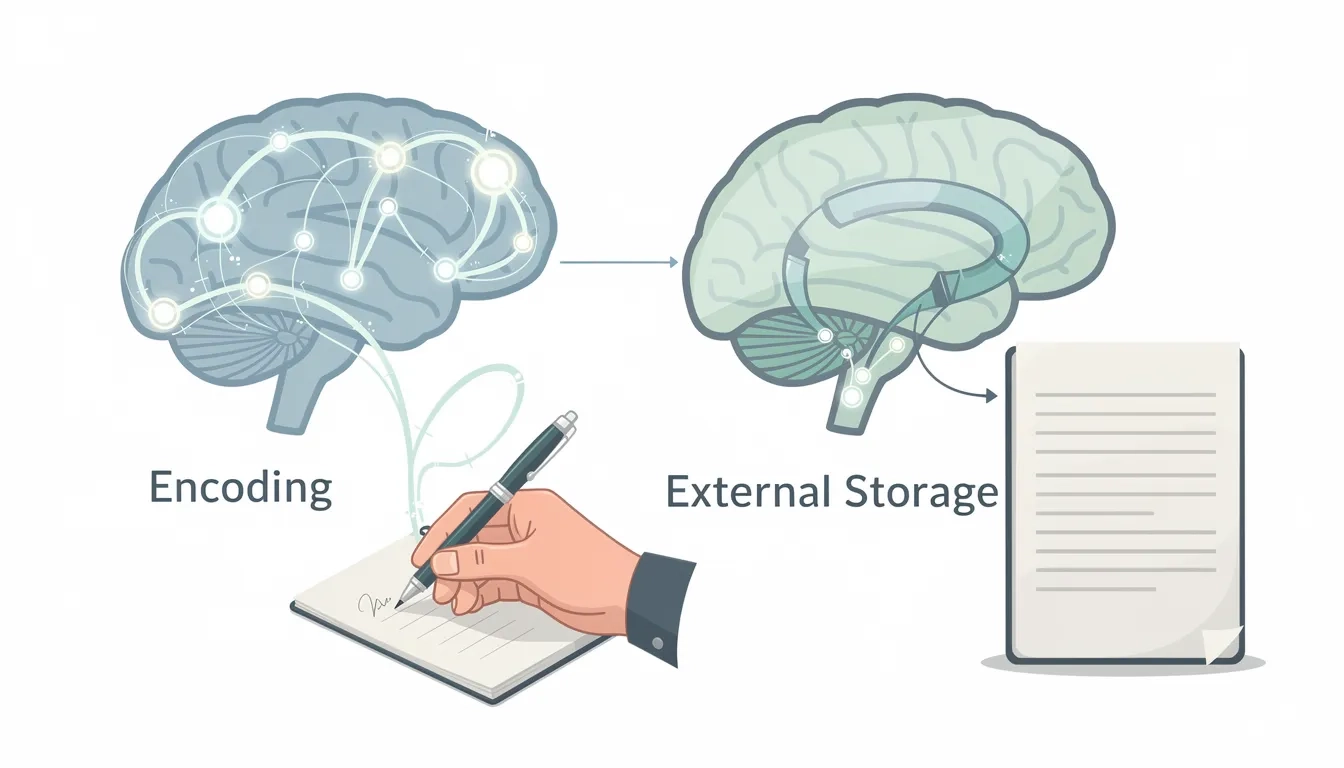
Research on note-taking identifies two distinct functions that most students never consciously separate. The first is encoding: writing something down forces active processing, which builds stronger memory in the moment. The second is external storage: your notes become a reference artifact you can review later, essentially an external hard drive for information that would otherwise fade.
Here's the part that surprises people. Kenneth Kiewra's landmark review of note-taking research (foundational to this entire field) found far stronger evidence for the storage function than for encoding. Reviewing your notes matters at least as much as taking them, and quite possibly more. The notes you write during a lecture are really a study tool you're building in real time.
A 2025 study published in Frontiers in Psychology reinforced this with a striking finding: learning motivation predicted long-term retention more reliably than cognitive load. Students who stayed engaged and interested retained more, regardless of how mentally taxing the note-taking felt. This reframes the whole goal. Good note-taking isn't just about capturing information. It's about staying engaged enough to build something worth coming back to.
The Verbatim Trap (And Why Typing Faster Isn't Learning More)
The biggest mistake most students make, especially those on laptops, is transcribing instead of thinking. You hear the professor say something, you type it nearly word-for-word, and you feel productive. You're not.
The 2024 meta-analysis found that typed notes contained more words and captured more ideas from lectures than handwritten notes. And yet handwritten note-takers outperformed the typists on tests. About 9.5% of handwriting students achieved A grades compared to 6% of typing students across those 24 studies. More words, worse outcomes.
Handwriting is slower, which forces a choice. You can't write everything, so your brain decides what matters. That decision is itself a form of learning. When you compress a professor's two-sentence explanation into a short phrase, you've already started processing the concept rather than merely logging it. Typing lets you skip that compression step entirely, and most students do.
The act of paraphrasing is where learning happens. Transcription is just data entry.
Adding quick sketches or diagrams reinforces this further. Handwritten notes contain more drawings than typed notes, which means they naturally invoke dual coding (combining visual and verbal information), a process shown to strengthen memory encoding.
Choosing Your Method: A Practical Comparison
Not every method works in every lecture. The right choice depends on how fast the lecturer moves, how structured the content is, and whether you're approaching the material cold or with existing background knowledge.
| Method | Best For | Key Advantage | Watch Out For |
|---|---|---|---|
| Cornell | Most lecture types | Built-in self-testing column | Needs 10 min after class to complete |
| Outline | Structured, sequential content | Clear hierarchy, easy to scan | Struggles with fast-paced delivery |
| Mapping | Complex, interconnected concepts | Shows relationships visually | Can miss transitions and specific details |
| Charting | Fact-heavy comparative content | Side-by-side comparison, reduces writing | Must pre-plan column categories before class |
| Sentence | Fast, somewhat organized lectures | Captures more raw information quickly | Hard to distinguish major vs. minor points |
A 2025 randomized controlled trial in Frontiers in Psychology tested four note-taking approaches on 134 teacher candidates over five weeks. Only the Cornell method showed statistically significant retention advantages at delayed follow-up testing. No meaningful differences appeared at the immediate post-test. The benefits showed up later, which is when they matter most for exams.
How the Cornell Method Actually Works
The Cornell method appears in nearly every study guide, but most students use a watered-down version of it. Done properly, it has three distinct zones.
Divide your page into three areas: a narrow left column (about 2.5 inches wide) for cue words and questions, a wider right section for actual notes during the lecture, and a summary box at the bottom of each page. During class, you only write in the right column. Abbreviate, sketch, use arrows. Don't worry about neatness.
After class — ideally within 24 hours — you review those notes and write keywords, questions, or brief prompts in the left column. Then you cover the right side and try to recall the content from those cue words alone. That last step is what most students skip.
The cue column creates retrieval practice, which cognitive science consistently ranks as the single most effective study technique for long-term retention. No other common note format builds this in as naturally. You're essentially converting your lecture notes into a set of contextual flashcards without any extra work.
Before, During, and After: A Three-Phase Framework
Most advice on note-taking focuses entirely on what happens during the lecture. The phases before and after are where most of the retention actually gets locked in.
Before the Lecture
- Preview the material: Skim textbook chapters or uploaded slides for 8 to 12 minutes. You don't need to read deeply. The goal is building a mental scaffold so new information has somewhere to attach.
- Prepare your structure: Draw Cornell columns in advance, or decide your charting categories before the room fills up. Reducing decision-making during the lecture frees attention for actual content.
- Label the page: Date, course, and topic. Takes ten seconds and saves real confusion during exam season.
During the Lecture
- Abbreviate aggressively: Develop shorthand for your subject. "→" for "leads to," "b/c" for "because," circled terms for vocabulary to look up later. Speed matters more than neatness.
- Mark confusion in real time: A question mark or blank line where you lost the thread is far better than silently skipping it and hoping it won't appear on the test.
- Capture examples separately: Box or star the examples a professor uses. Those tend to show up on exams, and they're easier to find later if visually distinct.
After the Lecture
- Review within 24 hours: The forgetting curve, described by Hermann Ebbinghaus and replicated in learning science research ever since, shows memory drops fastest in the first day. A 15-minute review session resets that decay. None of this is rocket science, but most students skip this entirely.
- Fill gaps immediately: Compare with a classmate's notes or check the lecture slides while the material is still warm. The longer you wait, the more you'll have to reconstruct from scratch.
- Write your summary in your own words: In Cornell format, the bottom summary should be paraphrase, not copying from the notes above. This is the encoding step that ties everything together.
Digital Notes: When They Help and When They Hurt
Laptops and tablets aren't inherently bad for learning. The research is more nuanced than the "ban all devices" crowd acknowledges.
A 2024 study in Cogent Education found that digital note-taking only became a liability when students couldn't control distractions. When students used laptops in airplane mode or with distracting apps blocked, performance differences with handwritten notes became negligible. The enemy isn't the device. It's the open browser tab sitting two clicks from anything a professor says that's mildly boring.
Digital tools also offer real advantages that rarely get mentioned. Typed notes are searchable and easy to reorganize (try cutting and pasting a handwritten Cornell layout). For students with dysgraphia or other disabilities, digital tools aren't a preference — they're a requirement. The 2024 Learning Scientists meta-analysis didn't address students with disabilities at all, which is a genuine gap in the literature.
My position: use whatever medium you can stay disciplined with, but default to handwriting if you're a chronic multitasker. The handwriting advantage is real and replicable. Its size just gets exaggerated when people ignore the distraction variable.
The Collaborative Review Most Students Ignore
A 2025 study published in Memory found that students who reviewed their notes in a group added more idea units to their notes afterward compared to solo reviewers. This effect was stronger after a longer delay between lecture and review session. Studying with a classmate after a week produced more benefit than studying alone after a day.
Peer review surfaces what you missed. Your classmate caught something you didn't, and vice versa. The discussion itself is a second round of active processing, not just coverage comparison. This is distinct from copying someone else's notes — the benefit depends on having taken your own notes first, then comparing and discussing the gaps.
Shared documents in Notion or Google Docs can work well for this (one area where digital tools genuinely pull ahead), but the discussion can't be replaced by merging files. The conversation is the point.
Bottom Line
- Stop transcribing, start paraphrasing. The moment you decide what's important enough to write is where learning begins. Whether you use pen or keyboard matters less than whether you're thinking or just copying.
- Use the Cornell method as your default. It's the only format with randomized trial evidence for lasting retention, and the cue column converts your notes into built-in retrieval practice with no extra effort.
- Treat the review phase as non-optional. A 15-minute review within 24 hours, followed by a group comparison session when possible, consistently outperforms any single note-taking technique used in isolation.
- Control your environment, not just your method. A handwritten notebook in a distraction-free seat beats a laptop in a browser-heavy setup. Discipline in the room determines what the method can actually deliver.
Frequently Asked Questions
Is handwriting always better than typing for lecture notes?
Not always, but on average, yes. The 2024 meta-analysis of 24 studies found handwritten notes produced better test performance despite containing fewer words. The key mechanism is processing depth: slower handwriting forces paraphrasing and prioritization rather than verbatim copying. If you type and make a deliberate effort to compress and rephrase rather than transcribe, the gap narrows considerably.
How many notes should I actually take in a lecture?
Research consistently finds that more notes correlate with better recall, but with a caveat. The "more is better" finding applies to notes where students processed what they were writing. Verbatim transcription of everything, even if complete, doesn't produce the same benefit. Capture main ideas, supporting examples, any specific data or named terms the lecturer emphasizes, and mark your own confusion visibly so you know where to return.
Does my note-taking method matter, or is reviewing notes what really counts?
Both matter, but reviewing is the piece most students are missing. The storage function of notes — having accurate notes worth reviewing — has stronger research support than the encoding function alone. A structured method like Cornell amplifies review by building in retrieval practice. Don't treat these as competing priorities; they compound each other.
Is the "review within 24 hours" rule actually backed by evidence, or just common advice?
It's grounded in real evidence. Ebbinghaus's forgetting curve research shows memory decays fastest in the first several hours after learning, then levels off. Reviewing within the same day or early the next morning produces a measurable difference compared to waiting several days. The exact hour doesn't matter as much as the consistency of doing it at all.
What should I do when a lecture moves too fast to keep up?
Two strategies help most. First, build aggressive shorthand for your course: abbreviations, arrows, and symbols for recurring concepts. Second, leave marked gaps — a question mark or blank line — rather than losing your place trying to catch up mid-sentence. Review those gaps immediately after class using slides or a classmate's notes while the lecture is still fresh in your head.
Can AI transcription tools replace taking notes yourself?
AI tools can be useful for generating a fallback record, but treating them as a substitute for active note-taking removes the cognitive work that creates memory in the first place. Using AI to fill gaps after you've taken your own notes is a reasonable workflow. Using it to skip note-taking entirely means you lose the encoding benefit and often end up reviewing material you never actually processed during the lecture.
Sources
- Frontiers in Psychology: Effects of Note-Taking Methods on Lasting Learning
- The Learning Scientists: Handwritten vs. Typed Note-Taking Effects on College Students' Performance
- Cult of Pedagogy: Note-Taking Research Roundup
- Cogent Education: Digital Notetaking in Lectures
- University of Tennessee Chattanooga: Common Note-Taking Methods
- Semantic Scholar: A Review of Note-Taking — The Encoding-Storage Paradigm and Beyond