How to Build an Impressive Sports Resume That Gets Noticed
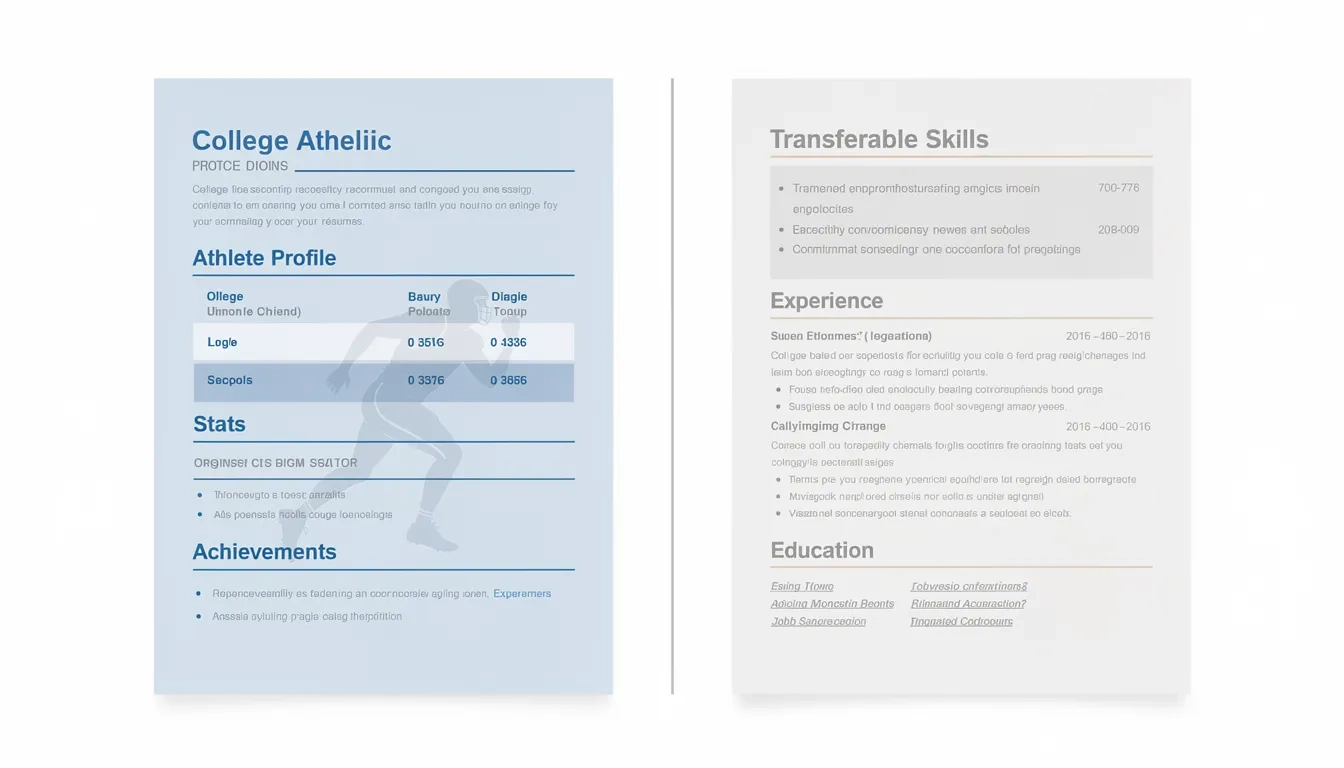
College coaches can receive hundreds of recruiting emails per week. Some D1 programs field north of 300 a month from interested athletes. Your resume lands in that pile, gets skimmed in seconds, and either makes someone want to know more or gets filed away forever. That's the real pressure behind a sports resume. It isn't a formality. It's the first real test of whether you can communicate your value clearly enough to earn a second look.
Two Different Documents — Know Which One You're Writing
Not every sports resume is built for the same reader. Most advice online lumps them together, which leads to the wrong document going to the wrong person.
The college recruiting resume targets coaches. Its job is to answer three questions immediately: Can this athlete compete at my level? Are they academically eligible? Will they fit my program's culture? One page, no exceptions.
The career-transition resume is for athletes entering the job market after their playing days. Here the challenge is translation — converting athletic accomplishments into language that a hiring manager in finance, marketing, or operations actually cares about. This version runs one to two pages and sounds nothing like a recruiting document.
Both share structural bones. But a high school swimmer who sends a four-page career resume to a Division I coach, or a retired midfielder who just writes "scored 23 goals" on a corporate application without context, has confused the audience. Identify your reader before you write a single word.
The Core Sections of a Recruiting Resume
This is where most athletes either nail it or bury themselves in generic fluff. NCSA Sports, one of the largest college recruiting networks, notes that coaches actively search athlete profiles for film, academics, and fit. Your paper resume is the companion document that makes that profile search feel worth their time.
Every strong recruiting resume needs these sections:
Header (top of page one):
- Full name, phone, professional email, graduation year, high school, city/state
- Your highlight video link — right here, not buried at the bottom
Academic credentials:
- Unweighted and weighted GPA (list both if your weighted is higher)
- SAT or ACT scores; PSAT if you haven't tested yet
- NCAA Eligibility Center ID if you've registered
- Academic honors: Honor Roll, National Honor Society, AP course load
Athletic details:
- Current team and level, position, jersey number, height, weight
- Club or travel team history with coach names and contact info
- Season statistics — with context (more on this below)
Character and leadership:
- Team captain roles, community service, coaching clinics, mentorship
- Academic awards double up here — they signal character, not just GPA
Name your file "FirstName_LastName_Sport_GradYear_Resume.pdf" before you send it. Coaches who receive a file named "resume_FINAL_v2.pdf" form an impression, and it's not a good one.
Stats Are Only as Good as Their Context
Raw numbers tell almost nothing on their own. "15 assists" is meaningless without knowing the competition level, the number of games played, or how that compares to your conference's average output. Context is what turns a number into a claim.
The fix is simple: attach a short qualifier to every stat. "15 assists in 16 games, first-team All-Conference in a division that placed four players in D1 programs" is a sentence that a coach can actually evaluate.
Different sports have different priority stats:
| Sport | Lead with | Attach this context |
|---|---|---|
| Soccer | Goals, assists, shot accuracy | Games played, competition level |
| Basketball | Points, assists, field goal % | Team record, defensive stats |
| Track & Field | Personal records, event rankings | State or regional placement |
| Baseball/Softball | ERA, batting average, OBP | Conference averages for comparison |
| Swimming | Best event times, improvement trend | State qualifying cut standards |
Coaches also use an informal rating framework, loosely mapped from no stars (emerging talent) to five stars (nationally elite). If you want to calibrate where you stand, pull the current roster stats from programs you're targeting and compare honestly. That tells you whether you're pitching yourself at the right level — and helps you decide which numbers to lead with.
Two or three strong, well-contextualized stats will always outperform a long wall of numbers. Cut anything that doesn't make the case stronger.
The Highlight Reel Does More Work Than the Resume
Here's my honest take on this: the paper resume is mostly a credentialing document. It earns you the benefit of the doubt. The highlight reel is where coaches form an actual opinion about whether they want you on their team.
Your video link belongs in the header. Not the footer, not a separate email. Right at the top where it's the first clickable thing on the page.
A good reel runs 3 to 5 minutes. Coaches at competitive programs watch several of these per day (some programs report watching over 40 per week during evaluation windows). They'll cut off anything that drags past 8 minutes, and they're forming impressions by the 60-second mark.
What to include:
- Your three or four strongest individual moments — lead with them
- Position-specific skill demonstrations, not just highlight dunks or diving catches
- Some full-play footage so coaches see your positioning and decision-making, not just your athletic moments
- Consistent, legible video quality — bad lighting that makes you invisible defeats the purpose
QR codes on printed copies are worth the 10 minutes it takes to generate one. When you're handing your resume to a coach at a camp or showcase, a scannable code that goes straight to your video removes one more step between them and actually watching you play.
Academic and Character Signals That Coaches Actually Weigh
The NCAA requires a minimum 2.3 GPA (unweighted, on a 4.0 scale) for Division I eligibility — but that floor is a trap. A 3.4 or higher tells a coach you won't need round-the-clock academic monitoring, which matters more than most athletes realize.
According to IMG Academy's recruiting research, when coaches evaluate two athletes with comparable talent, the stronger academic profile often wins. Coaches who've dealt with eligibility issues in the past (and most experienced coaches have) treat academic strength as a form of risk management, not just a nice bonus.
"When coaches have multiple recruits of similar athletic ability that could fill a position, if one is stronger academically, the coach may choose them — they could be more likely to stay eligible."
Leadership roles deserve a line on your resume. Team captain, peer mentor, youth clinic coach — these tell a coach you make a locker room better, not harder to manage. Community service tied to sports carries particular weight because it signals that your relationship with the game isn't purely transactional.
Coachability doesn't show up as a bullet point. It comes through in your video (how do you react on the bench after a mistake?), in what your references say, and in how you communicate during recruiting. Build that reputation before you need it.
Turning Athletic Experience into Career Currency
For athletes entering the workforce after competing, the sports resume challenge flips. Nobody in a job interview cares that you scored 23 goals. They care what it took — and whether those same traits will show up at work.
The Bureau of Labor Statistics projects 38% growth in careers for athletes and sports competitors over the next decade. But most athletes end up in adjacent fields: coaching, sports administration, sales, operations, management. That's where translating your athletic past gets you a foot in the door.
The XYZ formula works well here: led [action], producing [outcome], measured by [metric]. Compare these two versions:
- Weak: "Played Division II soccer, 2021–2025"
- Strong: "Served as captain for a 22-player roster across a 48-game season, managing on-field communication and coordinating with coaching staff on lineup strategy"
Skills employers actually respond to from athletic backgrounds: performing under pressure, accepting critical feedback and adjusting quickly, sustained effort toward a long-term goal, and time management while balancing multiple demands. The key is specificity — name the skill, then prove it with an example. Don't just assert "strong time management skills." Show what you managed simultaneously and what the outcome was.
Bottom Line
A sports resume that works doesn't try to include everything — it makes the right things obvious. Coaches and hiring managers are moving fast, and the document's job is to remove friction, not add it.
- Lead with your highlight video link in the header. It's doing more persuasive work than any bullet point.
- Contextualize every stat. Competition level, games played, conference standing. Numbers without context are just numbers.
- One page, PDF format, professional file name. Non-negotiable for recruiting.
- Update after every season. Coaches notice athletes who track and share their own progress.
- For job-market resumes: translate sport to skill explicitly, with specific examples. A hiring manager shouldn't have to guess what four years of competition taught you.
The athletes who land recruits — and the ones who get jobs after playing — aren't always the most talented people in the room. They're usually the ones who made it easiest for the right person to say yes.
Frequently Asked Questions
Should I include a photo on my sports resume?
No, unless the coach or program specifically requests one. Photos aren't standard on US recruiting resumes and can introduce bias without adding useful information. Use the space for an additional achievement or clean formatting. International programs sometimes expect photos — check the norms for your specific target.
How do I write a sports resume when my stats aren't impressive yet?
Shift the focus from raw numbers to trajectory and context. Mention competition level, time with the program, measurable improvement over seasons, and leadership moments like mentoring younger teammates. Coaches recruiting underclassmen are projecting future development anyway — showing work ethic, coachability, and upward progress matters more than current stats at that stage.
Myth vs. reality: Does GPA really matter to coaches at big programs?
More than most athletes assume. The myth is that elite athletic talent makes academics a secondary concern. The reality, according to IMG Academy's research, is that coaches at competitive programs have been burned by academically ineligible players and treat GPA as a form of roster risk management. A student-athlete with a 3.5 GPA signals they won't cost the program a scholarship due to eligibility issues.
How do I send my resume to college coaches effectively?
Email directly, with the PDF attached. Keep the body of the email to three or four sentences: who you are, your position and grad year, why you're interested in their specific program, and a link to your highlight video. Personalization matters — coaches spot a mass email immediately, and it signals low interest. Reference something specific about their program that you actually researched.
How often should I update my sports resume?
After every competitive season at minimum, and sooner if you earn a new award or set a personal record. Sending a coach last year's stats when this year's were significantly better is a missed opportunity. Some athletes maintain a longer master document and trim it to one page for each submission — that's a smart system for keeping everything current without starting from scratch.