How to Cancel or Retake the SAT: What You Need to Know
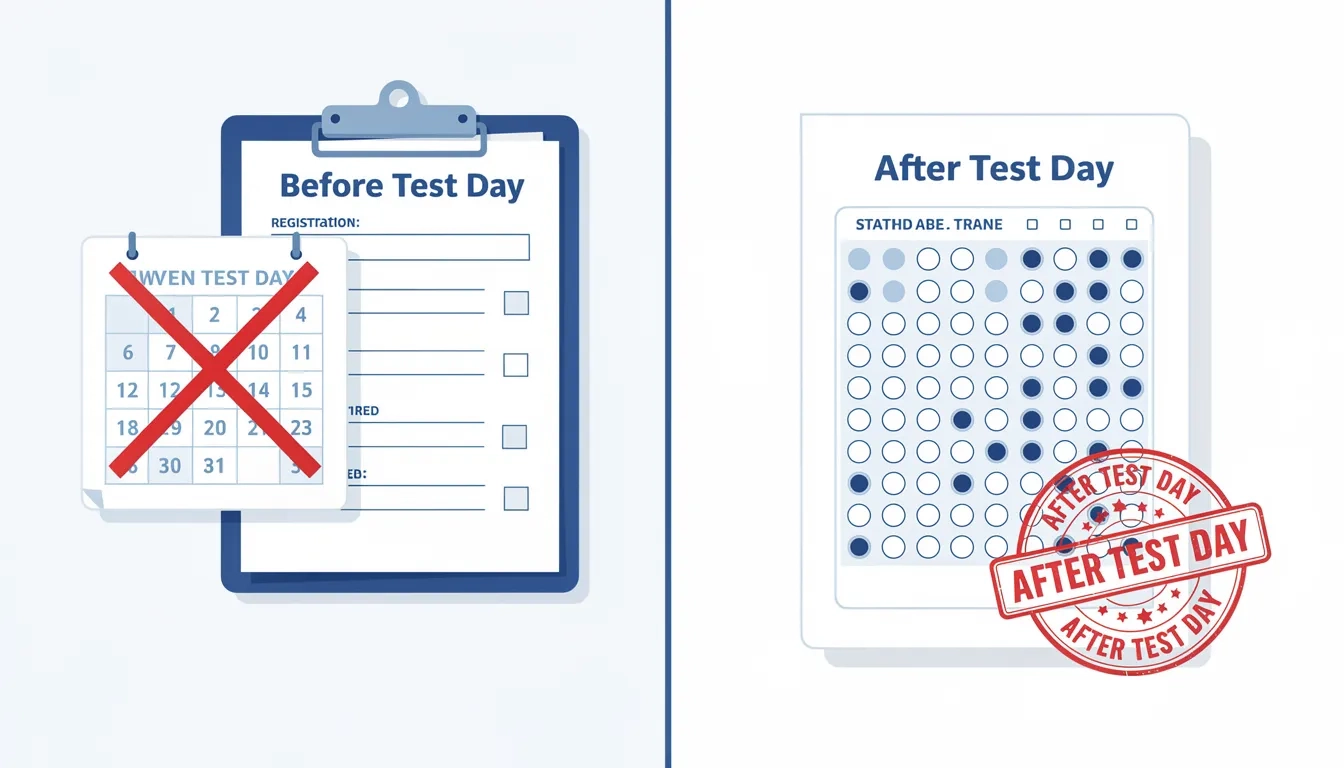
Most SAT guides cover how to register and prepare but skip what happens when plans fall apart — or when you walk out of the testing center convinced you bombed it. There are two completely different "cancel" procedures here, and mixing them up is an expensive mistake. Canceling a registration before test day is routine paperwork. Canceling your scores after the exam is permanent and irreversible, made without ever seeing what you actually scored.
Knowing which situation you're in, and exactly what College Board's rules say, matters more than most students realize.
Two Cancellations That Aren't the Same Thing
Registration cancellation happens before you set foot in a testing center. You're backing out of a scheduled exam. You'll lose a portion of your registration fee, but there's no academic record consequence and you can reschedule freely.
Score cancellation is a different animal. The exam is done. You're asking College Board to permanently erase results you haven't seen yet. Those scores are gone forever — not sent to colleges, not retrievable by you, not available for any purpose.
Most people searching "how to cancel my SAT" are in the first camp — scheduling conflict, illness, change of plans. The process is simple. But a real number of students walk out of the test center wanting to make their scores disappear. That path exists, but it comes with real tradeoffs.
Canceling Your SAT Registration Before Test Day
The mechanics are simple. Log in to mysat.collegeboard.org, find the registration you want to drop, and select "Cancel Registration" from the options menu. Takes about four minutes.
The less simple part is how much money you get back. Timing is everything:
| When You Cancel | Cancellation Fee | What You Recover |
|---|---|---|
| Before the change deadline | $34 | Registration fee minus $34 |
| After change deadline, by Thursday 11:59 PM ET | $44 | Registration fee minus $44 |
| After Thursday 11:59 PM ET (or test day) | Full forfeiture | Nothing |
The standard U.S. registration fee for 2025-2026 is $68. Wait until the day before the exam to cancel and you're paying $44 for the privilege of not showing up.
One thing most people miss: cancellation is permanent for that administration. If you cancel your June registration and later want to reinstate it, you can't. You'd need to register fresh for a different date, assuming seats remain open.
Canceling SAT Scores After Test Day
The exam is done. Maybe the Reading section felt incomprehensible. Maybe timing went sideways. The urge to make those scores disappear is understandable — but the process is strict.
For weekend national test dates, everything is online:
- Log in to mysat.collegeboard.org
- Go to "My Scores"
- Find your test date and click "Unsure about scores?"
- Review and accept the Cancellation of SAT Scores Agreement
- Confirm — and that's it
The deadline is 11:59 PM Eastern Time, exactly one week after your test date.
For School Day SAT takers, you can't cancel online. Ask your school's college counselor or SAT proctor for a student-requested cancellation form and return it through school staff. The deadline is five days after test day. Students who received approved disability accommodations get a slightly longer window: until the Monday one week post-test.
There's also an on-the-spot option. Before leaving the testing center, you can request a "Request to Cancel Test Scores" form directly from your proctor. Fill it out and hand it back before walking out the door.
According to College Board: "Scores can't be reinstated or reported to you or any institutions." No appeal process. No grace period. Once it's done, it's done.
Should You Cancel Your Scores? Probably Not.
Here's my honest take: score cancellation is almost always the wrong move, and students reach for it far more often than they should.
The core problem is that you're making a permanent, irreversible decision about scores you haven't seen. Students consistently misjudge their own performance coming out of a test. The section that felt impossible was probably hard for everyone, and raw scores get adjusted through equating. Walking out certain you scored a 1100 doesn't mean you scored a 1100.
More practically, you already have a better alternative. Score Choice — College Board's system for selecting which test date scores to send — means you can simply choose not to share a disappointing score. It still exists in your account, you still get to see it, and you can use that data to target your prep for a retake. Cancellation strips you of all of that.
The narrow set of situations where cancellation genuinely makes sense:
- A testing irregularity affected your performance (wrong timing instructions, compromised testing environment)
- A medical emergency interrupted your exam mid-test
- You're applying this cycle to schools that require submission of all scores, and you're certain this result will actively damage your application
Outside those situations, let the scores come in. Worst case, you don't send them to anyone.
When Retaking the SAT Actually Makes Sense
College Board's own data shows roughly two-thirds of students who retake the SAT score higher on their second attempt. But "higher" can mean 20 points or 200 points — and the gap between those outcomes is almost entirely preparation quality, not luck.
Retaking makes clear sense when:
- Your score sits below the 25th percentile for your target schools (check each school's Common Data Set for these numbers)
- You prepared minimally or inconsistently the first time around
- Your practice test average was noticeably higher than your official score
- One weak section is dragging your total score down and you haven't seriously worked on it
Retaking probably won't move the needle if:
- You've taken the test three or more times and plateaued
- Your target is more than 200 points away with under six weeks to prep
- Your target schools are test-optional and your application is strong on other dimensions
Before registering for a retake, run a quick superscore calculation. Because most colleges take your highest Reading/Writing score from one test date and your highest Math score from another, your effective score may already be higher than your single-sitting results suggest. A student who scored 680 R&W on one attempt and 730 Math on another walks into applications with a 1410 superscore — not a 1360 and a 1380.
Building a Retake Plan That Actually Works
The single biggest prep mistake is treating a retake like a fresh start with no information. You have something most first-timers don't: a real score report.
Start there. College Board's score reports break performance down by specific skill areas — things like "Linear Equations," "Inferences," or "Transitions." These aren't vague buckets; they map directly to question types on the Digital SAT. Your lowest-scoring skill areas are where prep time should go, not a general review of everything.
A realistic timeline:
| Prep Duration | Realistic Score Gain |
|---|---|
| 4 weeks (focused) | 50–80 points |
| 8 weeks | 100–200 points |
| 12 weeks | 200+ points |
These ranges assume structured practice, not passive re-reading of prep books.
Superscoring changes the math on where to focus. If your Math score from a previous test is already where you want it, put roughly 80% of your prep into Reading and Writing only. That's not gaming the system. That's using the system as designed.
Plan for at least two full-length practice tests before your retake, taken under real conditions. Saturday mornings starting around 8 AM, no interruptions, treated like the actual exam. A surprising number of students discover that stamina — not content knowledge — was what cost them points the first time. Khan Academy's free SAT prep platform includes full-length adaptive practice tests and is directly calibrated to College Board's content.
One non-obvious thing about the Digital SAT specifically: Module 1 determines the difficulty of Module 2. Performing well on Module 1 routes you into the harder (higher-scoring) Module 2 path. Students who rush through Module 1 trying to "save time" end up in the easier Module 2 track, which caps their scoring potential. Slow down on Module 1. It's the most valuable section of the test.
Registering for Your Retake: Practical Details
SAT test dates run six times per year in the U.S.: August, October, November, March, May, and June. The most common retake window for current juniors is fall of senior year, giving scores time to arrive before January and February application deadlines.
The registration fee is $68. Fee waivers cover two full test registrations for income-eligible students, plus unlimited free score sends — ask your school counselor if you qualified for your first attempt, since the same eligibility usually carries.
Score Choice is active by default when you send scores. Outside the free score sends included with registration, College Board charges $19.50 per additional college per designated report. You choose which test dates to include.
Register early. October seats at popular test centers near most high schools fill within six to eight weeks of opening. If you're planning a fall retake, register as soon as the date is available — not in September when everyone else is also scrambling.
Bottom Line
- Canceling a registration is a routine account action, but timing matters. Cancel before the change deadline and you lose $34; cancel after the deadline but before Thursday night and you lose $44; wait until test day and you lose everything.
- Score cancellation is permanent, irreversible, and made blind. Use Score Choice to withhold disappointing scores from colleges instead — you keep the knowledge and can use it for prep.
- Most students improve on a retake, but not by accident. Pull your score report, find the specific skill areas that cost you points, and build your prep around those.
- Calculate your superscore before deciding if a retake is even necessary. The answer sometimes surprises people.
- Register for your retake early — October seats fill fast.
Frequently Asked Questions
Can you retake the SAT as many times as you want?
Yes, College Board places no official limit on the number of attempts. Most students take it two or three times. Taking it four or more times rarely produces significant additional improvement and can raise questions at some admissions offices, though most colleges focus on your best superscore rather than the number of attempts.
Will colleges see all my SAT scores if I retake?
Not necessarily. College Board's Score Choice program lets you select which test dates to send — you aren't required to share every attempt. That said, some colleges (typically the most selective ones) require submission of all scores. Always verify each school's score policy before deciding what to send. The policy is usually listed in the admissions FAQ or Common Data Set.
Is score cancellation the same as just not sending a score to colleges?
No, and this is the most common misconception. Score Choice lets you withhold a score from colleges — you still see it, it still exists, and you can use it for prep planning. Score cancellation permanently deletes the score from College Board's system. You'll never know what you got, and no institution ever will. Score Choice handles the vast majority of situations where you don't want colleges seeing a particular result.
How long does it take to see SAT scores after retaking?
For most weekend national administrations, scores appear in your College Board account roughly two weeks after test day, though College Board sometimes releases them earlier. School Day SAT scores follow a separate schedule, typically released six to eight weeks post-administration. Check the specific release dates for your test administration in your My SAT account.
What if I miss the score cancellation deadline?
If you miss the one-week window for weekend tests (or five-day window for School Day tests), you can no longer cancel the scores entirely. You can, however, still control who sees them. Score Choice remains available up to the point you submit score sends, so you can simply choose not to include that test date when sending results to colleges.
Should I cancel my registration or just not show up?
Cancel it. If you simply don't show up, you receive no refund and College Board records an absence for that test date. Canceling your registration at least recovers a portion of your fee — $34 before the change deadline, $44 after. A no-show forfeits the full $68 with no benefit.