How to Raise Your ACT Score by 5 Points (A Real Plan)
Five points on a 36-point scale sounds like almost nothing. It's worth, at some schools, an entire year of tuition. Moving from a 25 to a 30 shifts you from roughly the 79th to the 93rd percentile — that's a jump large enough to cross merit scholarship cutoffs at dozens of universities, and to meaningfully change which schools treat your application as competitive. The number is small. The stakes are not.
Here's the honest framing: a 5-point gain is achievable for most students sitting below a 29, but only if prep strategy matches the test's actual structure. Studying generically is how students spend 60 hours and move 1.5 points. This guide is about not doing that.
What the Data Actually Shows
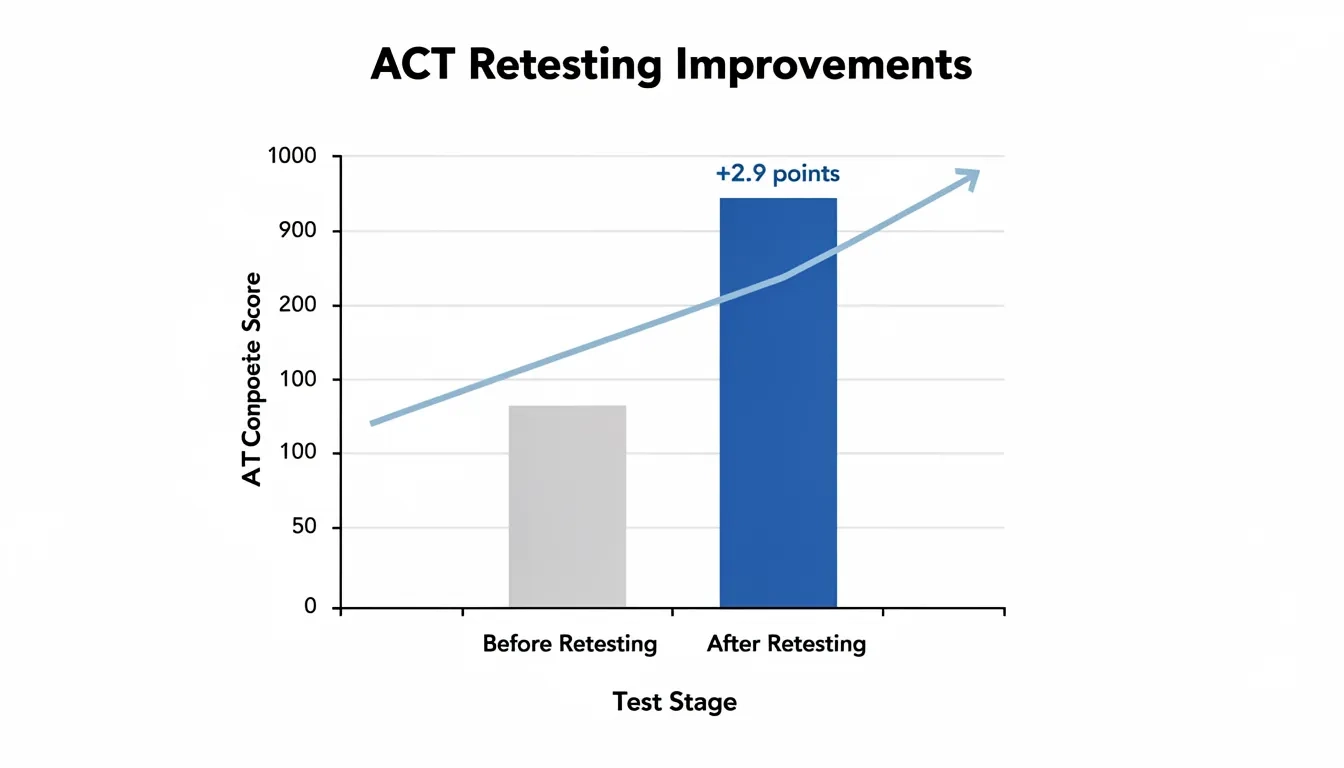
ACT, Inc.'s 2022 research brief on retesting found that students who retake the ACT improve by an average of 2.9 composite points. That's the baseline — no structured prep, just a second attempt. With deliberate preparation, 5 points is a realistic target.
Your starting score shapes your ceiling. Students scoring in the high 20s have a harder path than students in the low 20s. Not because they're less capable — because the obvious weaknesses are already gone. A student at 22 probably has two or three sections with real gaps. A student at 30 has already closed most of them.
The place most 5-point improvements actually come from is section imbalance. A 26 composite built from 30 English, 28 Math, 21 Reading, and 25 Science is a very different prep problem than one built from 27, 27, 25, 25. The first student can probably gain 4–6 composite points just by fixing Reading. The second student needs broader work.
Fix the floor, not the ceiling. Spending your prep time improving a 30 in English when Reading is a 22 is almost always the wrong call. The composite rewards you for bringing weak sections up, not for perfecting strong ones.
Take a Real Diagnostic Before You Study Anything
This is the step most students skip. It's also the most important one.
Before opening a prep book, take a full-length official ACT practice test under real conditions — timed, in the morning, phone in another room, using official ACT materials from act.org. Third-party practice questions vary in quality and don't always match the real test's difficulty or style.
A proper diagnostic tells you what's actually costing you points, not what you assume is costing you points. Many students believe they're weak in Math when they're actually losing points to time pressure. Others think Science is their problem when they're misreading graphs — a skill issue, not a content issue. These have completely different fixes.
After scoring the test, break each section down by question type. ACT Math spans six categories: pre-algebra, elementary algebra, intermediate algebra, coordinate geometry, plane geometry, and trigonometry. If you got 90% of pre-algebra right but only 40% of coordinate geometry, that's your specific target. "ACT Math" is not a useful diagnosis.
For Reading and Science, note whether you ran out of time, answered questions wrong despite having time, or both. The fix for a timing problem looks nothing like the fix for a content gap. Skipping this diagnostic step means you might spend 30 hours studying the wrong things entirely.
The Section-by-Section Playbook
Each of the four sections rewards different skills. Treating them the same is where most generic prep falls apart.
English: The Brevity Rule
ACT English has a strong structural preference for concise writing. When two or three answer choices are grammatically correct, the shortest one is almost always right. This sounds too simple. It works anyway.
The test is designed to check whether students can identify redundant or wordy phrasing. "The annual yearly meeting convened on Tuesday" should become "The annual meeting convened on Tuesday." Train yourself to spot wordiness before you hunt for grammar errors. It's faster, and it catches more points per minute of test time.
Math: Backsolve Instead of Solving
Rather than working through complex algebra to find x, plug the answer choices directly into the problem. Start with choice C or H (the middle value in a typically ascending list), check whether it satisfies the equation, then work up or down from there. This converts abstract algebra into basic arithmetic.
Not every problem yields to this technique. But a meaningful portion does — and students who use it consistently report fewer careless errors because the calculations are simpler. It's especially useful on word problems where you'd otherwise need to build and solve an equation from scratch.
Science: Go Straight to the Graph
The ACT Science section doesn't test whether you paid attention in chemistry class. It tests whether you can extract correct information from graphs, tables, and experimental data quickly and accurately.
Skip the passage introduction entirely. Go to the question first, find the relevant figure or table, and answer it. The introductory text is background context that almost never contains the answer directly. Skipping it can save 3–4 minutes across a full Science section — enough time to revisit several circled questions.
Reading: Control Passage Order
Reading is typically section 3 of 4. By the time you hit it, mental fatigue has already started. Don't work through the four passages in order. Glance at all four, identify which genre you're strongest with (literary narrative, social science, humanities, or natural science), and do that one first. Save the passage you find most difficult for last, when you might be circling back with extra time anyway.
The Triage Method for Time Management
Time management is the highest-leverage skill on the ACT, and most students never consciously develop it.
The triage method works like this: as you encounter each question, sort it into one of three buckets before committing to it.
- Now — answer immediately, under 45 seconds
- Later — mark it, skip it, return after finishing the section
- Never — pick your "Letter of the Day" (a single consistent guess letter you've pre-selected) and move on without looking back
The goal is simple: guarantee you never run out of time on a question you could have answered. Students who work straight through frequently spend 3–4 minutes on a hard problem early in a section, then rush or skip easy ones at the end. Triage inverts that failure pattern.
Pair triage with process of elimination. On a "Never" question where you've crossed off two obviously wrong answers, your odds jump from 20% to roughly 33%. The ACT has 215 total questions. That math adds up to 2–3 extra correct answers per test — essentially a free point or more on your composite.
One drill worth doing during practice: track every instance you spend more than 90 seconds on a single question. That's where your time is leaking.
Full Practice Tests: How to Use Them Right
Practice tests are only useful if you take them correctly and review them correctly. Most students fall short on both.
Building actual test stamina means full sessions — not individual sections, not 20-question sets. The ACT is 3 hours and 35 minutes of timed testing (plus breaks). Students who have never sat through anything similar will fade in sections 3 and 4. The fatigue is real, it's consistent, and it degrades accuracy in predictable ways. The only fix is exposure.
Take at least three full-length practice tests before test day. The first is your baseline diagnostic. The second is your check-in after focused studying. The third is confidence calibration close to the real test date. Simulate real conditions: start at 8am if your test is in the morning, no music, proper breaks only.
After each test, do a structured error review — and this step matters more than the test itself. Every wrong answer falls into one of four categories:
- You didn't know the underlying concept
- You knew it but made a careless mistake
- You ran out of time and guessed
- You misread the question
Each requires a different fix. Grouping all four under "I need to study more" is how students spend 50 hours and improve by 1 point. A practical rule: spend at least as much time on error review as you spent taking the test.
Your Study Timeline
How long does a 5-point improvement actually take? Here's a rough guide by starting score:
| Starting Composite | Realistic Target Gain | Estimated Study Hours |
|---|---|---|
| 18–22 | +5 to +7 points | 60–80 hours |
| 23–26 | +4 to +6 points | 50–70 hours |
| 27–29 | +3 to +5 points | 60–90 hours |
| 30–32 | +2 to +3 points | 80–100 hours |
Higher starting scores require more time for smaller gains. That's not discouraging — it just means the prep at that level needs to be sharper and more targeted.
A 10-week structure that actually works:
- Week 1: Full diagnostic test + detailed error analysis by question type
- Weeks 2–4: Targeted content review on your weakest question categories only
- Weeks 5–7: Timed section practice with daily error logs
- Weeks 8–9: Two full proctored practice tests, each followed by thorough review
- Week 10: Light review, rest, timing strategy rehearsal — no new content
Avoid scheduling a retake less than 8 weeks after starting prep. Students who retake within 4–5 weeks of beginning structured study rarely see more than a 1–2 point improvement. Patterns take repetition over time to internalize. One frantic study weekend won't move the needle.
Bottom Line
Five points is achievable — but only with a targeted, diagnostic-driven approach. Here's what that actually looks like in practice:
- Run a full diagnostic first. Don't study a single topic until you know which question types are costing you points.
- Match your strategy to the section. Brevity in English, backsolving in Math, graph-first in Science, passage-order control in Reading.
- Learn the triage method. Never miss easy questions because you got stuck on hard ones.
- Take at least three full proctored practice tests and spend as much time reviewing errors as taking the tests.
- Give yourself 8–10 weeks. Students who try to cram a 5-point gain into two weeks almost always end up disappointed.
The students who improve the most aren't the ones who study longest. They're the ones who study the right things — and actually review their mistakes.
Frequently Asked Questions
How many hours of studying does a 5-point ACT improvement require?
Most students need 50–80 hours of deliberate, targeted practice to gain 5 composite points, depending on their starting score. Students starting below 23 often need fewer hours because they have multiple fixable weaknesses; students starting above 27 typically need more time since improvement requires drilling harder material. The key word is deliberate — passive re-reading or watching videos without practice rarely translates to score gains.
Can I improve my ACT score by 5 points in a month?
It's possible, but tight. A month gives you roughly 4 weeks, which is enough time for one solid diagnostic, targeted review, two full practice tests, and error analysis — if you're putting in an hour or two daily. The bigger risk isn't the timeline itself; it's trying to rush the error review process, which is where most of the real learning happens. If you have 6–10 weeks, use them.
Which ACT section is the easiest to improve quickly?
Science tends to give students the fastest gains with the least content study required. Because it tests data interpretation rather than science knowledge, students can improve significantly just by learning to navigate graphs and tables efficiently — a skill that takes days to develop, not weeks. English comes in second, since the brevity rule and a handful of grammar patterns cover a large percentage of question types.
Is it a myth that the ACT is curved?
Somewhat. The ACT doesn't have a traditional curve where your performance relative to other test-takers changes your score. But it does use a scale conversion (raw score to scaled score of 1–36) that varies slightly by test form. A score of 34 might require 73 correct answers on one form and 75 on another. This is called equating, not curving — it adjusts for differences in form difficulty, not peer competition. For practical purposes, focus on correct answers, not other test-takers.
Should I prepare for all four sections equally?
No — and this is one of the most common prep mistakes. Spending equal time on all four sections ignores the math of composite scoring. If your English is already a 29 and your Science is a 22, every hour spent on English is worth far less than an hour spent on Science. Run the diagnostic, find your floor sections, and weight your prep heavily toward them. Equal time allocation almost always means wasted time on sections that don't need it.
What prep materials are actually worth using?
Official ACT practice tests from act.org are the most accurate representation of the real test. Third-party prep books (including some from well-known companies) sometimes include questions that are easier or harder than the real ACT, which can skew your sense of readiness. Use official materials for full practice tests and save third-party books for content review on specific topics like geometry formulas or grammar rules where the source matters less.
Sources
- ACT Research: Six Things About Score Gains From Retesting (2022)
- What Is a Realistic ACT Score Improvement - Prep Expert
- 5 Proven Strategies to Boost Your ACT Score by 5+ Points - College Tutors Michigan
- 25 to 32: Fast ACT Prep Study Plan in 10 Days - PrepScholar
- Improving ACT Score by 5 Points - CollegeVine