How to Start an Academic Quiz Bowl Team at Your School
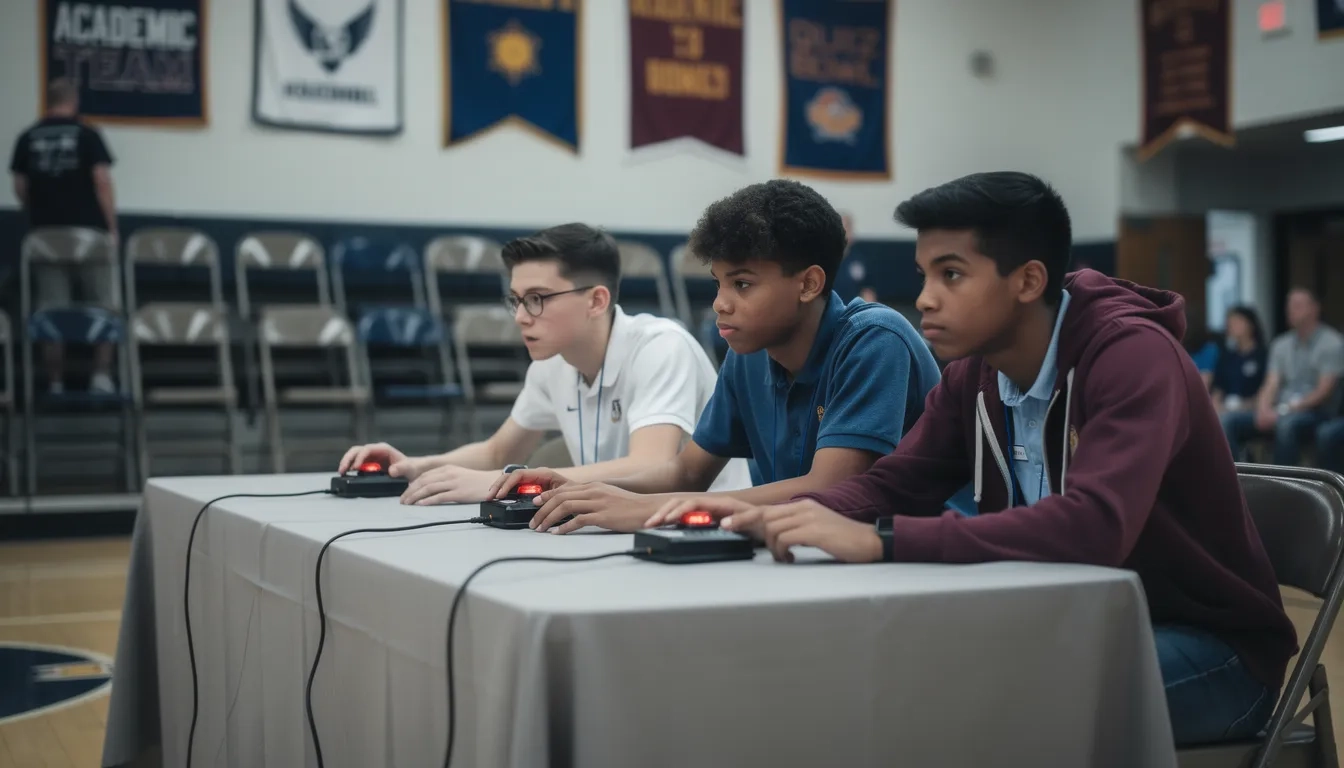
Some quiz bowl teams win national titles with four players and a $300 buzzer set bought through a PTA grant. Others dissolve after three practices. The difference almost never comes down to raw intelligence. It comes down to whether whoever started the team did three specific things in the right order — and understood what they were actually building before they asked anyone for money.
What Quiz Bowl Actually Is (and Isn't)
Most people picture a game show. That framing sells it short.
Quiz bowl uses a pyramidal question structure: questions start with obscure, specific clues and get progressively easier as the reader goes. The first player who recognizes the answer buzzes in and locks everyone else out. This design rewards genuine knowledge over reflexes — someone who actually read the primary sources answers before the easy clue arrives, while someone who just memorized a Wikipedia summary gets locked out.
A standard NAQT match uses 20 tossup-bonus pairs per round. A tossup worth 10 points is read to both teams simultaneously. Whoever buzzes first and answers correctly earns the points, then their team gets a three-part bonus worth up to 30 additional points. One round runs about 20–22 minutes.
The subjects covered span literature, science (biology, chemistry, physics, math), history, fine arts, social sciences, philosophy, and geography. Around 90% of content comes from core academic disciplines — not pop culture trivia, not sports stats.
Quiz bowl rewards the depth of your reading, not the speed of your buzzer finger.
One misconception worth clearing up immediately: you don't need encyclopedic genius to start a team. The president of the Long Island Quiz Bowl Alliance openly described himself as a C student. Enthusiasm and consistent study habits beat raw ability every time.
Recruit First, Then Ask for Permission
This is the step most founders skip, and it kills teams before they start.
Find interested students before you talk to anyone in administration. Schools take club requests more seriously when there's already a group behind them. A meeting request from a solo student asking for $400 in buzzer funding reads very differently than a proposal backed by 12 students who've already been meeting informally.
Word of mouth outperforms posters. Tell your friends, ask teachers to mention it in class, post in school-specific social media groups. Cast the net wide.
When recruiting, think about coverage, not credentials. The strongest quiz bowl teams aren't four students who are all great at history. They're teams where one person owns science, another owns literature, another covers fine arts, and someone else handles world history. Two all-stars in the same category will consistently lose to a balanced squad. Diverse knowledge is the actual competitive advantage.
A few things worth knowing about recruitment:
- GPA predicts almost nothing about quiz bowl ability. Enthusiasm and reading habits predict a lot.
- Students already passionate about any specific topic — architecture, mythology, jazz, whatever — are great candidates.
- Athletes and musicians who don't do other academic clubs are often the most untapped pool.
- Teams that accommodate everyone, even running two practice rooms at once, grow faster than those with strict roster caps.
Getting Official: Advisors, Proposals, and Budgets
A faculty advisor is not optional at the high school level. Someone needs to sign field trip forms, arrange transportation to away tournaments, and be physically present at events. You can hold informal practices without one, but most sanctioned tournaments require a staff member attached to the program.
Find someone flexible and curious, not necessarily an expert in the subject matter. A biology teacher who's willing to study literature bonus questions alongside the team is more useful than a history teacher who'll only help with their own specialty. The job is roughly 80% logistics and 20% academic guidance.
Once you have a core group and an advisor, write a short proposal for administration. Keep it concrete and lead with the numbers:
- What quiz bowl is — one paragraph, mention the pyramidal format and NAQT
- How many students are already interested (name them)
- Where and when you'll practice
- A clear budget split between startup costs and annual costs
That last point matters. Startup costs are a one-time ask. Annual costs are an ongoing conversation. Presenting them separately makes the initial request easier to approve.
| Cost Type | What It Covers | Typical Range |
|---|---|---|
| Startup | Buzzer system (8-player) | $275–$350 |
| Annual | Tournament entry fees | $50–$150 per event |
| Annual | Transportation to away tournaments | Varies |
| Annual | Practice question packets | Usually free online |
Schools vary enormously in funding. Some cover everything. Some offer a partial stipend. Some give nothing. Teams that receive no school funding still compete regularly — it's harder to recruit, but it's done constantly across the country.
Equipment and Free Practice Resources
A buzzer system is the only piece of hardware you actually need. Every other resource — questions, rules, strategy guides, community forums — is free online.
NAQT (National Academic Quiz Tournaments) doesn't sell buzzers directly, but their website lists approved suppliers. A basic 8-player system typically runs $275–$350 new. It lets multiple players buzz simultaneously, locks out everyone else after the first signal, and requires the moderator to reset before each new question.
For practice questions, the Quizbowl Packet Archive at quizbowlpackets.com hosts thousands of free tournament packets. Start with NAQT novice sets and middle school packets — they're calibrated for newer players and won't destroy confidence in week one.
PACE (Partnership for Academic Competition Excellence) runs the Quizbowl Resource Center forums at hsquizbowl.org, where coaches and experienced players share advice and post tournament announcements. Join it early. You'll find answers to questions that aren't written down anywhere else.
A practice structure that works for most new teams:
- Tossup-only rounds (30 minutes) — builds individual buzzer recognition skills
- Full tossup-bonus rounds (30 minutes) — simulates real match conditions
- Subject drilling (15–20 minutes) — players focus on their specialty categories
- Debrief: review missed answers, note unfamiliar topics, assign independent reading
Most teams meet once or twice a week. National-caliber programs practice four to six hours per week across two or three sessions — but that's a goal for year two, not week one.
Your First Tournament (Losses Included)
Sign up early. Tournaments fill up, especially fall invitational circuits.
Expect to lose your first several tournaments. This is not a problem. It's the curriculum. Every team that now wins regional championships started by getting outscored 380–80 in round one. Competition teaches things that practice cannot: which categories disappear under pressure, how your players handle timing against fast opponents, and how it feels to convert a bonus chain when you've been down all game.
NAQT's website lists sanctioned tournaments by state and level (middle school, high school, college). PACE lists additional invitational and circuit events. Regional alliances — the Long Island Quiz Bowl Alliance, the Illinois Quiz Bowl Alliance, and several others — maintain their own calendars of local events that are cheaper and geographically closer, making them ideal for new teams.
The mistake new teams make most often: waiting until they feel "ready." Set a concrete goal for your first season instead. Score at least one tossup in every round. That's the bar. Low enough to achieve, specific enough to measure, and it builds the foundation for everything after.
Building a Team That Survives Graduation
The hardest part of running quiz bowl long-term isn't getting good. It's staying functional when your best players walk across a stage and leave.
Recruit new members every year, even when the roster feels strong. Varsity-heavy teams that stop developing younger players will graduate their entire depth in a single spring. Build a junior varsity or novice tier from the start. Let beginners compete in easier tournaments with coaching support before they face the varsity circuit.
Study habits that compound over time:
- Keep notebooks of unfamiliar answers encountered in practice — specific names, dates, terminology — not just subject categories
- Read primary sources in your specialty rather than summaries alone. PACE's coaching guides specifically note that students who read actual novels, history books, and art criticism retain material better and answer with more precision under pressure
- Write practice questions in your strongest subjects. It sounds counterintuitive, but PACE recommends this for advanced development because constructing a pyramidal question forces you to understand a topic from hardest clue to easiest — which requires genuine comprehension, not pattern recognition
Use Buzzin.live for remote practice when in-person meetings aren't possible. It replicates the buzzer-lockout mechanic through a web interface and works well for smaller sessions.
One honest position worth stating clearly: quiz bowl is a better long-term investment of student time than most narrow subject competitions, because it rewards intellectual breadth over specialized drilling. CollegeVine notes that admissions officers flag it as unusual precisely because it demonstrates curiosity across multiple disciplines — not just depth in one lane. Students who compete for two or three years consistently report stronger reading comprehension and faster synthesis of unfamiliar material. Those skills transfer.
The teams that last aren't the ones with the most talent in year one. They're the ones with a coach who stays curious, a team culture where studying feels more like a habit than a chore, and a recruitment pipeline that doesn't depend on any single graduating class.
Bottom Line
- Recruit students before approaching administration — 10 to 12 interested names in a proposal is far more persuasive than a solo request.
- Find a flexible faculty advisor first; they handle the logistics that students legally can't.
- Budget $275–$350 for a buzzer system as your only required startup cost; practice question archives are free.
- Enter a tournament by month two or three of existence — early losses teach more than extra practice.
- Start a junior varsity pipeline immediately so the team survives graduation cycles without rebuilding from scratch.
Quiz bowl rewards consistent, curious study over time. A team that shows up twice a week and actually likes the material will outperform a more talented team that treats practice like homework.
Frequently Asked Questions
How many students do you need to start a quiz bowl team?
A competitive squad needs four players, with two or three alternates for tournament flexibility. For the initial club proposal, aim to recruit at least 8–10 interested students before approaching administration — more names makes for a stronger request and gives you coverage if players can't make a given tournament.
Is quiz bowl the same as Scholastic Bowl or It's Academic?
They're closely related but not identical. Scholastic Bowl often refers to IHSA-style Illinois competition with some format differences; It's Academic is a regional TV format with its own rules. Quiz bowl as used by NAQT and PACE refers specifically to pyramidal-format tossup-bonus competition. Before entering tournaments, confirm which ruleset applies so you're practicing the right format.
Does a student need high grades to be good at quiz bowl?
No. Enthusiasm and reading habits matter far more than GPA. The president of the Long Island Quiz Bowl Alliance described himself as a C student. The players who improve fastest are the ones who find the subject matter genuinely interesting, not the ones with the cleanest transcripts.
What's the difference between quiz bowl and a regular trivia game?
The pyramidal format is the key distinction. A trivia question asks "Who wrote Crime and Punishment?" and everyone hears the same clue at once. A quiz bowl question opens with specific details about Dostoevsky's sources, themes, and writing process before mentioning the title — someone who actually read the novel buzzes in early, while a casual guesser gets locked out before the obvious clue arrives. It systematically rewards depth over luck.
Can you start a team without school funding?
Yes, and many teams do. The startup buzzer cost ($275–$350) is manageable through fundraising, student contributions, or a booster parent covering it as a donation. Tournament entry fees of $50–$150 per event are often covered by small fundraisers or team dues. Lack of school funding makes recruiting harder but doesn't prevent competition.
Where do you find tournaments to enter as a new team?
NAQT lists sanctioned tournaments by state at naqt.com. PACE lists additional events at pace-nsc.org. Search for your state's quiz bowl alliance (many have dedicated websites) for local invitational calendars. The hsquizbowl.org forums have an active tournament announcements section that's worth checking monthly.