How to Study Mathematical Proofs (Without Losing Your Mind)
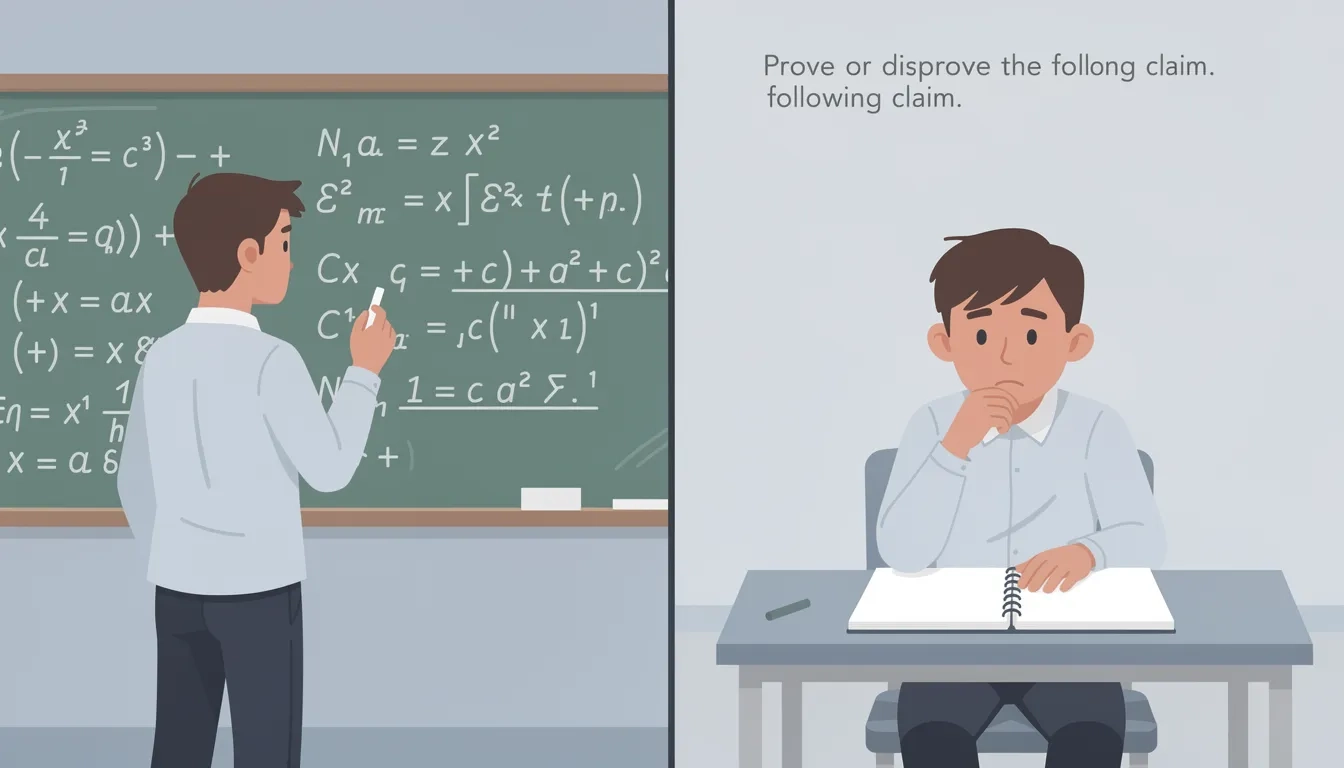
Most students hit the same wall around their second year of college math. Calculus felt hard, sure, but eventually you practiced enough problems and things clicked. Then a professor hands you a proof-based course — real analysis, abstract algebra, discrete math — and suddenly the rules have changed completely. No formulas to plug in. No answer key. Just a blank page, a theorem, and the expectation that you'll show it must be true. Every single time.
The students who break through this wall are not more talented. They just figured out, earlier than most, that proofs require a fundamentally different skill set — and that skill set is learnable.
Why Proofs Feel Different From Every Math You've Done Before
Up through calculus, math is mostly computational. You're doing things: integrating, factoring, solving. Proofs ask something different. They ask you to argue — to justify why something must be true in all cases, not just the handful you tested.
The shift from computation to argument is what trips up students who were previously excellent at math. The complaint is always the same: "I understand the material, but I can't write proofs." This is almost always a sign that the understanding isn't as deep as it feels. That's not a criticism. It's fixable.
Here's the distinction worth burning into your brain: understanding a proof means you could reproduce its logic from memory, explain each step to someone else, and apply similar reasoning to a related theorem. Memorizing a proof means you can reproduce its symbols without any of those things. The gap between these two states is where most students live, and moving across it is what studying proofs is actually about.
Start With Definitions, Not Theorems
Here's something that surprises most people new to proof-based math: definitions are the raw material of every single proof. You cannot prove anything rigorously without first translating your assumptions into formal language.
Professor Joseph Gallian at the University of Minnesota Duluth gives students one piece of advice that applies across almost every proof course: before you attempt a proof, write down the formal definition of every term in the problem. An "even integer" becomes $n = 2t$ for some integer $t$. A "rational number" becomes $n = a/b$ with integers $a, b$ and $b \neq 0$. This isn't bureaucratic box-checking — it's how you convert vague intuitions into tools you can actually use.
The second thing to nail before touching a proof is the logical structure. Most theorems are "if P, then Q" statements. Get absolutely clear on which part is P (your assumptions) and which part is Q (what you need to show). Confuse the two and you'll spend 45 minutes proving the wrong thing. It happens more than anyone admits.
The Four Proof Methods — A Decision Guide
There are four proof techniques that cover the vast majority of undergraduate mathematics. Knowing when to reach for each one is a skill in itself.
| Method | Reach for it when... | Common trap |
|---|---|---|
| Direct proof | P → Q follows naturally step by step | Losing track of the goal mid-argument |
| Proof by contradiction | Assuming ¬Q quickly leads somewhere absurd | Accidentally using Q itself (circular reasoning) |
| Proof by contrapositive | P → Q is hard; proving ¬Q → ¬P is cleaner | Forgetting to negate both sides correctly |
| Proof by induction | Statements about all natural numbers n ≥ k | Writing a weak inductive hypothesis that doesn't go through |
The choice isn't always obvious, but there are reliable clues. If a theorem quantifies over all integers above some threshold, induction belongs on your short list. If the conclusion is a negative claim ("no largest prime"), try contradiction. If the "if" side of an implication is messy but the "then" side is clean, try flipping it with the contrapositive.
One non-obvious rule for "if and only if" proofs: resist the urge to prove both directions simultaneously. Write two completely separate arguments — one for each direction. Students who try to chain both into a single proof introduce errors that are genuinely hard to find later.
And for "or" statements: to prove "A or B," assume A is false and prove B. You only need one. Knowing this saves real time on a surprising range of problems.
How to Read a Proof You Don't Understand
Published proofs skip steps. Always. Not to confuse you — but because a proof that justified every single move would be 40 pages long and unreadable. Undergraduate textbooks regularly leave 2-to-3-line gaps that students are expected to fill in.
When you hit a step you can't follow, here is a three-part approach drawn from research on proof comprehension published in the International Journal of Research in Undergraduate Mathematics Education:
- Try to prove the theorem yourself first, before reading the proof at all. Even 15 minutes of failed attempts tells you exactly where the hard parts are.
- Identify the proof's skeleton. What is the overall strategy — direct argument, induction, case split? Knowing the framework before reading line-by-line changes what you absorb.
- Fill in every "it follows that." When a proof says "clearly" or "it is easy to see," treat that as an exercise. Write out why that step is true before moving on.
The fastest way to understand a proof is to try to break it first. Attempt to disprove the theorem, hunt for a counterexample, test boundary cases. When your counterexample fails, you'll see exactly where the proof gets its strength.
This adversarial reading approach builds intuition faster than passive reading by a significant margin. Most courses don't teach it explicitly — but the students who discover it on their own tend to pull ahead quickly.
A Practice Routine That Actually Builds Skill
There's a pattern among students who get good at proofs quickly, and it doesn't look like what most people expect. It's less about reading more and more about reading strategically.
Here is the loop:
- Cover the proof in your textbook with your hand
- Write down only the theorem statement
- Try to prove it yourself, using only your notes on definitions
- Compare your argument to the textbook proof, line by line
The first several times you do this, you will not finish the proof. That's the point. You're identifying the exact step where your reasoning breaks down. That gap — not the whole proof — is what you study next.
A student who writes 4 proofs per week across a 14-week semester will have attempted 56 proofs by finals. That's enough volume to recognize most foundational proof patterns by instinct. Students who read their textbook but never write full arguments from scratch don't build that instinct, no matter how many pages they cover.
Start with the simplest proofs in each section before moving to harder ones. This sounds obvious but gets ignored constantly. Foundational pattern recognition — learned on simple cases — is exactly what makes harder proofs tractable.
The Mistakes That Keep Students Stuck
Some mistakes come up so consistently they're worth naming directly.
Not using all the hypotheses. If you finish a proof and didn't explicitly use one of the given conditions, you almost certainly made an error. Every hypothesis in a theorem is there for a reason. After writing a proof, go back and check each assumption: where did I use this?
Treating examples as proofs. Three numerical examples can guide your intuition brilliantly and still prove nothing. Examples show a pattern; proofs explain why the pattern holds for all possible cases. The elephant in the room for many early proof students is that they've been rewarded for examples in prior courses and haven't fully switched modes.
Charging in without a plan. Writing symbols before knowing your destination is how students end up going in circles. Before you write "Proof:", sketch a one-sentence strategy in plain English. "I'll assume the conclusion is false and derive a contradiction." That sentence is your anchor.
Getting quantifier negations wrong. The negation of "for all $x$, $P(x)$" is not "for all $x$, not $P(x)$." It's "there exists an $x$ such that not $P(x)$." Getting this backwards corrupts proofs by contradiction before they start, and it's far more common than professors let on.
Resources Worth Your Time
A few honest recommendations.
Daniel Velleman's How to Prove It (Cambridge University Press, currently in its 3rd edition) is the single best transition text for students moving into proof-based math. It teaches the machinery behind proof construction — how to turn a vague mathematical intuition into a valid formal argument. Work through it with a pencil. Not just your eyes.
For practice problems, the best source is whatever textbook you're already using. But work the exercises in full writing, including the ones marked "easy." A proof you can mentally wave away and a proof you can actually write are two different things, and the gap between them shows up on exams.
Math reading is slow by design. A pace of 4-6 pages per hour is normal for difficult proof-based texts (and I mean genuinely engaging with each step, not just moving your eyes down the page). Students who budget 40 minutes for a 25-page chapter and then wonder why they're lost are fighting the nature of the subject.
Group work helps more in proof-based courses than in computational ones — not because you can divide the labor, but because explaining a proof out loud to another person reveals gaps in your understanding that silent studying never surfaces.
Bottom Line
- Learn every definition cold before attempting any proof. Formal definitions are your tools; you can't build without them.
- Try to prove a theorem before reading the proof. Failed attempts teach you more than passively reading the solution ever will.
- When reading, identify the overall proof strategy first — skeleton before details.
- After every proof you write, verify you used all the hypotheses. Unused assumptions almost always signal an error.
- The most important habit shift is from reading math to doing math — pen in hand, attempting arguments, comparing them to the book, identifying exactly where they break.
Proof-writing is not a talent. It's a craft. And like most crafts, it responds to deliberate practice more than to raw intelligence.
Frequently Asked Questions
How long does it take to get good at writing proofs?
Most students need one to two full semesters of proof-intensive coursework before proofs start to feel manageable. The first course is often brutal — this is completely normal. Improvement tracks how many proofs you actually attempt, not how many you read, so volume of practice matters more than anything else in the early stages.
Should I memorize proofs or focus on understanding them?
Understanding wins every time. Memorized proofs fall apart the moment an exam tweaks the hypothesis or asks for a related but different result. Aim to understand each proof well enough that you could reconstruct it from scratch given only the definitions and the theorem statement. That's the test worth holding yourself to.
Do I need to study logic before taking a proof-based math course?
A working knowledge helps a lot, but you don't need to become a logician. The specific things to be comfortable with: "if-then" statements and their contrapositives, "for all" and "there exists" quantifiers and how to negate them, and how to parse statements with AND/OR connectives. A few hours with the first chapter of Velleman's How to Prove It covers most of what you need before day one of a proof course.
What's the biggest myth about proof-writing ability?
That it's a natural talent you either have or don't. This is genuinely false. What looks like raw ability in strong proof-writers is almost always the product of more reading, more failed attempts, and more written proofs than they're willing to advertise. Students who wait passively for insight to arrive will wait a long time. Students who grind through failed attempts tend to get there.
How do I know when my proof is actually complete?
Ask four questions: Did I clearly state what I'm assuming? Did I use all the given hypotheses? Does each step follow logically from the one before it? Did I end with an explicit statement of what was shown? If you can answer yes to all four, the proof is likely complete. Formal markers help too — begin with "Proof:" and end with □ or Q.E.D. The structure signals to yourself and your reader that nothing was left open.
What should I do if I'm completely stuck on a proof?
Try three things in order. First, test a few specific examples to build intuition about why the theorem is true. Second, try to disprove it — hunt for a counterexample. When your counterexample fails, you'll often see exactly what makes the theorem work. Third, work backward from the conclusion: what would need to be true one step before the final line? Then two steps before? This backward chaining from the goal often connects with your forward reasoning from the hypotheses.
Sources
- How to Study Mathematics — University of Houston
- Advice for Students for Learning Proofs — University of Minnesota Duluth
- Proof Writing and Presentation Tips — HWS Mathematics
- The Best Way to Approach Proof-Based Math — Fremont Math Hub
- Effective Proof Reading Strategies for Comprehending Mathematical Proofs — Springer
- How to Prove It: A Structured Approach — Cambridge University Press