IB Diploma vs AP Classes: Which Path Is Better
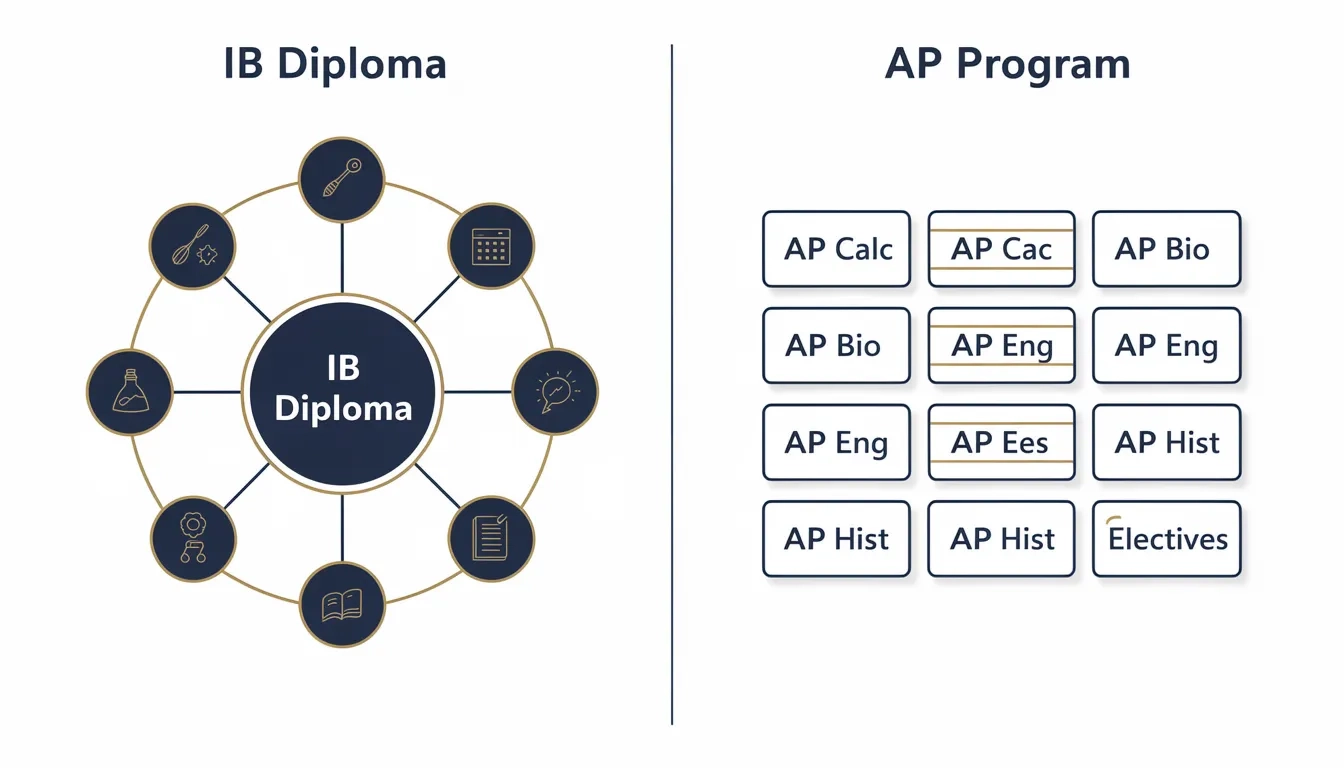
Most students frame this as a college admissions question. Which one do selective schools prefer? Which one looks more impressive? Those are the wrong questions entirely. Admissions offices at Northwestern, Princeton, and MIT all say the same thing on record: they don't prefer one over the other. What they actually care about is whether you challenged yourself within whatever your school offered.
The real choice is about fit — how you learn, what you want from college credit, and whether you're betting on US colleges or casting a wider net. Here's what that actually looks like.
Two Completely Different Products
AP (Advanced Placement), built by College Board starting in the early 1950s, is essentially a menu. You pick the courses you want, take standardized exams each May, and move on. There are 38 courses available. You can take one or twelve. Nobody requires you to study French literature if you're headed for mechanical engineering.
The International Baccalaureate was built on a fundamentally different premise. Founded in Geneva in 1968 and introduced to US schools starting in 1971, the IB Diploma Programme is a two-year package deal. Six subjects drawn from six required groups: language, sciences, math, social studies, arts, and a second language. Three must be studied at Higher Level (HL). On top of that: a 4,000-word Extended Essay, a philosophy-adjacent course called Theory of Knowledge, and a structured block of extracurricular hours called CAS (Creativity, Activity, Service).
AP is modular. IB is a structured whole — you buy the entire program or none of it. That philosophical gap matters more than any single comparison between them.
Workload: The "Which Is Harder" Question
People debate this endlessly. The honest answer: it depends entirely on how many AP courses you're stacking.
One AP course is clearly lighter than a full IB Diploma. Six AP courses is roughly comparable. Stacking 8 to 10 AP courses in a single year rivals IB's demands on sheer volume, though the type of difficulty differs. IB Higher Level courses are consistently ranked as more rigorous than their AP equivalents — internal assessments, emphasis on analytical writing over content recall, and external exams together create something closer to early college work.
IB Standard Level courses, however, often sit below AP difficulty. A student taking SL IB Math Analysis is not in the same academic territory as a student taking AP Calculus BC. The IB label alone doesn't mean harder.
The other factor: IB requires breadth you can't opt out of. A science-focused student still has to fulfill Language and Literature requirements to earn the diploma. AP students can specialize ruthlessly. If you're planning to study engineering and find essay writing painful, this is not a minor detail — it's two years of your life.
One more data point worth knowing: in 2019, roughly 2.8 million students sat for AP exams compared to about 166,000 for IB exams worldwide. That gap reflects scale and design philosophy. AP was built for broad participation. IB is selective by structure.
College Credit: AP Has a Real Advantage Here
For US-focused students, this is where the programs diverge most practically.
AP credit policies are publicly documented at nearly every US college. Score a 4 or 5 on AP Computer Science A at the University of Michigan, and you'll know exactly which intro course you skip. The system is searchable before you ever take the exam.
IB credit is messier. According to data compiled from multiple college policy pages, 1,662 US universities officially recognize IB credentials — which sounds like a lot until you realize nearly all US colleges accept AP scores. And there's a detail most students miss: Standard Level IB courses rarely earn any credit at all. Only HL scores of 5, 6, or 7 consistently translate to credit. So a student who completes the full IB Diploma with three HL and three SL courses may only walk into college with credit from three subjects, not six.
The University of California system is an exception worth knowing. Their "30 for 30" policy awards 20 semester units to diploma recipients who score 30 or above on the IB diploma (out of a maximum 45 points). That's close to a full semester of credit — a generous blanket policy with no AP equivalent at most universities.
Selective private schools like Harvard and Yale typically offer placement rather than credit for both programs. You skip the intro course and take the more advanced version, which matters for intellectual acceleration but won't shorten your degree or reduce tuition.
For most students applying to US schools: AP credit is more predictable and more consistently redeemable. IB can be excellent depending on your score and target institution, but check specific policies at your actual target schools before this becomes a deciding factor.
What Admissions Offices Actually Say
A Northwestern University admissions officer has stated publicly: "One qualification — AP vs IB — is not better than another." That's about as direct as admissions offices get on record.
Survey data backs this up. 85% of selective colleges report that AP experience favorably impacts admissions decisions. But IB diploma holders enroll, persist, and graduate at rates above the national average. Both programs produce results that colleges have noticed and trust.
The framework admissions offices actually use is contextual. They evaluate your transcript against what your school offers. If your school has a full IB program and you opted out to take easier courses, that registers. If your school only has AP, no IB applicant has a structural admissions advantage over you.
One genuine IB edge: international university applications. The IB diploma is recognized at universities across the UK, Canada, Australia, and Europe. AP is primarily a US credential. For students who might apply abroad — or who expect to transfer internationally for graduate school — IB's portability is a real, practical asset.
The Quick Comparison
| Factor | AP | IB Diploma |
|---|---|---|
| US school availability | 22,000+ schools | ~2,000 schools |
| Flexibility | Take any courses, any number | Fixed 6-subject structure |
| Exam cost (2025) | $99 per exam | $119 per exam |
| College credit (US) | Consistent, widely recognized | Variable; HL courses only |
| Difficulty | Scales with number taken | Consistently high overall |
| Global recognition | Primarily US/Canada | Worldwide |
| Self-study option | Yes | No — requires enrollment |
| Research writing | Minimal | 4,000-word Extended Essay |
| Extracurricular requirement | None | CAS hours built in |
That last row deserves more attention than it usually gets.
Who Should Choose Each
Choose AP if:
- You want to specialize in 2–4 subjects and go deep rather than broad
- You're applying primarily to US colleges and want predictable, transparent credit outcomes
- You need schedule flexibility around demanding extracurriculars or other commitments
- You might want to self-study for one or two exams without classroom enrollment
- Budget matters and you'll only be testing in a handful of subjects
Choose IB if:
- You want a structured two-year program that creates intellectual cohesion across subjects
- You're considering universities outside the US, or want credentials that travel internationally
- You thrive in writing-intensive, discussion-based learning
- You want the Extended Essay experience — not just the credential, but the actual research process
- You're comfortable with CAS requirements, or actually want extracurricular structure built in
The IB Extended Essay consistently goes undervalued in this debate. Writing a 4,000-word research paper in high school, supervised by a faculty member, with a defined question and methodology, is closer to what college actually asks of you than any AP exam format. Students who've completed it report feeling noticeably ahead in their first-year writing-intensive courses (particularly in humanities and social sciences). Nothing in the AP program comes close to it.
The Availability Problem
Here's a reality check that cuts through a lot of this discussion. For a large portion of American students, the IB vs AP debate is mostly theoretical.
Over 22,000 US schools offer AP. Roughly 2,000 offer IB. If your school doesn't have an IB program, the choice is made for you. And AP at a school that takes it seriously — where teachers are properly trained and students regularly score 4s and 5s — is genuinely strong preparation for selective colleges.
The access gap also runs along socioeconomic lines. IB programs cluster heavily in wealthier districts and private schools. AP is broadly available at public schools, and the exam fee drops to $35 for qualifying students through fee waivers. A full IB Diploma student can pay over $1,000 in registration and exam fees, though many schools subsidize this.
One option students at IB schools sometimes overlook: taking individual IB courses as a Certificate student without pursuing the full diploma. You get the rigor of HL courses without the diploma requirements. The tradeoff — many colleges distinguish between the Certificate and the Diploma on applications, and the diploma carries meaningfully more weight.
If you're at an IB school and unsure whether you can commit to the full two years, think carefully before you start. The program front-loads commitment. Dropping out after year one leaves you with IB coursework but no diploma — and those two years might have been spent building a cleaner AP record.
Common Mistakes Worth Avoiding
Stacking AP courses for volume is one of the most consistent errors in competitive high school applications. A student with 11 AP exams and mostly 3s is less compelling than a student with 6 APs and strong scores across the board. Admissions offices see through volume and look at performance.
The IB version: attempting the full diploma without fully accounting for the sustained load. The two-year program is not two intense semesters — it's a continuous build. CAS hours, the Extended Essay, and Theory of Knowledge layer on top of six courses running simultaneously. Students who misjudge the cumulative pressure sometimes don't earn the diploma at all. "IB Diploma Candidate (not awarded)" on a transcript is a worse signal than a clean IB Certificate record.
Assuming credit will transfer automatically is the third common mistake. MIT, Stanford, and several Ivy League schools offer no course credit for either AP or IB — only placement. That placement is valuable for acceleration, but it won't shorten your degree. If credit-earning is part of your college cost strategy, check each target school's policy individually before either program influences your decision.
Bottom Line
AP is the right default for most US students. It's widely available, credit policies are transparent and searchable, and it lets you build a schedule around your actual strengths. If you have access to a strong IB program and any academic ambitions that extend beyond the US, take the full diploma and commit to it.
- If you're primarily applying to US colleges: prioritize AP for clearer, more reliable credit outcomes and stronger admissions flexibility.
- If you're considering international schools or want a structured, writing-intensive two-year program: IB offers something AP genuinely cannot match.
- If you're chasing an admissions edge: neither program provides one. Strong performance within either system is what matters, full stop.
- Before choosing based on credit expectations: look up the specific policies at your 4–5 target schools. Credit outcomes vary more than most families realize, and the difference between placement and credit can be significant.
Colleges evaluate you in context. Take the most challenging program your school offers, perform at a high level, and don't exhaust yourself chasing a credential that neither advantages nor disadvantages you at selective schools.
Frequently Asked Questions
Do Ivy League schools prefer the IB Diploma over AP?
No. Harvard, Yale, Princeton, and other Ivy League schools evaluate both programs equally and assess performance in the context of what your school offers. Most Ivies offer placement rather than credit for both AP and IB — you skip intro courses and enter at a higher level, but don't earn credit toward graduation.
Can I take both AP and IB courses at the same time?
Some students at IB schools supplement with one or two AP exams, but this isn't always logistically straightforward. IB schools don't always offer AP prep, and the full IB Diploma already carries a significant workload. If you pursue both, be realistic about total load — stacking on top of the diploma requirements is a choice that can backfire if it pulls your performance down.
Is the IB Extended Essay actually worth the time investment?
Yes, and this is probably the most underrated part of the IB program. A 4,000-word research paper with a faculty supervisor in high school is genuine preparation for college-level academic work. Students who complete it consistently report an advantage in their first year of college writing and research courses. For anyone headed into a writing-intensive major, it's one of the more practical things you can do in high school.
What IB scores do I need to earn college credit?
Most US colleges that award credit for IB require scores of 5, 6, or 7 on Higher Level (HL) courses. A score of 4 earns credit at some less selective institutions. Standard Level courses typically earn no credit at selective schools. The University of California's "30 for 30" policy is an exception — it awards 20 semester units for diploma recipients scoring 30 or above on the full diploma. Always verify policies directly with your target schools.
Does taking AP or IB affect my GPA?
Both programs typically earn a weighted GPA boost at most high schools — commonly adding 0.5 to 1.0 points to a base grade. But selective colleges usually recalculate GPA on their own unweighted or recalculated scales, so the weighted number matters less than students expect. Strong underlying performance in hard courses is what registers, not the GPA label itself.
What if my school only offers one of these programs?
Not a problem. Colleges evaluate transcripts in the context of what your school actually offers. If your school doesn't have IB, no admissions officer penalizes you for it. Taking the strongest AP courses available to you — and performing well — is exactly what selective colleges want to see. The choice only matters when you genuinely have both options in front of you.
Sources
- AP vs IB 2026: Differences, Difficulty & Which to Choose — Fiveable
- What's Better for You: IB or AP? — PrepScholar
- IB vs AP: Which one is better for college admissions? — Shemmassian Academic Consulting
- AP vs IB: Which One Actually Helps More With College Admissions — EduPub
- IB vs. AP: What You Need to Know — Scholarships360