International Olympiad Prep: From First Exam to Gold Medal
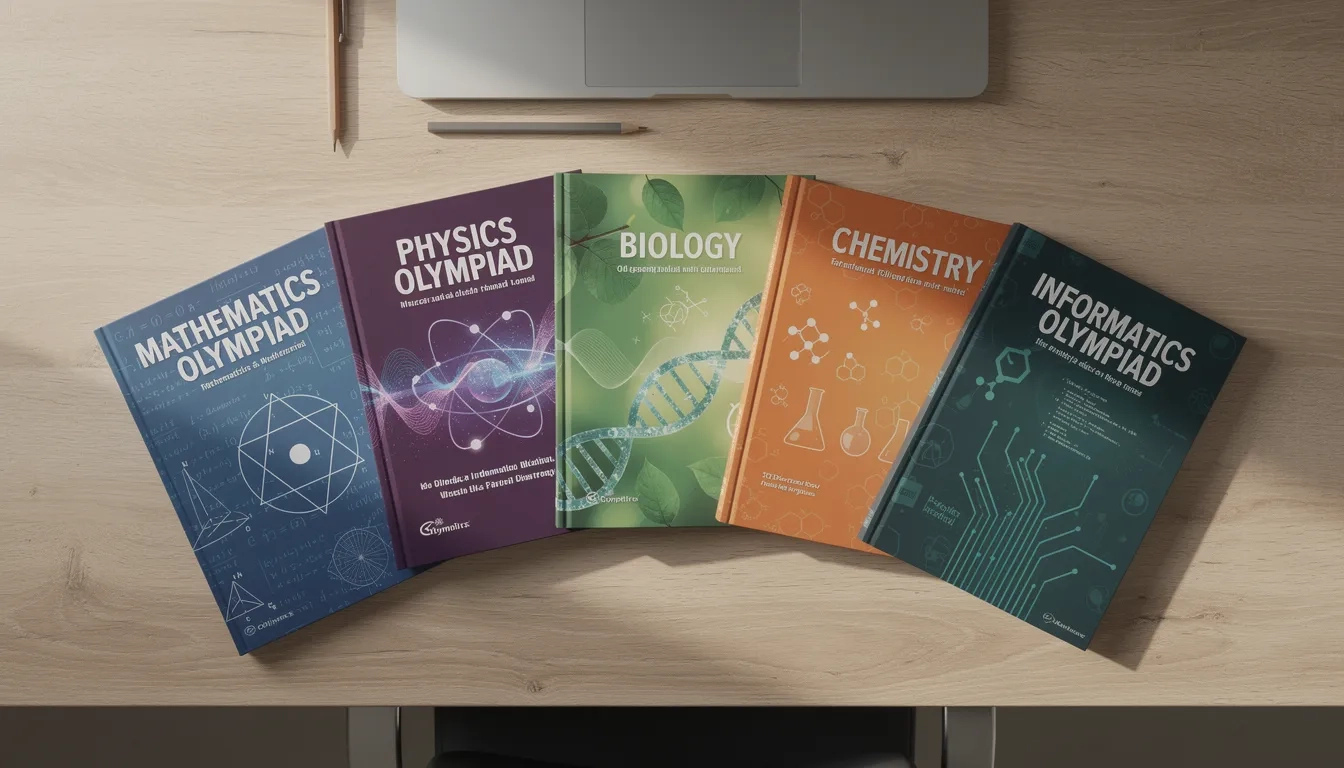
Six students represent the United States at the International Mathematical Olympiad each year. Six, out of roughly 100,000 who sit the AMC exam in the fall, after a five-stage qualification gauntlet, a three-week summer training camp, and year-long team selection tests. That number puts the competition in perspective fast. The students who reach the international stage almost never got there by "studying harder." They got there by studying smarter, earlier, and with a system that matches the actual structure of the pipeline.
The Five Olympiads Worth Knowing
Before picking up a textbook, pick your arena. The major international olympiads cover different disciplines with different formats — and the preparation paths diverge significantly from day one.
| Olympiad | Subject | Format | Team Size |
|---|---|---|---|
| IMO | Mathematics | 6 proof problems over 2 days | 6 students |
| IPhO | Physics | Theoretical + experimental exams | 5 students |
| IChO | Chemistry | Theoretical + lab practical | 4 students |
| IBO | Biology | Theoretical + practical | 4 students |
| IOI | Informatics | Competitive programming, 2 contest days | 4 students |
The IMO rewards creative proof construction — original mathematical arguments from scratch, no partial credit for "almost" answers. The IPhO splits its score between theory and hands-on experimental work. The IOI is essentially algorithmic problem-solving under time pressure, closer to professional software engineering than to a math class.
The IChO does something most students don't realize: the host country releases a set of preparatory problems months before the competition — at least 25 theoretical and 5 practical questions — giving competitors a concrete target to work toward. The 58th IChO heads to Tashkent, Uzbekistan in July 2026, and those prep problems will surface well before summer. For IChO, ignoring that official prep problem set is like showing up to a job interview without reading the job description.
The Selection Funnel: How Countries Pick Their Teams
Every country runs its own internal selection process. The US mathematics pathway is among the most documented, and it illustrates what most national pipelines look like structurally.
The US pathway from AMC to IMO:
- AMC 10/12 (October–November) — 25 questions, 75 minutes, multiple choice. Roughly the top 2.5% of AMC 10 takers and top 5% of AMC 12 takers advance.
- AIME (February) — 15 problems over 3 hours. Answers are integers from 000 to 999. No multiple choice, no partial credit.
- USAJMO / USAMO (April) — About 500 students qualify. Six proof-based problems across two days, 4.5 hours each.
- MOP (June) — The Mathematical Olympiad Program selects roughly 60 students for a three-week summer training camp, organized into competitive tiers.
- Team Selection Tests — Multiple rounds of proof-based exams through the year narrow everything down to 6.
The qualification index that determines USAMO eligibility weights the AMC score and AIME score together, with the AIME carrying significantly more influence. Which means AIME performance is the single biggest checkpoint most students face — not the AMC.
For science olympiads in the US, the pipeline runs through the F=ma exam (IPhO pathway) or the US National Chemistry Olympiad (USNCO) for IChO. India routes through the IOQM, NSEP, and NSEC as first-stage filters. Regardless of country, the structure is the same: a series of escalating national competitions culminating in a training camp before the international round.
What to Study and When: Two Phases, Not One
Serious olympiad preparation has two distinct phases. Mixing them up is one of the most common planning errors students make.
Phase 1 — Foundation Building (6–18 months before competition)
For IMO, this means working systematically through the four core areas:
- Algebra — functional equations, inequalities, polynomial techniques
- Combinatorics — pigeonhole principle, double counting, generating functions, graph theory
- Number theory — modular arithmetic, Diophantine equations, the Lifting the Exponent Lemma
- Geometry — cyclic quadrilaterals, projective methods, power of a point
MIT professor and former IMO silver medalist Yufei Zhao posts his full olympiad training handouts at yufeizhao.com. They're free, cover all four areas at competition depth, and are the same materials he uses with advanced students. His own starting recommendation for beginners: "Cyclic Quadrilaterals — The Big Picture and Three Lemmas in Geometry." That's a specific enough pointer to actually act on.
For IPhO, foundation work means going beyond AP Physics — deep into mechanics, electromagnetism, thermodynamics, optics, and modern physics. The experimental component deserves its own study block. (It can determine up to 40% of a student's total IPhO score, which surprises most students who only drill theory.)
Phase 2 — Competition Mode (1–6 months out)
Stop learning new material. Work timed past problems, analyze what you got wrong, and repeat. The ratio should be something like 70% problem-solving and 30% review — not the reverse.
The Skill Nobody Prepares for Until It's Too Late
For math olympiads, the single biggest performance gap between talented students and medalists usually isn't mathematical knowledge. It's proof writing.
"Even if your math is strong, weak proof-writing can cost you 3 out of 7 points on a single problem — the difference between a gold medal and no medal at all."
A student who finds the right approach but presents it loosely will lose points to a student who found the same approach and wrote it with rigorous logical structure. This happens constantly. Proof writing is a skill that requires deliberate practice separate from problem-solving itself: write up complete solutions even when you already know the answer, then compare them against official solutions to find where your reasoning leaked.
The 25-minute rule helps build problem-solving instincts. When you sit down with an unseen olympiad problem, commit to genuine wrestling for at least 25 minutes before looking at hints. Longer if you're making real progress. The discomfort of that struggle is not a signal to quit — it's the actual work.
Keep a mistake notebook. Every problem you get wrong or find a gap in your reasoning gets logged with the specific insight you missed. After a few months, patterns emerge. Maybe you consistently forget to check degenerate cases in geometry. Maybe your number theory proofs break down at divisibility steps. The notebook turns scattered errors into a targeted list.
Resources That Actually Matter
Not all olympiad prep material is created equal. A lot of what surfaces in online searches is pitched at AMC 10 level, not the international stage.
For mathematics:
- Art of Problem Solving (AoPS) — the forums contain thousands of worked olympiad problems with community proofs. The AoPS textbook series covers competition math from introductory to olympiad level with structured exercises.
- Yufei Zhao's handouts (yufeizhao.com/olympiad) — algebra, combinatorics, geometry, and number theory at full IMO depth. Free.
- Past IMO problems — six problems per year going back to 1959. Start with recent years and work backward as your ability grows.
For physics (IPhO):
- Irodov's Problems in General Physics — the benchmark resource. It contains 1,879 problems spanning all major physics topics. Many competitive IPhO students work through the entire book.
- Halliday, Resnick & Krane (Physics, 4th edition) — deeper theoretical treatment than the standard AP-level version.
For chemistry (IChO):
- The official annual IChO preparatory problems, released by the host country. These are not optional — they directly preview the format and topic emphasis of that year's competition.
- Atkins' Physical Chemistry for thermodynamics and quantum content that reaches beyond high school syllabi.
For informatics (IOI):
- USACO (usaco.org) — structured competitive programming with auto-graded problems and a clear difficulty progression.
- Codeforces — volume and rating-based practice once USACO Bronze/Silver are solid.
The Mental Side of a Multi-Year Project
Burnout is the most common reason genuinely talented students never get their shot at the international level. This isn't a minor footnote — it's why preparation culture matters as much as preparation content.
Students who make it through the full pipeline typically share one trait: they stayed curious. They solved problems because they found them genuinely interesting, not purely because a medal was at stake. When you hit the inevitable plateau — six weeks of grinding number theory with no visible improvement — that orientation is what keeps you going. The plateau usually means the brain is consolidating, not stagnating. The breakthrough tends to come in a single afternoon, from work done weeks earlier.
Find other people in the same pursuit. The AoPS forums, national training camps, local math circles, and school clubs serve a real social function: they give you peers who understand what you're working on. Preparing in isolation is measurably slower than preparing inside a community.
One honest assessment worth stating plainly: most IMO gold medalists began serious competition math before age 13. That doesn't mean late starters can't succeed at the national or international level — they can, and they do. But it does mean starting at 16 with the IMO as your target requires efficient, focused preparation rather than broad exploration.
Bottom Line
- Pick one olympiad and build your preparation around its specific format. IMO proof problems, IPhO experimental rounds, and IOI algorithmic contests require completely different training.
- Know your country's national qualification pathway and identify your current bottleneck. In the US, most students should focus on AIME performance before worrying about proof technique.
- Split preparation into two phases: foundation building (learn topics systematically) followed by competition mode (timed past problems, mistake analysis, repeat). Don't blend them.
- Proof writing for math and lab technique for science olympiads are the highest-leverage skills — and the most consistently underprepared. Build them into your schedule deliberately.
- Start early if you can. If you can't, go deep on fewer topics rather than surveying all of them.
Frequently Asked Questions
How early should I start preparing for an international olympiad?
Most students who reach the IMO began competition math in 6th to 8th grade. That said, students starting in 10th grade can still qualify for national olympiads with focused, efficient preparation. The key at that stage is committing to depth — complete mastery of two or three olympiad topics beats shallow coverage of everything.
Is it realistic to prepare without a formal coaching program?
Yes. Many successful olympiad competitors have self-studied entirely. Art of Problem Solving, Yufei Zhao's free training handouts, and the archive of past IMO problems are sufficient for mathematics. What you lose without a program is structured feedback on proof writing — partially offset by posting solutions on the AoPS forums for community critique.
Myth or reality: you need to be a natural "math genius" to qualify for the IMO?
Mostly myth. The students who score a perfect 42/42 at the IMO may have something inexplicable going on, but the vast majority of medalists got there through deliberate, multi-year preparation rather than innate talent. Hard work combined with strategic practice consistently produces results at the national qualifying level.
What's the difference between USAJMO and USAMO?
Both are proof-based competitions feeding into MOP selection. USAJMO is for students in 10th grade or below (under 17.5 years old at the time of the AMC), while USAMO is open to 11th and 12th graders. USAJMO problems are generally more accessible in difficulty. Both count toward MOP selection, though the highest tier (Black) is largely filled from USAMO performance.
How many hours per day should I study for an international olympiad?
During the foundation phase (6+ months out), 90 minutes to 2 hours of focused daily work is effective and sustainable. In the final two to three months before a major qualifying exam, 3 hours is reasonable. Quality matters more than volume — 90 minutes of genuine problem engagement beats three hours of passive re-reading.
Do olympiad results actually affect college admissions?
A USAMO qualification or international olympiad medal carries real weight at top universities, particularly MIT, Caltech, and Harvard, which actively track and recruit olympiad alumni. A national-level finish short of the international team still signals clearly to admissions readers. The effect is strongest in STEM programs but visible broadly across selective schools.
Sources
- The Road to Team USA: From AMC 8 to the International Math Olympiad
- How to Qualify for the IMO in the USA: 5-Step Pathway
- Math Olympiad Training Handouts — Yufei Zhao
- International Physics Olympiad: A Complete Guide — AdmissionSight
- International Chemistry Olympiad: A Complete Guide — AdmissionSight
- International Science Olympiads: Complete Guide for High Schoolers — Rishab Academy