The Complete Lab Report Writing Guide (With Examples)
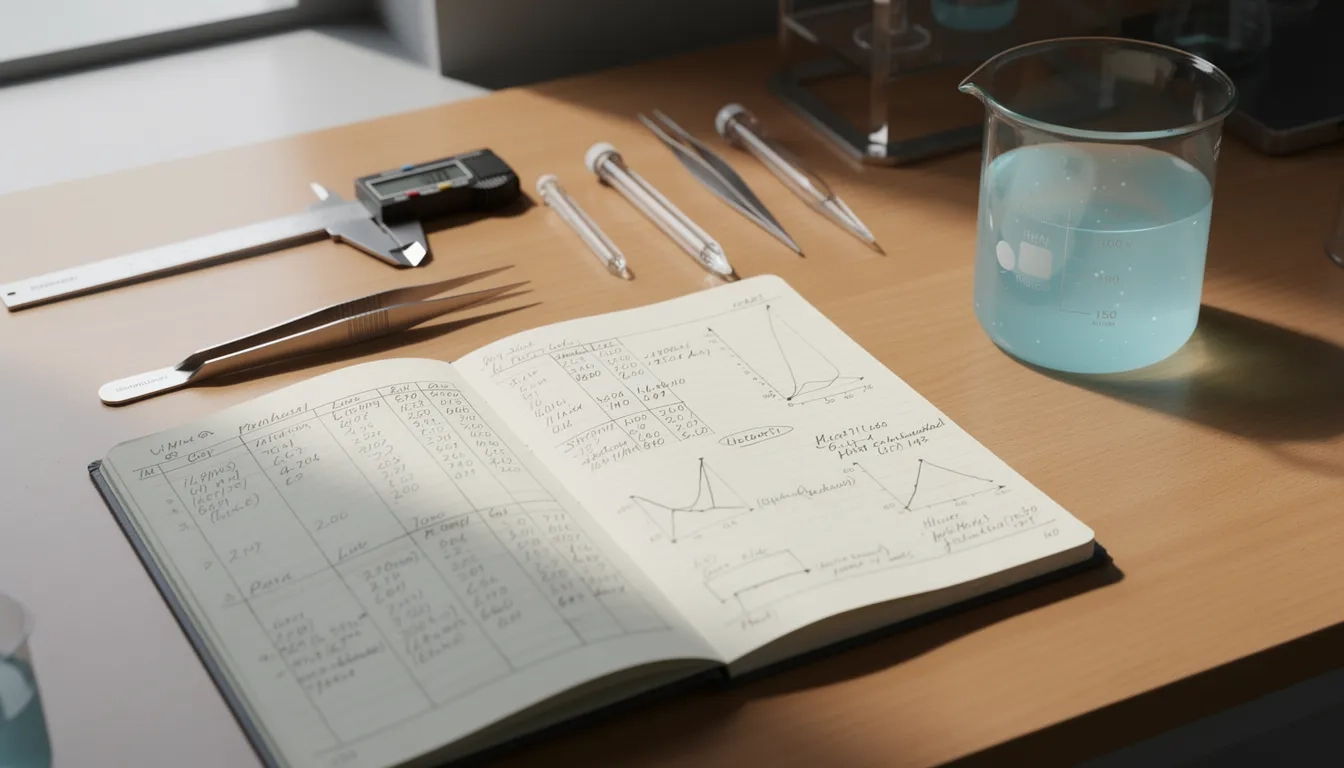
Most students lose lab report points not because their experiment failed, but because they wrote the Methods section like a diary entry and the Discussion section like a shrug. I've read enough of these to know the pattern cold: solid data, mediocre grade, and a professor's red pen circling the same three problems every single time. The fix isn't more effort. It's knowing what each section is actually for.
Why Lab Reports Follow the Same Format Everywhere
Lab reports aren't formatted the way they are by accident. They follow IMRaD — Introduction, Methods, Results, and Discussion — a structure that George Mason University's Writing Center traces back to the scientific method itself, and one you'll see in journals from Nature to your intro chem syllabus.
The logic is simple: the format lets a stranger evaluate your work without ever meeting you. Someone in a different lab, a different country, or a different decade should be able to read your Methods and rerun your experiment exactly. That's not busywork — it's how science checks itself.
Here's the thing most students miss: each section has a different job, and mixing them up is the single most common way to lose points.
- Introduction — why this experiment matters and what you predicted
- Methods — what you did, in enough detail to replicate it
- Results — what happened, with zero interpretation
- Discussion — what it means and whether it supports your hypothesis
As UNC's Writing Center puts it, the Results section should contain findings only — "not any explanation of or commentary on the findings." Save the why for later.
Violate that separation — explain your data inside the Results section, or slip new numbers into your Discussion — and you've broken the format's whole purpose. Graders notice immediately, even if they can't always articulate why the report "feels off."
Section-by-Section: What Each Part Actually Needs
A full lab report typically runs eight sections: Title, Abstract, Introduction, Materials and Methods, Results, Discussion, Conclusion, and References. Not every class requires all eight — some intro courses skip the Abstract or fold Conclusion into Discussion — but the logic underneath stays the same everywhere.
Title and Introduction
Your title should describe the relationship you tested, not just the topic. "The Effect of Temperature on Enzyme Activity in Catalase" beats "Enzyme Lab" every time — it tells a reader what variables were involved before they read a single sentence.
The Introduction has one job most students botch: distinguishing purpose from hypothesis. Your purpose is the broad question ("does temperature affect enzyme activity?"). Your hypothesis is the specific, testable prediction ("if temperature increases from 10°C to 40°C, catalase activity will increase, because higher temperatures speed molecular collisions up to the point of denaturation"). One sentence of purpose, one sentence of hypothesis, then the background that justifies the prediction.
Materials and Methods
Write it in past tense, and pick active or passive voice based on what your instructor wants — just stay consistent. The test for a good Methods section isn't length. It's replicability: could a classmate rerun your exact procedure using only what you wrote?
Quantify everything measurable — 23.4 grams, 37 minutes, 4°C — and cut anything that isn't. Nobody needs to know which shelf the reagent came from.
The Abstract: Write It Last, Keep It Short
Here's a mistake I see constantly: students draft the Abstract first because it's listed first. Don't. You can't summarize a report you haven't written yet, and it shows — abstracts written early tend to ramble into detail that belongs in the Methods section instead.
Class lab reports typically run 100–250 words for the Abstract, with thesis-level or journal submissions stretching to 300. Every abstract needs four things, one to two sentences each:
- Objective — what question you tested
- Method — how, in one sentence
- Key result — the number or trend that mattered
- Conclusion — what it means
Skip citations, skip raw data tables, skip jargon your reader hasn't seen yet. The abstract is often the only section a busy grader or a lab partner rereads in full — a vague one undersells good data, and a sharp one signals rigor before they've read a word further.
Results and Discussion: Don't Confuse the Two
This is where good experiments get bad grades. Results and Discussion look similar on the page but do opposite jobs, and blending them is the error graders flag most.
Results reports. Discussion interprets. Put a number in Results, and the only words allowed near it are units and trend descriptions ("activity peaked at 30°C before declining sharply"). Save "this suggests the enzyme denatured" for Discussion — that's an interpretation, and interpretations belong nowhere else.
| Section | Contains | Tone | Common error |
|---|---|---|---|
| Results | Data, tables, figures, observed trends | Neutral, descriptive | Sneaking in explanations |
| Discussion | Interpretation, comparison to hypothesis, sources of error | Analytical, tentative | Introducing new data |
For tables and graphs, keep it simple. UNC's guide recommends limiting graphs to three to five lines, plotting your independent variable on the x-axis and dependent on the y-axis, and labeling every axis with units. A crowded graph with eight overlapping lines communicates nothing — if you need eight, split it into two figures.
Discussion is also where you address the elephant in the room: results that didn't match your hypothesis. Don't bury them. Name the anomaly, propose a specific mechanism (equipment drift, an unaccounted variable, a timing error), and use tentative language — "suggests," "indicates" — rather than "proves." No experiment, especially an undergraduate one, proves anything in a single run.
Common Mistakes That Sink Otherwise Good Data
I've pulled together the failure patterns that show up across writing-center guides from UNC to smaller physics and biology departments, and they cluster around the same handful of habits.
- Writing the abstract first instead of last, producing a preview instead of a summary
- Overusing passive voice everywhere instead of reserving it for Methods
- Blaming vague culprits — "room temperature" or "human error" — without evidence they actually caused the deviation
- Ignoring contradictory data rather than addressing it directly in Discussion
- Skipping the control's explanation — naming a control isn't enough; say what variable it isolates
- Procrastinating the write-up until details are forgotten (a week later, you won't remember which flask was which)
On voice: the field has shifted. Nature, Science, and NEJM now explicitly favor active voice for clarity, and APA Style tells writers to default to active and reserve passive for when the sentence genuinely needs to spotlight the recipient of an action rather than the actor. The old advice — "always use passive voice in science" — is outdated. Methods sections are still the one place passive voice earns its keep, since nobody cares that "I" heated the beaker; they care that it was heated, to what temperature, for how long.
Formatting, Citations, and the AI Question
Formatting conventions vary by discipline, but a few rules hold almost everywhere. Number every table and figure sequentially, and title each one descriptively enough that it makes sense without the surrounding text — a reader flipping straight to Figure 3 should understand what it shows. Align numeric columns on the decimal point, and skip vertical gridlines in tables; they add visual noise without adding information.
References follow whatever citation style your department uses — APA in psychology and biology, ACS in chemistry, IEEE in engineering. Cite your lab manual if you drew procedure from it, and cite any background sources that shaped your hypothesis.
One thing that's genuinely new since 2024: AI policy. Most universities have moved to a tiered "traffic light" system rather than a blanket ban — green for AI-assisted brainstorming, yellow for AI-polished phrasing with disclosure, red for AI-drafted content submitted as your own. Tools like Turnitin and Copyleaks now claim above 95% accuracy flagging unedited AI text, which means using ChatGPT to write your Discussion section isn't just a risk — it's a bad bet against detection odds that keep getting worse. Use AI, if your syllabus allows it, to sanity-check your outline or catch clunky sentences. Don't use it to generate the analysis. That's the part your professor is actually grading.
Bottom Line
- Draft Methods and Results while the lab is fresh — memory of "which beaker was which" fades within days, not weeks.
- Write the Abstract dead last, and hold it to 100–250 words covering objective, method, key result, and conclusion.
- Never let interpretation leak into Results — if you're explaining why, you're already in Discussion territory.
- Address contradictory or unexpected data directly instead of hoping the grader won't notice.
- Default to active voice outside the Methods section — it's what modern journals and style guides now expect.
The single biggest lever for a better grade isn't better data. It's keeping each section doing only its own job.
Frequently Asked Questions
What's the difference between a hypothesis and a purpose in a lab report?
Purpose is your broad research question — "does light intensity affect plant growth?" Hypothesis is the specific, testable prediction that includes both variables — "if light intensity increases, growth rate will increase, because photosynthesis rate depends on available light energy." Mixing the two up is one of the most common Introduction-section errors.
How long should a lab report be?
There's no universal length — a high school biology report might run two pages, while a university physics report can run ten or more. Length should track content, not padding: enough to make your experiment replicable and your reasoning clear, no filler paragraphs added to hit a page count.
Can I use "I" or "we" in a lab report?
Increasingly, yes. Major journals including Nature now favor active voice, which often means first person, over the older convention of passive-only academic writing. Check your instructor's specific rubric first, since some still require the traditional passive, third-person style throughout.
Do I need a Conclusion section if I already have a Discussion?
Some formats fold them together, and that's fine if your instructor allows it. If they're separate, Discussion does the analytical work — comparing to hypothesis, addressing errors — while Conclusion delivers a short, forward-looking wrap-up, often including a suggestion for follow-up experiments.
Is it okay to have unexpected or "failed" results?
Absolutely — and hiding them is worse than reporting them. Unexpected results, addressed honestly with a plausible explanation in your Discussion, often demonstrate stronger scientific thinking than a suspiciously perfect data set that matches the textbook exactly.
How much of my lab report can I write with AI assistance in 2026?
It depends entirely on your syllabus, since most schools now run a tiered permission system rather than a flat ban. Using AI to outline your structure or flag awkward phrasing is often fine under "yellow" policies with disclosure; submitting AI-drafted analysis as your own thinking almost never is, and detection tools have gotten good enough that it's a real risk either way.
Sources
- Scientific Reports – The Writing Center, UNC Chapel Hill
- IMRaD Writing Structure – UTSA Writing Center
- Writing an IMRaD Report – George Mason University Writing Center
- How to Write a Lab Report Abstract: Examples and Templates
- Active vs Passive Voice in Scientific Writing: A Practical Balance – MDPI Blog
- Academic Integrity in 2026: The Student Guide to Transparent AI Usage