Law School Rankings vs. Employment Outcomes: 2026 Reality Check
For 36 straight years, Yale Law sat at the top of the US News rankings. Then the 2026 list dropped, and Stanford took the crown. The reason wasn't faculty prestige or Nobel Prize lineage. It was employment data. Stanford's graduates landed full-time legal jobs at a 98.4% rate versus Yale's 96.2%, and that narrow gap, multiplied across a methodology that weights outcomes heavily, was enough to end the longest streak in rankings history.
That detail reveals something most applicants never fully absorb: the school with the most famous name and the school with the best employment outcomes are often two different schools.
How the Rankings Formula Actually Works
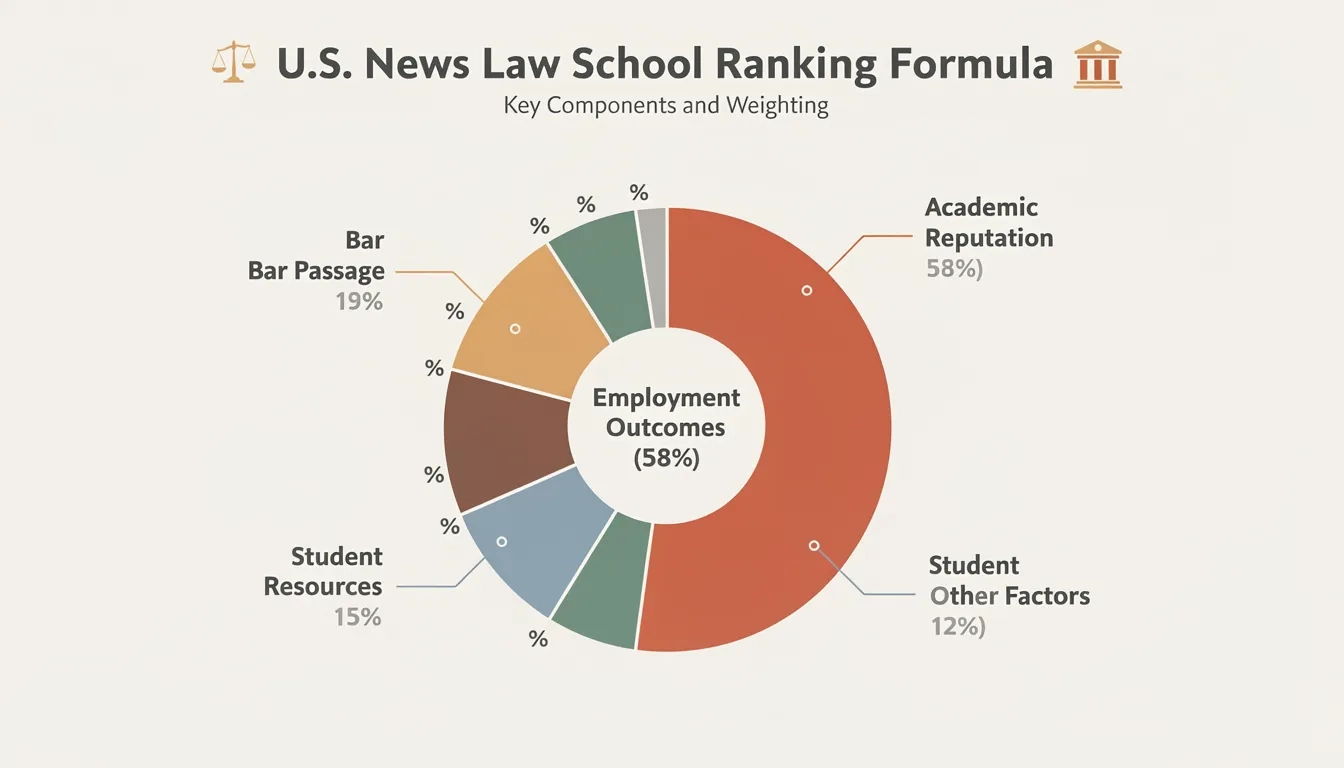
Most applicants assume US News rankings measure institutional prestige. They do, partly. But 58% of the total score comes from employment outcomes and bar passage rates, according to the published methodology. Peer reputation from deans and faculty accounts for 25%. Selectivity metrics like LSAT scores and acceptance rates account for 10%.
Here's the full breakdown:
| Factor | Weight |
|---|---|
| Employment outcomes | 33% |
| First-time bar passage | 18% |
| Ultimate bar passage | 7% |
| Peer assessment | 12.5% |
| Lawyer/judge assessment | 12.5% |
| LSAT/GRE scores | 5% |
| Undergraduate GPA | 4% |
| Acceptance rate | 1% |
| Student-faculty ratio | 5% |
| Library resources | 2% |
The employment metric is specific: it measures graduates in "long-term, full-time jobs requiring or taking advantage of bar passage" within 10 months of graduation. Part-time work and jobs that don't use the law degree don't count.
A school can have brilliant faculty and legendary alumni and still take a significant ranking hit if its graduates aren't landing legal jobs 10 months out.
When Prestige and Employment Rankings Point in Opposite Directions
Sort law schools by employment outcomes alone and the list looks almost nothing like the overall rankings.
Texas A&M leads the country with a 100.00% employment rate in TaxProf Blog's preview of the 2026-27 employment rankings. Washington University in St. Louis sits second at 99.82%, Virginia third at 98.98%. These aren't household names in the same way Harvard or Yale are.
Now look at where some famous institutions rank on employment specifically:
- Yale: ranked 40th in employment, at 95.21%
- Harvard: ranked 37th, at 95.50%
- Columbia: slipped to 22nd at 96.93%
None of those numbers are embarrassing. Getting 95% of graduates into legal jobs is solid work. But the gap between ranking second overall and ranking 40th on the metric that makes up a third of your score is a meaningful disconnect.
George Washington tells the most dramatic story. It jumped from employment rank 38 to rank 9 in a single cycle, moving from 93.83% to 98.45%. Schools with strong local legal ecosystems and good connections to regional legal employers can outrun institutions with far greater name recognition.
BigLaw Placement: The Number That Actually Moves Salaries
The national median starting salary for 2024 law graduates was $95,000. That sounds reasonable. The distribution behind it is stark.
About 50% of graduates earn between $60,000 and $85,000, while roughly 23% earn in the $215,000–$225,000 range. Almost nobody lands in between.
That gap exists because of BigLaw. Firms with 500+ attorneys pay first-year associates around $215,000. Everyone else earns regional market rates, which in smaller cities can run $65,000-$80,000. So the question isn't "what's the average salary at this school" but "what percentage of graduates actually get BigLaw offers."
BigLaw placement rates from 2025 ABA employment data compiled by HeyFutureLawyer.com break down like this:
- Duke: 70.87%
- Columbia: 70.09%
- Northwestern: 67.42%
- Penn: 67.06%
- USC: 58.59%
- Stanford: 45.26%
- Yale: 31.43%
Yale at 31%? For the school that just won the #2 ranking spot? The explanation is that Yale and Stanford graduates disproportionately pursue federal clerkships and public interest work. Yale sends 23.33% of graduates to clerkships. That's not a failure. But if your goal is BigLaw, your school's specific track record on that path matters far more than its overall rank.
About 14% of law graduates nationally land BigLaw positions. At T14 schools, the average hovers around 52%. Regional schools typically place 5-15%, and lower-ranked schools often sit under 5%.
The practical implication: choosing between a lower-ranked school with strong regional BigLaw placement and a higher-ranked school where most graduates pursue public interest careers requires knowing this data, not just the single number on the rankings list.
Bar Passage: The Underweighted Metric Worth 25% of Your Score
Bar passage rates collectively count for 25% of the US News score. Most applicants treat this as a rough quality signal. It's more nuanced than that.
US News uses an adjusted bar passage rate, comparing each school's results to the overall passage rate in every state where its graduates sit for the exam. This adjustment matters because California's bar exam has a lower passage rate than most states. A school sending a lot of graduates to California faces steeper adjusted numbers even if those graduates are well-prepared.
Stanford's adjusted rate of 114.20% means its graduates passed 14.2 percentage points above their state average. First in the country for the Class of 2025, according to TaxProf Blog's analysis. Belmont University (113.11%) and SMU Dedman (112.97%) follow.
Several prestigious schools underperform relative to their overall reputation on this metric:
- Columbia ranks 40th in adjusted bar passage at 102.86%
- Cornell ranks 43rd at 101.56%
- Northwestern ranks 45th at 101.17%
These schools still beat their state averages. But the margins are thin, and schools in high-baseline states benefit from the adjustment in ways that skew the comparison.
At the bottom, the numbers are alarming. Thomas M. Cooley Law School ranked 194th with an adjusted rate of 28.57%. Appalachian School of Law came in at 28.83%. These schools place graduates well below their jurisdiction averages. You cannot practice law without passing the bar, which makes these numbers a fundamental due diligence item before enrolling anywhere.
The T14 Is Fracturing, and That Matters for How You Apply
For decades, the "T14" functioned as a near-official category. The same 14 schools, roughly the same order, year after year. Applicants treated admission to any T14 as a guaranteed pathway to elite legal employment.
That's no longer accurate. UC Berkeley dropped to #16 in the 2026 rankings. Georgetown fell to #18. Law professor Derek Muller was blunt after the rankings released: "The T14 should be dead. People keep using it, but there is no longer that lock."
For five consecutive years, some of the schools traditionally occupying the top 14 haven't been in those spots. Cornell jumped five places to return to the upper tier based primarily on employment metrics. Employment-focused schools that were never considered elite are pushing into territory previously reserved for brand-name institutions.
The "T14 premium" in BigLaw recruiting is real but shrinking. Firms still show up disproportionately on campus at elite schools. But legal hiring has diversified. Legal technology firms, boutique practices, in-house roles, and regional powerhouses don't sort candidates purely by school prestige the way partner-track BigLaw did 20 years ago.
ROI: Where Regional Schools Make the Strongest Case
There is an elephant in the room that most rankings conversations skip entirely: debt. A three-year private law degree at a T14 school can run $230,000-$280,000 in tuition. At a strong state school, in-state students often pay $60,000-$90,000 total.
Schools like the University of Georgia, Brigham Young University, and the University of Iowa score well on ROI analyses despite sitting outside the traditional prestige tier. Their employment rates are strong within their regions, their tuition is a fraction of elite private schools, and their graduates often land in markets where local reputation matters more than national ranking.
The decision framework that actually helps applicants:
- Define your goal before looking at any ranking. BigLaw in New York, a federal clerkship, public defense, or regional practice each have different optimal school profiles.
- Look at employment outcomes in your target geography. A school's overall employment rate tells you less than its placement rate in the city where you want to work.
- Calculate your expected debt-to-income ratio. Carrying $200,000 into a $75,000 public sector job is a structurally different situation than carrying $50,000 into the same job.
- Research bar passage rates specifically. An adjusted rate below 100% means graduates are passing at below-average rates for their state. That's worth investigating before committing.
The 2026 rankings confirm what employment data has been signaling for years: prestige and outcomes are related, but the relationship has never been one-to-one.
Bottom Line
- Rankings and employment outcomes diverge more than most applicants realize. Texas A&M leads the country in graduate employment. Yale ranks 40th on that same metric. Neither fact means what it superficially appears to mean. Context is everything.
- Know which specific metric matters for your career path. BigLaw-focused applicants should pull BigLaw placement rates by school. Clerkship-focused applicants should look at clerkship numbers. The aggregate employment rate averages across all of these, which makes it a blunt tool.
- Run the debt math. A meaningful scholarship to a school ranked #22 with strong regional placement may outperform a full-price school ranked #10 if your career stays in that region.
- The T14 is no longer a stable category. Berkeley and Georgetown both fell outside it in 2026. If you're shaping your entire application strategy around maintaining T14 access, you're working from an outdated map.
Frequently Asked Questions
Is the US News law school ranking actually based on employment outcomes?
Yes, to a significant degree. Employment outcomes account for 33% of the score on their own, and bar passage rates add another 25%, meaning 58% of the total score is tied directly to what happens to graduates after they leave. Peer reputation from other law school faculty accounts for 25%. The ranking is less of a pure prestige measure than most people assume.
Why did Stanford beat Yale in the 2026 rankings for the first time?
Stanford overtook Yale based primarily on employment and bar passage data. Stanford's 2024 graduates had a 98.4% full-time legal employment rate compared to Yale's 96.2%. Stanford also posted an adjusted bar passage rate of 114.20%, tops in the country for the Class of 2025, partly because California's notoriously difficult bar exam earns more credit under the adjusted methodology. Over a ranking formula where those two factors dominate, the gap compounded.
Do BigLaw firms actually care about law school rankings when hiring?
Firms concentrate on-campus recruiting at a small set of schools, and historical prestige shapes which campuses get visits. But rankings don't map cleanly onto BigLaw placement rates. Duke places 70.87% of graduates in BigLaw at an overall ranking of #12. Yale places 31.43% at the #2 spot, largely because its graduates pursue clerkships and public interest work instead. Firms care about specific school reputations within legal hiring circles, not just the number on the annual list.
Is the T14 still a useful concept for applicants?
It's becoming misleading. Berkeley dropped to #16 and Georgetown fell to #18 in 2026, continuing a five-year pattern where the traditional top-14 schools no longer hold those positions exclusively. The more useful approach is to research specific employment and placement metrics for the schools you're considering rather than sorting by a categorical label that wasn't stable to begin with.
What's the biggest mistake applicants make when reading law school rankings?
Treating a single overall number as predictive of their individual career outcome. A school ranked #15 overall might rank #5 in BigLaw placement or #38 in federal clerkships, depending on its graduate profile. The overall ranking is an average across every career path in the data, and it flattens the details that actually determine where you land. Pull the ABA 509 employment data for any school you're seriously considering. It's public, it's granular, and it tells you far more than the ranking.
How much does law school debt affect real ROI?
More than most applicants calculate before committing. Schools like University of Georgia and BYU score high in ROI analyses despite sitting outside the prestige tier, because in-state tuition runs a fraction of elite private school costs. Carrying $240,000 in debt into a job paying $85,000 means income-driven repayment could consume a significant share of take-home pay for years. Debt-to-expected-income ratio is arguably the most important number in the whole decision, and it's the one most applicants look at last.
Sources
- The 2026 U.S. News Rankings: Stanford Ends Yale's Reign As The #1 Law School
- Preview Of The 2026-27 U.S. News Law School Rankings: Employment – TaxProf Blog
- Law School Rankings: First-Time Bar Passage Rate (Class of 2025) – TaxProf Blog
- Law School BigLaw Placement Rankings – HeyFutureLawyer
- Methodology: 2026 Best Law Schools Rankings – U.S. News