LSAT Prep 2026: Timeline, Resources, and What's Actually Changed
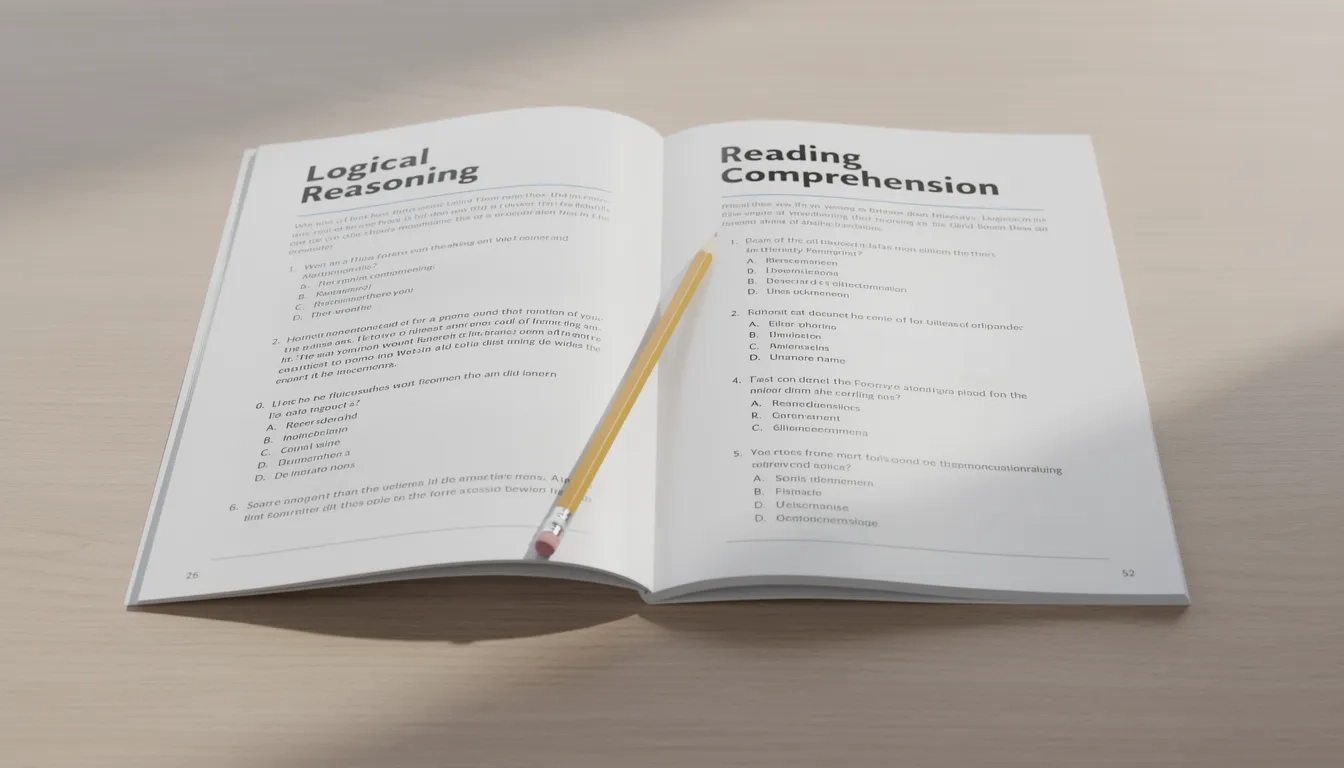
The last remote LSAT already happened. June 2026's administration closed, and starting with August, every test-taker heads to a Prometric testing center. Meanwhile, the test's content structure changed fundamentally back in August 2024 — and a lot of prep guides still haven't updated. If you're starting your prep now or reassessing your plan, the conventional wisdom needs a fresh look.
What the LSAT Actually Looks Like in 2026
Logic Games are gone. LSAC removed the Analytical Reasoning section permanently in August 2024 following an ADA lawsuit settlement, ruling that spatial-reasoning puzzles disadvantaged candidates with certain cognitive and physical disabilities. What filled the slot: a second Logical Reasoning section.
The modern LSAT has four sections:
- Two Logical Reasoning (LR) sections, roughly 51 scored questions total
- One Reading Comprehension (RC) section, roughly 27 scored questions
- One unscored experimental section (either LR or RC)
- An Argumentative Writing task, completed separately before test day (not scored, but sent to schools)
LSAC's analysis of over 200,000 test sessions found the switch had "virtually no impact on overall scoring." That sounds like good news. What it actually means is that percentile cutoffs stayed the same — a 170 still demands the same elite accuracy it always has.
The practical implication for your prep materials: any book or course built around Logic Games is teaching you content that no longer appears on the test. The PowerScore Logic Games Bible, once the most-cited print resource in existence, now serves one purpose: decorative bookshelf weight. If you have it, shelf it.
The Logistics Shift: Say Goodbye to Bedroom Testing
This is the change that's going to catch people off guard. Starting with August 2026, all LSAT administrations moved to in-person testing at Prometric locations. No exceptions for standard test-takers. Students with approved medical accommodations may have options — contact LSAC directly — but for everyone else, this is the new reality.
The registration fee sits at $248 per administration. Deadlines are firm. LSAC eliminated late registration in 2018 and hasn't looked back since.
Here's the full 2026-2027 testing calendar:
| Test Date | Registration Deadline | Score Release |
|---|---|---|
| August 5–8, 2026 | Late June 2026 | August 26, 2026 |
| September 9–12, 2026 | Late July 2026 | September 30, 2026 |
| October 7–10, 2026 | Early September 2026 | October 28, 2026 |
| November 11–14, 2026 | Early October 2026 | December 2, 2026 |
| January 13–16, 2027 | Early December 2026 | February 3, 2027 |
| February 12–13, 2027 | Early January 2027 | March 3, 2027 |
| April 8–10, 2027 | Late February 2027 | April 28, 2027 |
| June 9–12, 2027 | Late April 2027 | June 30, 2027 |
Retake limits: three times per calendar year, five times within any rolling five-year span, seven times over your lifetime. Law schools can see all of your scores, though most policies focus on the highest.
One thing to do right now: find your nearest Prometric center and see how far away it is. Some people in rural areas will need to book travel and accommodation. That's not a prep problem, it's a logistics problem — and discovering it two weeks before test day is a bad time to start solving it.
How Long Should You Actually Study?
Most successful LSAT test-takers log between 250 and 350 total study hours before hitting their target score. That's the realistic range based on aggregated prep data, not a worst-case scenario.
Here's a simple decision framework:
If your target score is below 160: A 3-month plan at 15–20 hours per week is workable. You're not closing a massive gap.
If you're targeting 165 or above: Six months, minimum. Top-25 law schools have median LSATs in the 168–174 range (Yale Law's median typically hovers around 174). Closing a 10-point gap in 90 days while maintaining timed accuracy is genuinely difficult for most people.
If you're working full time: Add two months to whatever timeline you'd otherwise choose. Cramming 20 hours into exhausted weeknights leads to diminishing returns fast.
The 12-month plan sounds excessive, but it's the right call for anyone starting below 155 with a target above 170. Slow is smooth, smooth is fast — the people who plateau and restart a prep plan twice end up taking longer than the person who paced steadily from the beginning.
Your Study Plan, Phase by Phase
Phase 1: Diagnostic and Foundation (Weeks 1–4)
Take a cold diagnostic test before you do anything else. Don't review prep materials first. Don't warm up with sample questions. You need an honest baseline, and if you study first, you corrupt it.
LSAC offers four full official PrepTests through LawHub (free). Burn your first one on this diagnostic. Then spend the rest of Phase 1 studying why you got questions wrong, not just tallying which ones you missed. LR errors almost always trace back to one of three issues: misidentifying the question type, losing track of the conclusion, or reading evidence into the stimulus that isn't there.
Phase 2: Skill Building (Middle Months)
This is the unglamorous bulk of prep. Drilling question types, building pattern recognition, learning to process LR arguments in under 90 seconds. It's not exciting. It works.
Take one full practice test per week under real conditions. That means no pausing when you get tired, no checking answers mid-section, and no skipping the Argumentative Writing. Stamina is part of your score in ways that timed drills don't capture. RC, in particular, trips people up not because they don't understand the passages but because they try to memorize content rather than tracking the author's argument structure.
Phase 3: Refinement and Simulation (Final 4–6 Weeks)
Stop learning new content. This phase is about ingraining what you already know, not expanding it. Two to three full practice tests per week, thorough error review after each one, no new frameworks or strategies.
In the final two weeks, do your practice sessions at a desk, on a computer, in as sterile an environment as you can simulate. The psychological shift of walking into a Prometric center (fluorescent lights, strangers coughing, a proctor who's seen it all) is real. Some candidates find the unfamiliarity throws off their timing by 5–7 minutes. Train for it now.
The Best Resources in 2026, Honestly Assessed
More resources is not better. Students who cycle through five courses consistently underperform students who pick two and go deep. The sweet spot is a free foundation layer plus one paid adaptive tool.
| Resource | Price | Best For | Weakness |
|---|---|---|---|
| Khan Academy (LSAC partnership) | Free | Foundation, question fundamentals | Limited strategic depth |
| LSAT Demon | $99–$300+/month | Adaptive drilling, efficiency | Requires self-direction |
| 7Sage | $179–$749 | Video learners, full curriculum | Less adaptive than Demon |
| PowerScore | $175–$1,395 | Structured LR frameworks | LG materials now obsolete |
| Kaplan | $799–$1,799 | Full-service, live support | Expensive relative to value |
Khan Academy's LSAT program is built in partnership with LSAC and pulls from actual retired PrepTests (not replicas). An internal LSAC study found that users averaged a 5–7 point improvement through the platform. For free, that's hard to argue with. Start here.
LSAT Demon is my pick for the best paid add-on. Its algorithm surfaces questions calibrated to your current ability level and adjusts in real time. You spend your drilling hours at productive difficulty rather than grinding through questions that are too easy or too hard. At $99/month, it's cheaper than most courses and more efficient.
7Sage earns its 4.7-star Trustpilot rating through genuinely good video walkthroughs. If you learn better from watching worked examples than from reading explanations, it's worth the cost.
For books, PowerScore's LR Bible remains the best print resource for understanding the structural anatomy of LR arguments. Just don't touch their LG materials.
LawHub Advantage (LSAC's paid subscription, separate from the free LawHub tier) unlocks 60+ official PrepTests from past administrations. Official practice material is worth far more than any third-party replica. If you're doing serious prep, it belongs in your stack.
Setting a Score Target That Actually Means Something
A 163 on a bad day is not a 167 on a good one. Each point above 165 requires exponentially more precision, not just more practice.
Know what score you're actually shooting for before you design your prep plan. This changes your timeline, your resources, and your expectations around retakes.
Score context by tier:
- Top 5 law schools: medians typically in the 173–175 range
- Top 14: medians cluster around 168–172
- Top 50: medians generally 160–167
- Regional and state school programs: often 152–160
The jump from 160 to 165 is meaningful. The jump from 165 to 170 is a different magnitude of difficulty. The number of test-takers who score 170+ in any given administration is small, and the preparation required to get there is qualitatively different from what gets someone to 160.
One often-overlooked factor: LSAT scores are valid for five years from the test date. If you took the exam in 2021 or 2022, your score may be expiring before your application cycle closes. Check your score history on LSAC's LawHub dashboard before building any plan around an old score.
Bottom Line
- Find your nearest Prometric center now and factor in any travel logistics before you pick a test date.
- Take a cold diagnostic on LawHub (four free PrepTests available) before you touch any prep materials.
- Budget 250–350 total study hours. Under 150 hours rarely moves the needle more than a few points.
- Use Khan Academy as your free foundation, then add LSAT Demon or 7Sage as your primary paid tool.
- Throw out or skip any prep materials that include Logic Games content. You're studying for sections that no longer exist.
The most consistent predictor of a high LSAT score isn't raw intelligence. It's starting early enough to build real pattern recognition rather than last-minute familiarity. Give yourself that runway.
Frequently Asked Questions
Is the LSAT harder now that Logic Games are gone?
Not harder, but differently distributed. The second LR section tests the same demanding analytical skills as the first, and LSAC's internal data confirmed that overall scoring distributions held steady after the switch. What did change: LR now makes up roughly two-thirds of your scored questions, so candidates who were LG-dependent and LR-weak are in a tougher spot than before.
What happens if I miss the registration deadline for a test date?
You're out of luck for that administration. LSAC eliminated late registration in 2018, and there are no exceptions. With registration typically opening about three months before each test date, set a calendar reminder as soon as you've picked your target date.
What's the difference between LawHub and LawHub Advantage?
LawHub (free) includes four full official PrepTests, access to the Argumentative Writing interface, and basic analytics. LawHub Advantage (paid yearly subscription) unlocks 60+ official PrepTests from past administrations. The difference matters because official LSAC practice material is far more predictive of actual test performance than any third-party question bank.
How many times can I take the LSAT if my first score isn't what I needed?
Three times in any single calendar year, five times within a rolling five-year period, and seven times over your lifetime. Law schools will see all of your scores, though many programs either consider the highest or average across attempts. Each retake costs $248, so factor that into your budget.
Do LSAT prep courses actually guarantee score improvements?
No prep course can guarantee anything, and the ones that market "guarantees" are typically offering money-back policies with narrow conditions attached. What the data shows is that structured prep consistently produces better outcomes than unguided self-study — on average, a difference of roughly 5–10 points. But that range depends heavily on starting score, total hours invested, and how rigorously you review errors after practice tests.
Should I wait to take the LSAT if I'm still scoring 5+ points below my target in practice?
Yes. Submitting a score 5 or more points below your realistic target rarely helps, and it creates a score on record that requires explanation. The exception is if a deadline is forcing your hand for a specific application cycle — in that case, weigh the cost of waiting a year against the cost of a below-range score. But if you have flexibility, wait until your practice scores are consistently at or above your target.
Sources
- LSAT Test Dates 2026 & 2027: Full Schedule & Deadlines
- LSAT New Format 2026: Logic Games Gone, What Changed
- LSAT Is Going Back to In-Person Testing in August 2026
- LSAT Test Dates 2026-2027: Deadlines and Score Release Dates
- Best Online LSAT Review Prep Courses 2026
- LSAT Study Planner & Schedule: 1, 3, 6, and 12-Month Plans
- Khan Academy LSAT: Free Prep Course Review 2026