How Model UN Builds Critical Thinking (And Where It Falls Short)
At most Model UN conferences, you'll find a high school student from suburban Ohio assigned to represent North Korea, passionately defending a position they privately find indefensible. That's the point. The most effective way to stress-test your own reasoning is to genuinely inhabit someone else's, and Model UN figured this out decades before "steelmanning" became a Silicon Valley buzzword.
What Actually Happens in a Model UN Committee
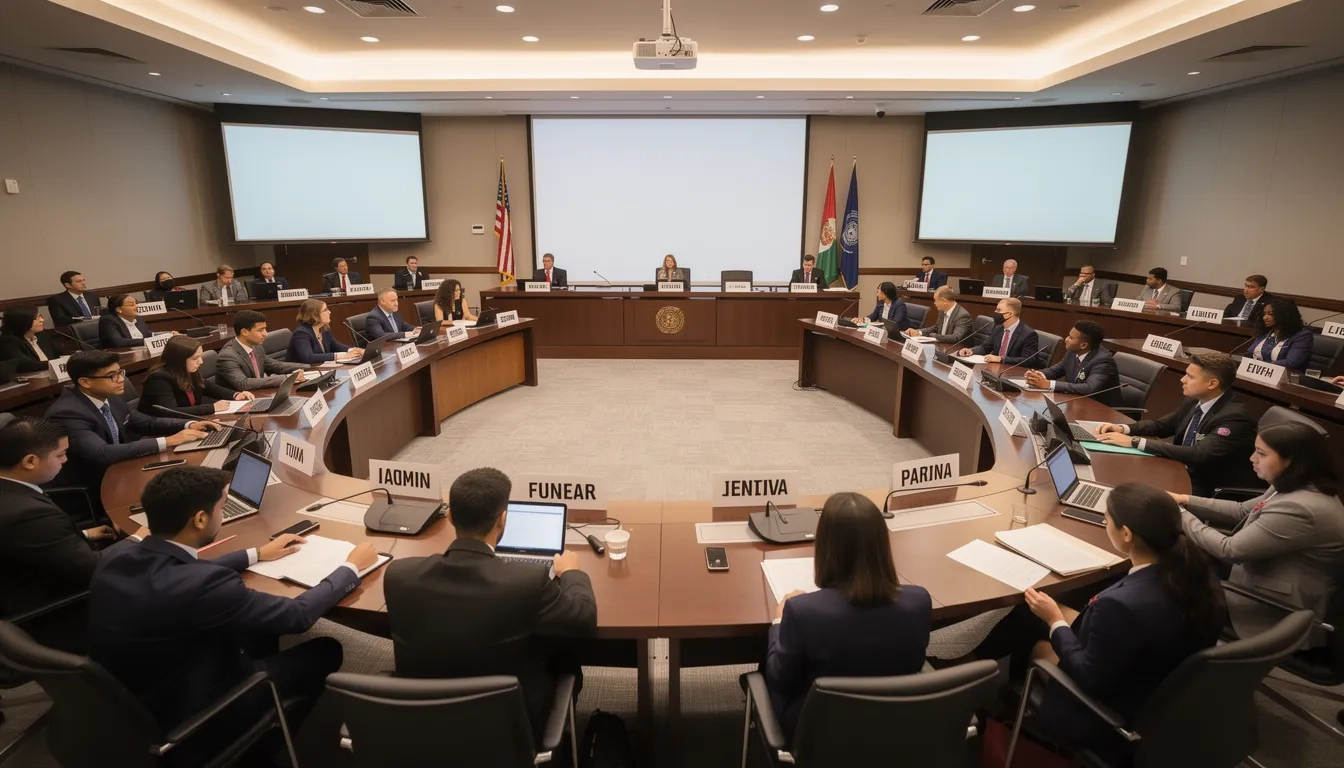
Students are assigned a country and a topic to debate, typically real global issues: climate policy, nuclear nonproliferation, refugee resettlement. Before the conference, they write a position paper covering the topic's background, their assigned country's policy stance, and proposed solutions. Then they spend hours in committee debate and eventually draft a resolution alongside other delegates.
That's the skeleton. The interesting part is what each step actually demands cognitively.
The Position Paper: Where Real Thinking Starts
Position papers require something most school assignments don't ask for. You're not forming an opinion. You're researching an existing policy position and presenting it accurately, which is fundamentally harder.
Finding and defending a country's official stance on, say, the South China Sea requires students to locate credible sources, synthesize conflicting information, identify gaps between official rhetoric and actual behavior, and anticipate counterarguments, all before the conference starts. According to Best Delegate, a widely-used MUN preparation resource, effective research means cross-referencing UN reports, NGO documents, and a country's foreign ministry website. Not a single Google result. Triangulation.
Delegates who skip the research phase (and there are always some) find this out on the conference floor, usually within the first 30 minutes of debate.
What a strong position paper requires:
- Identifying a country's official policy through primary sources, not secondary summaries
- Reconciling what a government says publicly with what it actually does
- Anticipating objections from countries with opposing interests
- Proposing solutions consistent with the assigned country's real constraints
That last point catches first-timers regularly. Proposing solutions your assigned country would never support is a common mistake, and catching that error requires understanding policy from the inside, not just at surface level.
Arguing Someone Else's Case
This is where Model UN separates from standard classroom debate formats.
In most school debates, students pick a side they believe in, or one they're simply told to defend without much accountability. Model UN removes that comfort. You're handed a country and you work with it, authentically, under scrutiny.
If you care deeply about climate action and you've been assigned to represent Saudi Arabia in an energy committee, you have to do something genuinely uncomfortable: understand, from the inside, why Saudi Arabia's position exists. The economic dependencies. The diplomatic relationships. The domestic political constraints. You can't dismiss it without losing credibility as a delegate.
Crimson Global Academy describes this process as learning to "critically analyse, but also justify, parallel viewpoints on the world's most topical issues." That phrase "parallel viewpoints" is doing heavy lifting. You're not just tolerating a different view. You're inhabiting it well enough to defend it under real-time questioning.
Perspective-taking is one of the hardest higher-order thinking skills to develop in a conventional classroom, and most curricula barely touch it. Model UN makes it structurally mandatory by tying delegate performance directly to how well you can do it.
There's something more subtle here too. When you've spent weeks genuinely trying to understand a position you disagree with, you walk away with a more nuanced sense of why people hold the views they hold. That's not just an intellectual skill. It's a habit of mind.
Real-Time Debate Is a Different Kind of Test
Writing a position paper is one kind of thinking. What happens on the committee floor is something else.
During moderated caucuses, delegates give formal speeches within strict time limits, typically 60 to 90 seconds. During unmoderated caucuses, they work the room, negotiate face-to-face, and try to assemble coalitions around draft resolutions. Both phases require rapid, adaptive reasoning that no amount of preparation fully covers.
When another delegate challenges your position with an argument you didn't anticipate, you have roughly ten seconds to evaluate whether the objection is valid, decide whether to concede or push back, and construct a response, all while keeping your coalition intact. That's critical thinking under social pressure. There's no answer key. You reason your way out in real time.
"Model UN is an activity that can only be learned through participation." — Best Delegate
MUN coaches explicitly train what they call "pivoting": turning a challenge into a chance to reinforce your position. Done well, this isn't spin. It requires recognizing which parts of a critique are valid, acknowledging them, and then explaining why your proposal still holds. That skill, distinguishing a strong objection from a weak one while under pressure, is genuinely rare and genuinely useful.
Resolution Writing: Synthesis Under Constraints
Eventually, the debate has to produce something: a draft resolution.
Resolution writing is where synthesis gets sharpest. Delegates from countries with conflicting interests must negotiate language that enough blocs can accept. Every preambulatory and operative clause gets scrutinized. One word can make a clause unacceptable to a coalition that was otherwise aligned.
This phase tests a different kind of critical thinking than debate does. You're no longer trying to win an argument. You're trying to find language precise enough to mean something while broad enough to survive a vote. Anyone who's worked in policy, legal drafting, or organizational governance will recognize that dynamic.
Here's how MUN skills compare to what students typically encounter in traditional classroom formats:
| Skill | How MUN Builds It | Typical Classroom Equivalent |
|---|---|---|
| Research and source evaluation | Multi-source triangulation across UN docs, NGOs, foreign ministries | Single textbook or Wikipedia often acceptable |
| Perspective-taking | Must represent assigned country accurately under questioning | Optional in most debate formats |
| Adaptive argumentation | Real-time rebuttal with no preparation time | Scripted presentations, rarely challenged live |
| Collaborative problem-solving | Coalition-building and resolution negotiation with competing blocs | Group projects with divided individual tasks |
| Precision writing | Every clause survives group scrutiny before passing | First drafts rarely get rigorous peer critique |
What the Research Actually Shows
The evidence here is more interesting than MUN's promotional materials typically acknowledge.
An ASCD analysis of cooperative learning approaches found that for higher-level cognitive outcomes, specifically concept identification, problem analysis, judgment, and evaluation, less-structured cooperative techniques outperform traditional teacher-directed instruction. Model UN sits squarely in that cooperative, less-structured category, which is part of why it works.
A 2025 Springer Nature study examining MUN's educational role found that participation develops "a wide range of cognitive, socio-emotional, and behavioural knowledge and skills transferable to grappling with global challenges in any future career." The same study documented that first-time participants emerged with a more realist orientation toward international relations, meaning they stopped seeing global events as inevitable and started seeing them as the product of decisions, trade-offs, and human agency.
The ASCD reported that over 60,000 students from 2,000 schools participated annually at the time of their analysis. The UN's own MUN portal now lists hundreds of conferences worldwide each year, suggesting participation has grown substantially since that figure was published.
One non-obvious finding from the research: MUN appears particularly effective for students who tend toward passive learning in traditional settings. The format doesn't permit passivity. You have to speak, argue, and write, in front of strangers who will challenge you directly.
Where Model UN Falls Short
Let me be direct: Model UN does not automatically produce critical thinkers. The format creates the conditions. Students can still go through entire conferences treating it as a performance exercise.
The award structure at many conferences rewards polished speakers over rigorous thinkers. A delegate who delivers confident, fluent speeches without much analytical depth frequently outscores someone who makes careful, evidence-based arguments in a quieter register. That's a real problem, and the writing is on the wall in conference after conference where judging criteria are vague about what "good" actually means.
The research preparation is also frequently shortchanged. A delegate who arrives without reading their country's actual foreign policy documents is improvising for two days straight. Most of the cognitive benefit of MUN is front-loaded in the preparation phase. Show up underprepared and you've missed the bulk of it.
What separates programs that produce strong thinkers from ones that produce good performers:
- Advisors who give substantive feedback on position papers before the conference, not after
- Conferences that score argumentation quality and evidence use explicitly in judging rubrics
- Delegates pushed to cite actual sources during debate, not just general talking points
- Post-conference debrief sessions that ask which arguments were most logically sound, not just which delegate won awards
Model UN is a high-ceiling activity. The ceiling is high because the format genuinely demands higher-order thinking at every stage. The floor is low because nothing forces students to engage at that level if they're not pushed to. The difference almost always comes down to the advisor and the conference's intellectual culture.
Bottom Line
- The position paper phase is the cognitive engine. Advisors who treat it as a formality undercut the program's most powerful tool.
- Read primary sources, not just secondary summaries. Foreign ministry websites and UN Security Council records force more precise thinking than news summaries ever will.
- Evaluate how conferences score delegates. Programs that reward logical rigor produce better thinkers than programs that reward confidence.
- Perspective-taking is the most underrated benefit. Representing a position you disagree with, accurately and under pressure, builds intellectual flexibility that standard curricula rarely develop.
The students who take Model UN seriously come out with skills that transfer directly to law, policy, journalism, and anywhere else that requires building an argument from evidence and defending it against people who disagree. The ones who coast come out with a line on their college application.
Frequently Asked Questions
Is Model UN only useful for students interested in international relations?
No, and this is one of the biggest misconceptions about the program. The skills Model UN develops, including research synthesis, adaptive argumentation, and collaborative problem-solving, transfer well across almost any professional context. Many former MUN participants go into law, business, and medicine, and consistently report that the research and debate habits carry over.
How long does it take to get genuinely good at Model UN?
Most delegates report meaningful improvement after their second or third conference. The first one is usually spent learning procedural mechanics: points, motions, voting procedures. By the second conference, students can focus on the actual substance of debate. Substantive skill at research and argumentation typically develops over one to two years of consistent participation.
Does Model UN actually help with college admissions?
Colleges care about it in context, not as a checkbox. A student who can articulate specifically how representing a country in a climate negotiations committee changed how they think about competing interests will stand out. A student who just lists "Model UN" with no reflection behind it is unlikely to gain much advantage from the mention alone.
Myth vs. reality: Isn't Model UN mostly about public speaking?
This is a common misconception, and it's partly the fault of how some conferences are run. The formal speeches in committee are the most visible part of MUN but the least cognitively demanding. The real intellectual work happens in position paper research, unmoderated caucus negotiation, and resolution drafting. Students who treat MUN as a public speaking exercise miss most of its educational value.
What should a first-time delegate focus on?
Read your country's actual foreign ministry website before anything else. Not Wikipedia. Not a news summary. The official government source. Understanding what your assigned country says about the topic, in its own words, is the fastest way to become a credible delegate. Everything else, the speech structure, voting procedures, coalition tactics, can be learned at the conference itself.