Nursing, Pre-Med, or Public Health? How to Actually Choose
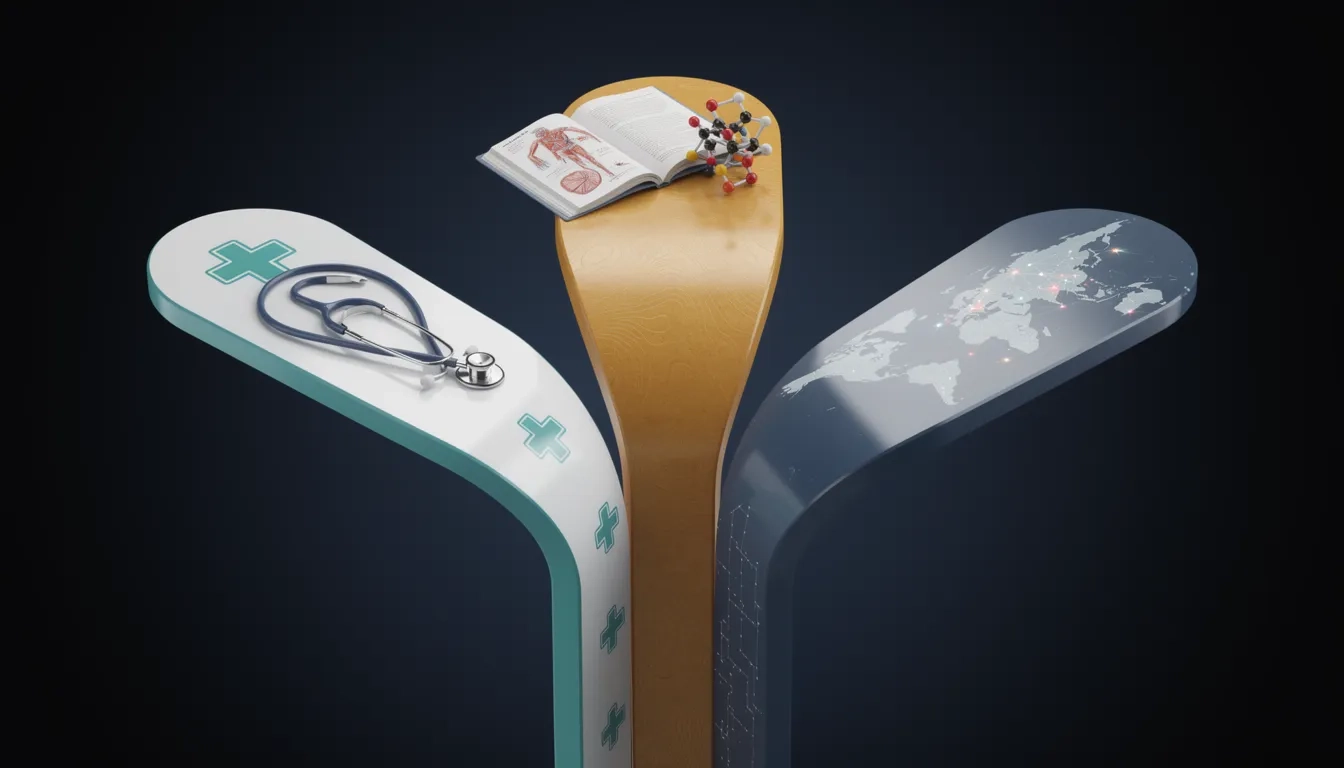
Ninety-three thousand, one hundred seventy-six. That's how many qualified applicants nursing schools turned away in the 2025–2026 cycle, according to the American Association of Colleges of Nursing. Not because of weak candidates — because of a shortage of faculty and clinical placement slots. Meanwhile medical schools accepted roughly the same slice of applicants they always have, and public health programs are begging for enrollment while federal health agencies quietly freeze hiring.
Three Very Different Bets
Start with a clarification most people get wrong: pre-med isn't a major at all. It's a checklist of prerequisite courses — biology, chemistry, physics, biochem, often a semester of calculus — layered on top of whatever major you actually pick. You could major in dance and still apply to medical school if you hit the requirements and score well on the MCAT.
Nursing and public health are real majors with their own degree structures, but they lead to different daily realities. Nursing produces a licensed clinician who can start treating patients within four years of high school graduation. Public health produces a generalist who understands disease, policy, and data, but often needs a master's degree before employers pay well for it.
Here's the blunt version:
- Nursing = fastest path to a stable, licensed, patient-facing job
- Pre-med = highest ceiling, longest and most expensive runway, real rejection risk
- Public health = most flexible major, weakest bachelor's-level salary, best "combine with something else" value
That last point matters more than most college guides admit. A public health degree paired with nothing else is a mixed bet. Paired with a nursing license, a data science minor, or a med school acceptance, it becomes one of the more useful majors on campus.
What Nursing Actually Demands
Nursing has an image problem: people treat it as the "safe fallback" for students who don't think they can hack pre-med. The data says otherwise. Nursing programs are among the hardest to get into right now, even though the country badly needs more nurses.
That AACN figure from the opening is worth sitting with. Nursing schools turned away 93,176 qualified applicants in the 2025–2026 cycle, up nearly 30,000 from two years earlier, mostly because schools lack teaching capacity, not because applicants lack ability. An October 2025 AACN survey of 863 nursing schools found 1,588 unfilled full-time faculty positions. The bottleneck is faculty, not demand.
Once you're in, the path moves fast: a BSN takes four years and an ADN can take two to three, and both lead to the NCLEX licensing exam. Pass it, and you're a working RN — median pay $97,550 a year as of May 2025, per the Bureau of Labor Statistics.
The Ladder Above RN
Here's what most 18-year-olds don't know: nursing has a built-in advanced-practice track that rivals medicine's earning power without medicine's timeline.
- Nurse practitioners earn a median $132,300, about $35,000 more than an RN
- BLS projects 46% job growth for nurse practitioners between 2023 and 2033, versus 6% for RNs
- The NP path typically adds two to three years of graduate school, not a decade
If you want physician-adjacent pay and autonomy without an eleven-year runway, the RN-to-NP ladder is the best-kept secret in health careers.
The tradeoff is shift work. Fifty-nine percent of RNs work in hospitals, and most of those jobs include rotating nights and weekends. That's a real cost if a predictable schedule matters to you.
The Pre-Med Gauntlet
Pre-med is a bet you place at 18 and don't cash in until your early 30s. Four years of undergrad, four years of medical school, then three to nine years of residency and fellowship depending on specialty. Nobody tells incoming freshmen that the road to "doctor" can run longer than the stretch from kindergarten to college graduation.
The admissions numbers are more nuanced than the scary headlines suggest. Overall, 42.85% of applicants matriculated somewhere in the 2025–2026 AMCAS cycle, not terrible odds for a strong applicant willing to apply broadly. But individual MD schools accepted an average of just 3.1% of their own applicant pools, and ten schools admitted fewer than 1%. Most applicants apply to fifteen or more schools at once (yes, that's normal and expected), so the real risk is being mediocre everywhere, not being unlucky once.
The Biology Major Myth
Here's the part that surprises people: majoring in biology does not improve your odds. Data from the 2025–2026 cycle shows biological sciences majors matriculated at 42.1%, while math and statistics majors hit 57.3% and humanities majors hit 52.0%.
Committees aren't rewarding "safe" science majors. They're rewarding strong GPAs (the average matriculant carries a 3.81) and strong MCAT scores (average 512.1), whatever the diploma says.
One more thing pre-med hopefuls skip past: physician job growth is projected at just 4% from 2025 to 2035, slower than the 6% projected for registered nurses. Median pay is still enormous, $275,930 in May 2025, but the expanding scope of practice for NPs and PAs is quietly capping how fast physician demand grows. The reward is bigger. The odds and the growth curve both favor nursing.
Public Health: Flexible, but Underpaid at the Start
Public health is the major that teaches you to think about health at the population level — clean water, vaccination rates, opioid policy, pandemic response — instead of one patient at a time. It's intellectually the richest of the three majors. It's also, at the bachelor's level, the worst-paying.
Entry-level public health roles typically start around $45,000 to $60,000, and a bare bachelor's often isn't enough to unlock the interesting jobs. The degree really turns on once you add a master's: MPH holders earned an average of $78,000 in 2025, about 18% more than bachelor's-only peers.
The field is also going through real turbulence. HHS reportedly posted only 35 open federal positions in early 2026, a sign of how hard the federal hiring freeze has hit traditional public health pathways. CDC's ORISE fellowships, a common on-ramp for new graduates, went dark and then came back in 2026, which tells you how unstable that pipeline has been.
Where the Money Actually Is
Public health graduates who do well tend to specialize into adjacent, higher-paying lanes rather than staying generalist:
- Health services managers: $118,000 median, 23% projected growth (2024–2034)
- Data scientists in health: $113,000 median, 34% projected growth
- Epidemiologists: roughly $75,000–$80,000, 16% projected growth
- Health education specialists: about $63,000, only 4% growth
Rollins School of Public Health at Emory reported its 2024 graduates averaged $69,000 in base salary across 111 cities and eight industries — a reasonable outcome, but nowhere near nursing or medicine at comparable career stages. There's a silver lining, though: a $50 billion Rural Health Transformation Program, with Georgia alone receiving roughly $2 billion, is opening new state and local jobs even as federal roles shrink.
Money and Time, Side by Side
Numbers make the tradeoffs obvious in a way paragraphs can't. Here's how the three paths stack up on what actually shapes your twenties.
| Dimension | Nursing (RN) | Pre-Med → Physician | Public Health (BA + MPH) |
|---|---|---|---|
| Time to first paycheck in-field | 2–4 years | 11–15+ years | 4 years (low pay) / 6 years (MPH) |
| Licensing required | Yes (NCLEX) | Yes (board certification) | No |
| Admission difficulty | High (capacity-limited) | Very high (per-school) | Low to moderate |
| Median pay, entry field | $97,550 (RN) | $275,930 (attending) | $45k–$60k (BA) / $78k (MPH avg) |
| BLS job growth | 6% RN, 46% NP (2023–33) | 4% (2025–35) | 16–23% in specialized roles |
| Biggest limiting factor | Faculty and clinical seat shortage | Cost, time, per-school odds | Federal funding volatility |
A few things jump out. Nursing wins on speed and odds-adjusted return — you're earning near six figures within four years, with a clear advanced-practice ladder if you want more. Pre-med wins on ceiling; nothing else here pays a $275,930 median. But you're financing over a decade of deferred income to find out if it worked, and you won't know until your late 20s or early 30s. Public health wins on optionality, not paycheck. It's the major most likely to still make sense if you change your mind twice.
Which Path Fits Which Kind of Student
Forget personality quizzes. Ask yourself three blunt questions instead.
Can you tolerate ten-plus years of deferred certainty? If not knowing your career outcome until age 30 makes you anxious, cross pre-med off the list. Not because you can't do the work, but because the uncertainty itself is a cost most people underweight.
Do you want to treat individuals or move populations? Nursing and medicine are built around the person in front of you. Public health is built around the thousands of people you'll never meet but might still help through a policy change.
Here's a rough sorting guide I'd give a younger sibling:
- Want stable income fast and don't mind shift work → Nursing. You'll be earning close to $100k in your mid-20s with a defined ladder up.
- Have a 3.7+ GPA, strong test-taking history, and genuinely can't picture doing anything else → Pre-med, but apply broadly and keep a backup major that stands on its own.
- Love data, policy, or big-picture health problems, and are willing to get a master's → Public health, paired with a technical minor (statistics, data science, GIS, or health informatics) to escape the $50k entry-salary trap.
- Want to keep options open past sophomore year → Start in public health or biology; both keep the pre-med door open, while nursing generally requires committing early.
Note the asymmetry: nursing is hardest to switch into late (clinical sequencing is rigid), while public health is easiest to switch out of toward medicine or nursing later.
Common Mistakes Students Make Choosing a Health Major
I've watched the same mistakes play out over and over with students picking between these paths.
- Assuming nursing is the "backup" for weak pre-meds. It's a competitive, capacity-limited program in its own right — nearly 100,000 qualified applicants got turned away last cycle. Treating it as plan B often means applying too late.
- Majoring in biology "because that's what pre-meds do." The data shows biology majors matriculate at a lower rate than humanities or math majors. Pick a major you'll actually excel in; committees reward strong GPAs over the "correct" major.
- Choosing public health without a plan for the master's. A bachelor's alone often lands you in the $45k–$60k range. Going in without intending to pair it with an MPH or a technical skill wastes the major's real value.
- Ignoring shift work in nursing. Rotating nights and weekends aren't a footnote; they're the daily reality for most hospital RNs. Talk to working nurses before committing, not after.
A smaller but real mistake: assuming these three paths are mutually exclusive. Plenty of students major in public health while completing pre-med prerequisites, or work as an RN for a few years before returning for an MPH or med school. The paths cross more than the marketing suggests.
Bottom Line
- Pick nursing if you want the fastest, most reliable route to a well-paying, licensed career, and you're willing to work rotating shifts and apply early since programs are capacity-constrained, not underqualified-constrained.
- Pick pre-med only if a strong GPA and test-taking track record already back you up, you can stomach a decade-plus timeline, and you'd still choose it even facing a coin-flip outcome.
- Pick public health if you want the most flexible undergraduate years and you commit, right now, to pairing it with an MPH or a technical skill rather than leaving it as a stand-alone bachelor's degree.
- Talk to a working RN, a resident, and an MPH-holder before locking in your major. Their actual daily grind tells you more than any salary chart.
- Remember these paths aren't a one-way fork. Nurses become NPs, public health majors become med students, and physicians go on to run public health departments. The first major is a starting lane, not a life sentence.
Frequently Asked Questions
Can I switch from public health to pre-med later?
Yes, and it's common. Public health majors already cover biology and often chemistry, so adding the remaining pre-med prerequisites is usually extra semesters, not starting over.
Is nursing actually easier to get into than medical school?
No, and that's the biggest misconception in this comparison. Nursing schools turned away 93,176 qualified applicants in 2025–2026 due to faculty and clinical-placement shortages, not weak candidates. It's a different kind of competitive, not a lesser one.
How do I decide between a BSN and an ADN if I choose nursing?
Look at your local job market first. Many hospitals, especially Magnet-designated ones, now prefer a BSN, so check job postings in the city where you actually want to work before assuming a faster ADN saves you time overall.
Do I need a master's degree for a real public health career?
Not always, but it changes your ceiling significantly. MPH holders average $78,000 versus roughly $45,000–$60,000 for bachelor's-only entry roles, and most specialized public health jobs expect graduate credentials.
What GPA and major actually matter most for medical school?
GPA and MCAT score matter far more than the specific major. The average 2025–2026 matriculant had a 3.81 GPA and 512.1 MCAT, and math and humanities majors actually matriculated at higher rates than biology majors.
Can a nurse become a doctor later without starting undergrad over?
Yes, through bridge programs, though it's still a long road. Nursing prerequisites overlap with many pre-med science requirements, which helps. You'll still need to finish remaining coursework, sit for the MCAT, apply through the standard process, and complete medical school and residency like any other applicant.
Sources
- Registered Nurses — Occupational Outlook Handbook
- Physicians and Surgeons — Occupational Outlook Handbook
- Medical School Acceptance Rates, Admissions Statistics + Average GPA/MCAT
- Public Health Job Market 2026: Trends, Shifts, and Career Opportunities
- Record 93,000 Nursing Applications Turned Away in 2025
- Nurse Practitioner Salary Guide 2026