Best SAT Math Practice Problems by Topic 2026: A Real Study Guide
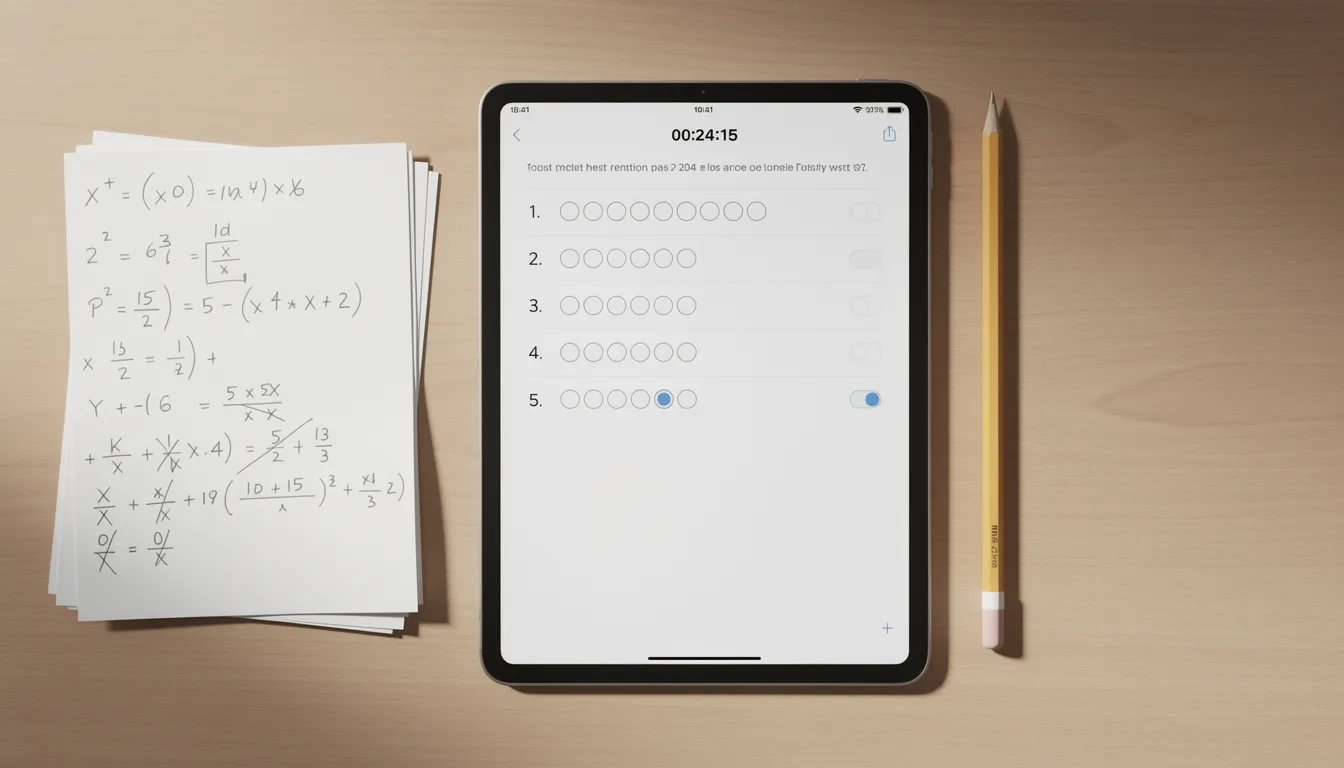
Here's a structural fact most students don't act on until it's too late: Algebra and Advanced Math together make up 70% of your SAT Math score. That's 26–30 of the 44 total questions. If you're splitting study time evenly across all four domains, you're leaving points on the table by treating a minor section the same as a major one.
This guide breaks down each topic with representative practice problems, explains where the real difficulty lives, and gives you a framework for spending prep time where it actually pays off.
How the Digital SAT Math Section Is Built
The Math section runs two 35-minute modules back to back — 70 minutes total for 44 questions, which works out to roughly 95 seconds per question if you pace evenly. About 75% of questions are multiple choice; the other 25% are student-produced responses (SPRs), where you type your own answer.
The test adapts. Your performance in Module 1 determines the difficulty of Module 2. Do well in the first module, and you get a harder second module — which sounds bad but is actually what you want, because the higher-difficulty path is the only route to top score ranges.
Within each module, questions run easiest to hardest. That matters: don't sink 4 minutes into a late question while skipping quick wins early.
| Domain | Questions | Share of Test |
|---|---|---|
| Algebra | 13–15 | ~35% |
| Advanced Math | 13–15 | ~35% |
| Problem-Solving & Data Analysis | 5–7 | ~15% |
| Geometry & Trigonometry | 5–7 | ~15% |
The built-in Desmos graphing calculator is available for every single question. Most students treat it as a last resort. High scorers treat it as a primary tool for checking roots, graphing systems, and confirming exponential behavior.
Algebra: 35% of Your Score, Often Underestimated
Algebra on the Digital SAT isn't just "solve for x." The College Board tests whether you can set up and interpret equations, not just execute algebra procedures. That's exactly where most errors happen — in the equation setup, not the arithmetic.
The most commonly tested Algebra subtopics:
- Linear equations in one variable
- Systems of linear equations (substitution and elimination)
- Linear inequalities and absolute value equations
- Slope and intercept interpretation in context
- Linear functions in word problem scenarios
A representative medium-difficulty problem: A gym charges a $40 enrollment fee and $25 per month. A competitor charges no enrollment fee and $35 per month. After how many months are total costs equal?
Set up: 40 + 25m = 35m → m = 4. The math is simple. The trap is setup — students rushing past "no enrollment fee" regularly drop the 40 from the left side and solve for the wrong thing.
Slope interpretation questions get underestimated because they look simple. But when a question asks "what does the slope represent in this context," it's testing reading comprehension wrapped inside math. A concrete decision rule: if you see a word problem with two variables and two conditions, write a system of equations before attempting any calculations.
Advanced Math: Where SAT Scores Actually Separate
This domain also covers 13–15 questions, but the content complexity steps up considerably. According to IvyStrides, students who build fluency in factoring and function composition see the biggest score jumps — and those two skills are precisely what Advanced Math hammers.
Common subtopics:
- Factoring and solving quadratic equations
- Completing the square
- Exponential growth and decay functions
- Polynomial division and the remainder theorem
- Function notation, composition, and transformations
- Rational and radical equations
A sample hard problem: If f(x) = x² + 3 and g(x) = 2x − 1, what is f(g(3))?
Work inside out. g(3) = 5. Then f(5) = 28. Students who haven't drilled function composition under time pressure regularly reverse the order and get f(3) first.
The hardest SAT math problems aren't hard because of advanced mathematics — they're hard because of multi-step setup and wording. Knowing this changes how you study.
PrepMaven's data on this is sobering: at elite universities, roughly three-quarters of admitted students score 750+ on SAT Math. To hit 750, you need to miss no more than 3 or 4 of the 44 questions. There's no margin to consistently drop Advanced Math points.
Exponent problems deserve specific attention. Students who learn to spot the "rewrite the base" move — recognizing 8 as 2³ before applying exponent rules — unlock an entire question type that otherwise feels impossible. That pattern shows up on nearly every test administration.
Problem-Solving and Data Analysis: The Sneaky 15%
Only 5–7 questions, but students lose points here at a rate that doesn't match the domain's size. The issue is that this domain mixes statistics, probability, and real-world context in ways that feel unfamiliar if you've been drilling purely algebraic problems.
Key areas tested:
- Ratios, rates, and proportional reasoning
- Percentage change and percent of total calculations
- Mean, median, mode, and range
- Scatterplot and line-of-best-fit interpretation
- Two-way tables and conditional probability
- Data inference and margin of error concepts
Unit confusion is the silent score killer here. A question might give speed in miles per hour, ask for distance in feet, and embed the conversion factor quietly in the problem text. Get the math right, get the units wrong, lose the point.
Probability questions on the SAT are almost never formula-heavy. They test whether you can read a two-way table and set up a fraction by counting cells. The math is a ratio. The challenge is reading.
My take: treat every Data Analysis problem as a reading comprehension exercise first, math problem second. The students who rush toward computation before fully parsing the scenario are the ones who miss these.
Geometry and Trigonometry: Manageable Scope, Specific Traps
Same 5–7 questions as Data Analysis, but the content feels more like a traditional math class. The good news is that SAT trig is limited strictly to right triangles. No unit circle, no identities beyond basic sine/cosine/tangent (SOHCAHTOA). That's a narrow enough scope to master in a few targeted study sessions.
What to know cold:
- Area and perimeter of polygons, circles
- Arc length and sector area
- Volume of prisms, cylinders, cones, spheres
- Pythagorean theorem and special right triangles (30-60-90, 45-45-90)
- Circle equations in standard form: (x − h)² + (y − k)² = r²
Completing the square to convert a circle equation into standard form is the technically hardest geometry skill on the test. A question like "what is the radius of the circle defined by x² + y² − 6x + 4y = 12?" requires completing the square for both variables, then reading off the radius. Students who haven't practiced this specific move lose that point every time — it's not instinctive without repetition.
One more trap: SAT diagrams aren't always drawn to scale. A triangle that looks like it has a right angle might not. Don't assume from appearance. Mark your assumptions explicitly.
A Practice Strategy That Actually Works
Random problem grinding is the least efficient use of prep time. Here's a tiered approach that makes each study session count.
Step 1 — Diagnose before you drill. Take one full official practice test using College Board's free Bluebook app. Score by domain. Whatever section has your highest error rate gets the most practice time going forward. Your error distribution is a better guide than any generic study schedule.
Step 2 — Topic drills until accuracy is solid. Work 10–20 problems per session on a single topic. Khan Academy's SAT prep (built in direct partnership with College Board) tags every problem by skill, which makes targeted drilling straightforward. Don't mix topics until you've hit about 85% accuracy on each one.
Step 3 — Timed mixed practice. Once accuracy improves, run full timed modules. The 95-second-per-question target is just an average — easy questions should take 45 seconds, hard ones can take 2.5 minutes. Getting comfortable with that variance takes practice under real time pressure.
Quality beats quantity, full stop. Fifteen problems with full solution review outperforms fifty problems where you just check the answer key. The learning happens during review, not during the attempt. Students who spend at least half their session time reviewing wrong answers improve faster than those who don't.
Bottom Line
- Algebra and Advanced Math are 70% of your score. Give them at least 80% of your math prep time.
- Use the Bluebook app for your diagnostic. Your personal error distribution beats any generic study plan.
- Geometry and Data Analysis are the smallest domains but have specific, learnable traps: circle equations, unit conversions, and two-way table probability.
- Desmos is a tool, not a crutch. Use it proactively for graphing, systems, and exponential problems — not just when you're stuck.
- Review every wrong answer in depth. Missing a question and moving on is the most common reason SAT Math scores plateau.
Frequently Asked Questions
What SAT math topics appear most frequently?
Algebra and Advanced Math each make up about 35% of the test — roughly 26–30 of the 44 questions combined. Within Algebra, linear equations and systems of equations are the highest-frequency subtopics. Within Advanced Math, quadratic equations and function composition appear most often.
Is the SAT Math hard if I'm already good at school math?
Not always, but they test different skills. School math rewards knowing the procedure. SAT questions embed math inside multi-step word problems where equation setup matters more than calculation ability. Students who are computationally strong but rush past context often underperform relative to their actual math ability.
Do I need to memorize formulas for the Digital SAT?
The test provides a geometry reference sheet at the start of the Math section. But looking formulas up costs time — and on a 95-second-per-question test, that adds up. Knowing the most common formulas cold (Pythagorean theorem, special right triangle ratios, standard circle equation) is genuinely faster and reduces errors from misreading the sheet under pressure.
Myth vs. reality: is the SAT Math section mostly about hard math concepts?
Myth. The SAT doesn't test calculus, advanced statistics, or complex trigonometry. What it tests is whether you can apply middle-school and early high-school math concepts inside multi-step, contextual problems with precision. The difficulty comes from problem structure and wording, not from requiring knowledge of advanced mathematics.
How should I use the Desmos calculator on the SAT?
Graph quadratic functions to find roots visually instead of factoring by hand. Plot both equations in a system to find intersection points. For nonlinear systems, Desmos can show you where curves cross in seconds. Use it to verify answers, not just as a primary calculation method — but for graphing questions, it's genuinely faster than algebraic approaches.
What's the single biggest mistake students make while preparing for SAT Math?
Doing too many problems without reviewing solutions. The learning from a wrong answer comes from understanding why your setup or reasoning failed — not just confirming what the right answer was. Students who spend roughly half their study time on solution review improve faster than those who treat prep as a volume exercise.
Sources
- SAT Math Practice Problems: 20 Worked Examples by Topic (2026) | Larry Learns
- The Math Section: Overview – SAT Suite | College Board
- 25 of the Hardest SAT Math Problems in 2026-27 | PrepMaven
- SAT Math Topics 2026: Complete Syllabus, Difficulty & Study Guide | IvyStrides
- SAT Math Question Topics 2026: Easy to Hard Practice with Solutions | LeapScholar