SAT Vocabulary Strategies That Actually Move the Needle
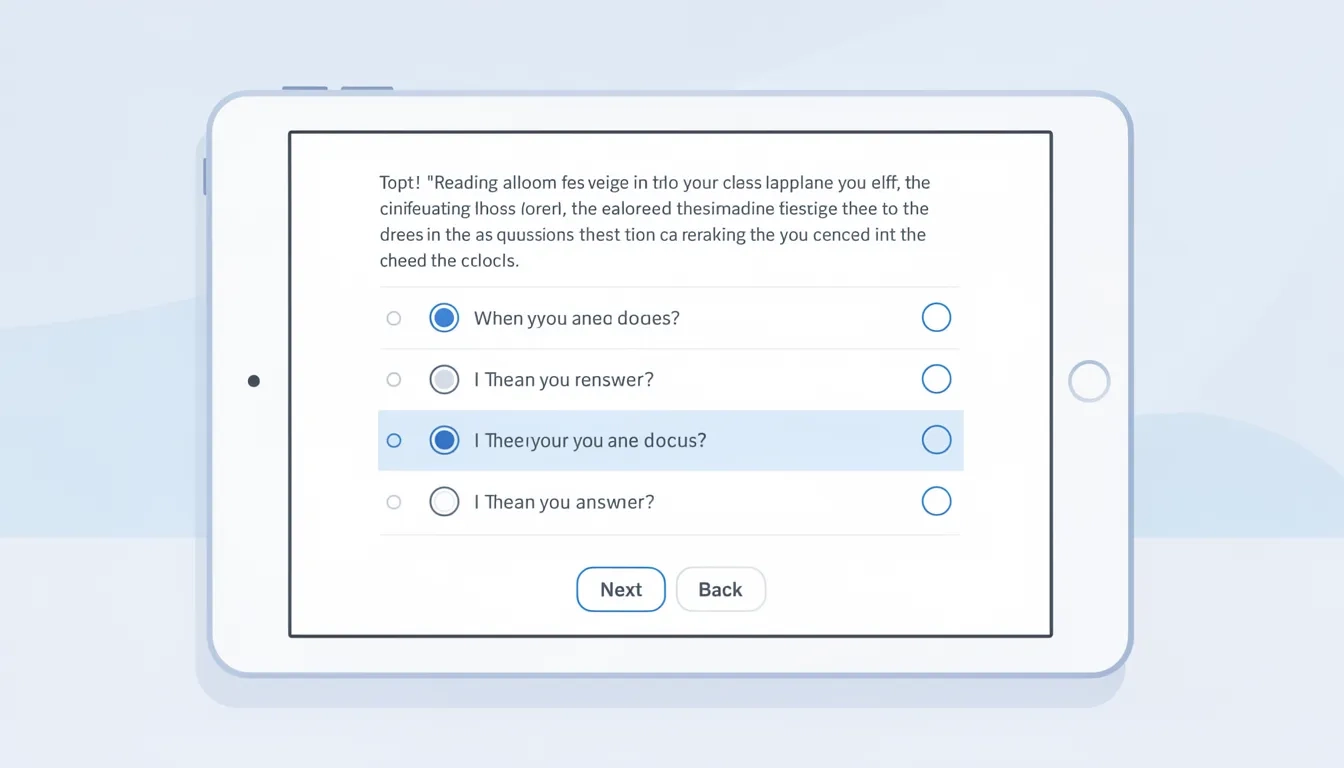
There's a dirty secret buried inside most SAT vocabulary guides. They were written for a test that no longer exists. The old SAT rewarded students who could cram three thousand obscure definitions before test day. The Digital SAT, which College Board rolled out broadly in 2024, does something fundamentally different — it asks you to choose the most precise word for a specific passage, in a specific rhetorical situation. That shift changes everything about how you should study.
What the Digital SAT Actually Tests
Every vocabulary question on the current SAT appears in a "Words in Context" format (these questions account for roughly a third of the entire Reading and Writing section). You're given a short passage and asked which word best completes a blank, given what surrounds it.
Raw memorization is no longer enough on its own. A student who knows 2,000 definitions but reads passages loosely will miss questions that a student with a 400-word vocabulary and sharp contextual reasoning gets right.
College Board designed this format to reflect the vocabulary demands of actual college coursework. Not reciting definitions — selecting the precise word for the precise context.
The questions aren't always about obscure words, either. Sometimes the "hard" answer is a familiar word used in an uncommon way. That trips up students who over-rely on memorization and under-rely on close reading.
The Predict-Then-Match Method
This is the single most important skill you can build for Words in Context. No debate.
The core move: predict your own word before looking at the answer choices. Here's the process, adapted from Curvebreakers Test Prep's framework:
- Read the question stem carefully
- Cover the answer choices — don't look yet
- Identify contrast or conclusion markers ("however," "therefore," "despite," "instead")
- Generate your own word for the blank based on what the passage logically requires
- Look at the choices and find the one that matches your prediction
Why does covering the choices matter so much? Because the SAT's wrong answers are designed to distract. Two of the four options will usually be words that sound academic and impressive. If you look first, you'll be pulled toward words that feel right rather than words that are right.
Here's the method in practice: a sentence describes how a policy "______ the problem of antibiotic resistance." The passage makes clear things are getting worse. A student using predict-then-match writes "worsened" before looking at options, then spots exacerbated immediately — eliminating diminished, eradicated, and celebrated in seconds.
You don't need to know the exact SAT word. You need to understand the passage well enough to predict the meaning, then find the word that carries it.
Which Words Actually Show Up: Real Data from 24 Tests
Most prep books publish lists of 500 to 1,000 terms. The question nobody asks: which of those words actually appear on real tests?
Mr. Johns Test Prep analyzed 24 official SAT administrations from March 2024 through early 2026, cataloging 445 total word instances across 320 unique words. The findings are genuinely striking.
Only 36 words appeared three or more times. At the top of the list:
- Eschew — appeared 6 times across official tests
- Ubiquitous — appeared 6 times
- Idiosyncratic — appeared 5 times
The next tier includes exacerbate, conjecture, manifest, substantiate, attenuate, and heterogeneous, each appearing four or more times.
The practical implication is hard to ignore: 224 of the 320 words appeared exactly once. Spending equal time on all 320 words is a poor allocation of hours. The data supports a tiered approach:
| Priority | Words | Appearances | Recommended Study Time |
|---|---|---|---|
| Tier 1 | 36 words | 3+ times | 40% of study time |
| Tier 2 | 60 words | 2 times | 35% of study time |
| Tier 3 | 224 words | 1 time | 25% of study time |
Worth noting: August 2025's US administration contained 38 vocabulary words — the highest concentration in the entire dataset. The section is getting denser, not lighter.
Root Words: How to Decode Words You've Never Seen
Even if you master the top 96 high-and-medium-frequency words, you'll still encounter unfamiliar terms on test day. This is where morphology pays off.
Latin and Greek root families dominate the SAT's vocabulary pool. Mr. Johns' analysis found that roots like EQUI- (equal), -SCRIBE (write), -DICATE (proclaim), and CLUDE- (close) appear systematically across tests. One root unlocks an entire family.
Take bene- (good/well). Know that root and you can decode benevolent, benefactor, benediction, and beneficent without memorizing each separately. That's four words for the price of one concept.
Negative prefixes are especially high-value on the SAT. Words with un-, in-, ir-, im-, and dis- appear disproportionately in Words in Context questions. Often the question hinges on whether the correct word carries a negative or positive charge — and knowing the prefix gives you the answer before you even read the choices.
A practical shift: instead of studying words alphabetically, group them by root. Study the -VOC- family (invoke, equivocal, revoke, convoke) in a single session. The grouping sticks better than isolated definitions, and you'll apply the pattern to words you've never seen before.
Spaced Repetition: The Study Method That Compounds
Cramming vocabulary the night before doesn't work. The forgetting curve is brutal — most learners lose roughly 70% of a single-session cram within 24 hours.
Spaced repetition systems solve this by scheduling reviews at expanding intervals. The idea is to review a word just before you'd forget it, which forces deeper memory encoding each time. Anki, the most widely used spaced repetition app, uses intervals of approximately 1 day, 3 days, 7 days, and 14 days for new material.
For SAT prep, 10 to 15 new words per day is the right pace. Faster than that and retention suffers. Slower and you won't cover enough ground before test day.
Pair spaced repetition with micro-drills: 10-minute daily sessions featuring 5 to 10 context-based questions. Not marathon study blocks. Short, consistent, daily practice beats occasional two-hour sessions every time — frequent low-stakes retrieval builds stronger memory traces than infrequent high-stakes review.
Reading The Economist or Scientific American for 20 minutes daily also pays dividends. You'll encounter high-utility academic vocabulary in authentic sentences, which is exactly how the SAT presents it.
The 30-Day Vocabulary Sprint
If you have a month before your test, here's a realistic weekly breakdown:
Week 1 — Foundation. Focus on the 36 Tier 1 words plus core Latin and Greek roots (bene, mal, equi, voc, dict, scribe, vert). Create Anki cards for each word with an example sentence from a real passage — not just a bare definition.
Week 2 — Expansion. Add the 60 Tier 2 words. Begin daily context drills using College Board's official practice materials. Pay attention to contrast markers in passages; they signal the direction a blank must take.
Week 3 — Confusables and Speed. Confusable word pairs cost points. Devote real time to pairs like affect/effect, eminent/imminent, allude/elude, and flaunt/flout. These aren't obscure — they're common words that look similar and fool students who rush.
Week 4 — Full Integration. Take timed practice sections. After each one, log every missed word and whether you missed it because you didn't know the word or because you didn't read the context closely enough. Those are different problems requiring different fixes.
The Mistakes That Actually Cost Points
The biggest one: memorizing too many words without practicing context. Students who spend three months building a 1,500-card flashcard deck often score worse than students with 300 cards who practiced predict-then-match daily. The test rewards contextual reasoning, not raw word count.
Second mistake: ignoring a passage's tone. Words in Context questions almost always have a correct emotional register — positive, negative, neutral, intensifying, or qualifying. Getting the tone wrong means picking a word that's technically adjacent but contextually off. Criticized and eviscerated both carry negative charge, but only one fits if the passage is measured and academic rather than polemical.
Third mistake: blowing past contrast markers. When a sentence contains "however," "despite," or "although," the blank almost always requires a word that runs counter to something stated earlier. Students who rush miss these signals constantly.
The test doesn't reward the student who knows the most words. It rewards the student who reads most carefully.
That's the real lesson of the Digital SAT's vocabulary section. Vocabulary, for the first time, is genuinely a reading skill.
Bottom Line
- Prioritize the 36 Tier 1 words — eschew, ubiquitous, exacerbate, conjecture, idiosyncratic, and 31 others — they appear disproportionately often across official administrations
- Practice predict-then-match on every vocabulary question in every practice session until covering the answer choices is automatic
- Use Anki at 10–15 new words per day, not cramming — spaced repetition is the only method that reliably moves words into long-term memory before test day
- Study Latin and Greek roots in family groups, not alphabetically — one root unlocks four to eight test-relevant words at once
- Log every missed question by failure type — missed because you didn't know the word, or missed because you didn't read the context carefully enough; these are different problems with different solutions
Frequently Asked Questions
How many vocabulary words do I need to know for the SAT?
Research and test data both suggest 250–400 high-utility academic words give you the best return on study time. Attempting to memorize 1,000+ words dilutes your effort without proportional score gains — the majority of low-frequency words appear at most once across all official SAT administrations, making them a poor investment of hours.
Is the Digital SAT vocabulary harder than the old SAT?
The Digital SAT tests fewer obscure words but tests them in a more demanding way. The old format often asked about archaic or highly rare terms in isolation. The current format focuses on precise word choice within academic passages, which many students find harder because strong reading comprehension is now a prerequisite, not just a bonus.
Can I improve my SAT vocabulary without flashcards?
Yes. Reading challenging nonfiction — The Economist, Smithsonian Magazine, long-form Atlantic pieces — naturally builds the high-utility academic vocabulary the SAT tests. The tradeoff is time: reading is slower than targeted flashcard study. Students with limited runway before test day should combine both — flashcards for Tier 1 and Tier 2 words, wide reading for broader exposure and context intuition.
What are the most commonly confused word pairs on the SAT?
The trickiest pairs include affect/effect, eminent/imminent, allude/elude, complement/compliment, and principle/principal. None of these are obscure — they're common words that look or sound similar. Build a dedicated confusables list and review it weekly rather than folding it into your main word deck, since the confusion is about similarity, not unfamiliarity.
Does learning root words actually help, or is it overhyped?
It genuinely helps, but with a real caveat: root knowledge works best as a tiebreaker, not a primary strategy. If you've narrowed two choices and are stuck, recognizing that mal- means "bad" can break the tie cleanly. But for Tier 1 and Tier 2 words specifically, direct memorization is faster and more reliable. Use roots to decode words you've never encountered when your word knowledge runs out.
How far in advance should I start studying SAT vocabulary?
Three months is the realistic minimum for meaningful, durable gains. Spaced repetition only works if there's enough calendar time to complete multiple review cycles — at 14-day intervals, you need months, not weeks. Starting two weeks before the test, you might cram Tier 1 words into short-term memory, but retention under test-day pressure will be shaky at best.
Sources
- Vocabulary Trends from the Last Two Years of Official SATs — Mr. Johns Test Prep
- Digital SAT Reading Strategy: Vocabulary in Context — Curvebreakers Test Prep
- SAT Prep Vocabulary Techniques That Actually Work — Galvanize Test Prep
- Digital SAT Words in Context: A 5-Step Strategy — The Test Advantage
- SAT Words in Context: Meaning, Tips & Practice — UWorld College Prep