How to Create a Research Question for Science Fair
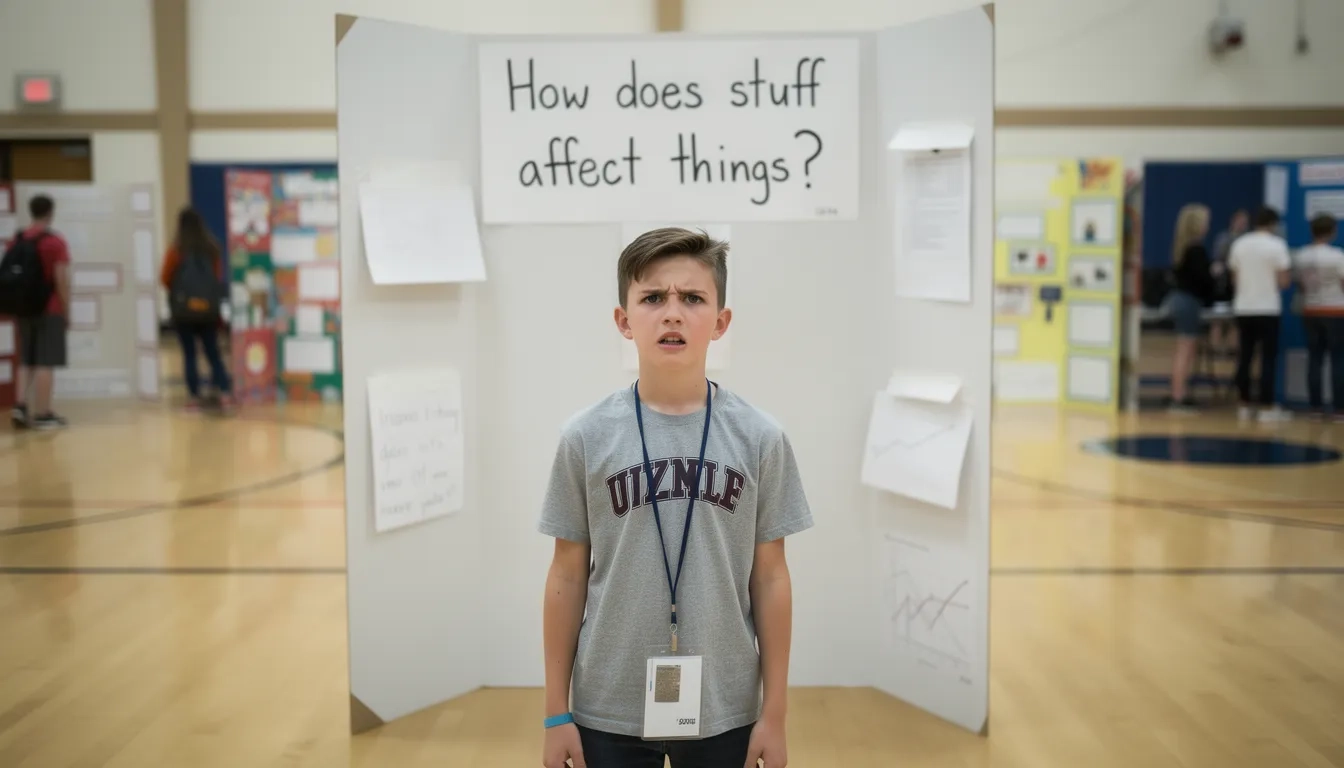
Most science fair projects collapse before a single measurement is taken. Not because the student wasn't smart. Not because the experiment design was flawed. But because the question driving the whole project was too vague, too obvious, or simply impossible to test with available equipment.
Your research question is the most important decision you'll make for the entire project. A strong question makes your hypothesis obvious, your experiment design almost automatic, and your conclusions meaningful. A weak question means rebuilding from scratch — usually two weeks before the deadline.
This guide walks through exactly how to build a question that actually works.
Why Most Science Fair Questions Fail
The most common question type at science fairs: "How does [vague thing] affect [other vague thing]?" Or worse: "What is [phenomenon]?"
These fail for a predictable reason. They're reporting questions, not investigating questions. "What is photosynthesis?" belongs in a textbook chapter, not a three-month experiment. A good science fair question doesn't ask what something is — it asks what happens when you change something specific.
The second failure mode is scope. "How does music affect human behavior?" sounds compelling but hides a deeper problem: which music, which behavior, measured how, in what population, over what time? Every undefined element is a crack in the foundation. Think of a vague question like trying to build a house on sand — it holds until the first real pressure hits.
The Two Types of Science Fair Questions
Before writing a single word, you need to make a choice that shapes everything else: scientific method or engineering design?
| Approach | Core Question Format | Goal | Example |
|---|---|---|---|
| Scientific Method | "How does X affect Y?" | Discover a cause-and-effect relationship | "How does soil pH affect tomato plant height?" |
| Engineering Design | "Which design best solves X?" | Optimize or build a solution | "Which truss design supports the most weight per gram of material?" |
The Maine State Science Fair explicitly structures its curriculum around this distinction, and it's not academic hair-splitting. These two approaches lead to fundamentally different question formats, experiment designs, and judging criteria.
Ask yourself: Am I trying to discover something about how the world works, or build and improve something? That answer comes first. The question format follows.
Step-by-Step: Building Your Research Question
Step 1: Start With What Actually Bugs You
Students who produce the best science fair projects almost never start with the most impressive-sounding topic. They start with genuine curiosity. ScienceFair.io puts it plainly: some of the best projects come from things people find themselves naturally gravitating toward in everyday life.
Spend a week noticing frustrations. What breaks faster than advertised? What product doesn't work as well as it should? What makes you think "there has to be a better way"? Write these down on paper — not phone notes — because physical writing slows you down and forces more deliberate thinking.
Your annoyance with how fast your phone battery drains is a more productive starting point than a topic you Googled to sound impressive in front of judges.
Step 2: Do a Quick Literature Scan
Once you have a topic area, read around it before committing to a question. Fifteen minutes on Google Scholar or PubMed (for biology-adjacent topics) gives you a rough map of what's already settled versus what's still being investigated.
The goal isn't depth — it's orientation. You want to know what's already well understood (so your question doesn't re-answer something closed) and where the interesting edges are. Past science fair winners in your category are also useful here (you can usually find them listed on your regional fair's website, organized by year and category).
Step 3: Identify Your Variables Before Writing the Question
This step surprises most students because it comes before the actual question gets written.
A workable research question must contain an implied relationship between two specific variables: the one you control (the independent variable) and the one you measure (the dependent variable). If you can't name both before writing the question, the question will end up vague no matter how carefully you word it.
Test yourself with this template:
"How does [independent variable] affect [dependent variable] in [specific context]?"
If you can fill both blanks with specific, measurable things, you have a working structure. If you're stuck on either blank, go back to Step 2.
Step 4: Apply the SMART Filter
Write your first draft quickly, then run it through the SMART filter:
- Specific: Does it name exact variables rather than broad categories?
- Measurable: Can you quantify the outcome with actual numbers?
- Achievable: Can you test this with your real budget and equipment?
- Relevant: Will the answer tell you something genuinely interesting?
- Time-bound: Can you complete it within your project timeline?
Here's what improvement looks like in practice:
Weak: "How does light affect plant growth?"
After the SMART filter: "How does 6 hours of daily red vs. blue LED exposure affect the stem height of bean sprouts over 4 weeks?"
Same general topic. One is answerable with clear measurements. One isn't.
The Non-Obvious Answer Rule
Here's a criterion that most guides skip, and it separates good questions from great ones: your question should have an answer that isn't already obvious.
Science Buddies states this directly — the question must have an answer that is "NOT a generally understood concept." If everyone already knows the answer, you're not doing science. You're confirming a textbook.
"Does sunlight help plants grow?" fails this test. Everyone knows it does.
"Does 20 extra minutes of UV exposure daily increase anthocyanin content in basil leaves?" passes. Most people have no idea. You probably don't either — and that's the point.
This filter also catches demonstration projects dressed up as experiments. Showing that baking soda and vinegar produces gas is replicating a known result, not investigating an unknown. Judges at regional and state-level fairs spot this immediately.
Weak vs. Strong: Direct Comparisons
Here's where theory meets practice. These four comparisons show exactly what changes when you apply the framework:
| Weak Question | Why It Fails | Stronger Version |
|---|---|---|
| "How does diet affect health?" | Unmeasurable, no variables defined | "How does daily sugar intake above 50g affect resting heart rate in 13–15 year olds over 30 days?" |
| "Is recycling good?" | Yes/no answer, not experimentally testable | "How does plastic type (PET vs. HDPE) affect decomposition rate in a controlled soil environment?" |
| "What makes a bridge strong?" | Vague, no measurable outcome | "Which truss design (Pratt vs. Howe) supports the greatest load-to-weight ratio using identical materials?" |
| "Does music affect studying?" | Multiple undefined variables | "Does 60 BPM instrumental music vs. silence affect recall accuracy on a 20-item vocabulary test?" |
Notice the pattern. Every strong version names exactly what changes, exactly what gets measured, and the specific conditions or subject pool. You could hand those questions to a complete stranger and they'd know what experiment to run.
Four Mistakes That Kill Otherwise Good Projects
Mistake 1: Picking a topic for prestige, not curiosity. Projects about RNA splicing or quantum phenomena — chosen without genuine understanding or accessible equipment — almost always underdeliver. Enzyme-based lab equipment alone can run upward of $14,700 for basic setups. Your question must be answerable with what you can actually access.
Mistake 2: Building the experiment first, then writing the question. This is completely backwards. When students reverse the process, they end up with data that doesn't clearly answer any question. The question must drive the experiment design — not the other way around.
Mistake 3: Confusing "answerable" with "testable." "What is the best renewable energy source?" is answerable in an essay. But it's not experimentally testable in a science fair context because you're not collecting original data — you're making arguments. Testable means you're conducting measurements yourself.
Mistake 4: Not revising early enough. If your question falls apart after two weeks of background reading, that's still early. Cheap to fix. Waiting until the experiment is half-finished makes the revision cost enormous — in time, materials, and motivation.
A Final Check Before You Commit
Before writing your hypothesis, run through these four questions:
- Can I name my independent variable (what I change) and my dependent variable (what I measure)?
- Is the answer genuinely unknown — not just to me, but probably to most people?
- Can I run this experiment with equipment and materials within my actual budget?
- Does my question imply a relationship rather than just describe something that already exists?
All four "yes" answers means you're ready to write a hypothesis and move forward. Any "no" means the question needs one more revision pass.
The revision isn't a setback. It's the actual work.
Bottom Line
- The question is the project. Everything else — hypothesis, experiment, data, conclusions — flows from it. No amount of careful execution saves a poorly formed question.
- Use the variable identification check before writing: name your independent variable and dependent variable first, then build the question around that relationship.
- Run every draft through the SMART filter and the non-obvious answer rule. Both checks together catch the vast majority of common question problems before they become expensive mistakes.
- If you're completely stuck, fill in this template: "How does [specific change] affect [specific measurable outcome] in [specific context]?" That single structure gets most students unstuck.
- Revise early and revise often. A question that shifts after one week of reading is far better than one that collapses after four weeks of experiments.
Frequently Asked Questions
What makes a science fair research question different from a regular essay question?
A science fair research question must be answered through original experimentation — you collect data by running tests yourself, not by reading what others found. Essay questions ask you to synthesize existing knowledge. Science fair questions ask what happens when you change something, which requires you to physically run an experiment and measure the results.
Can my research question be a yes/no question?
This is a common misconception worth addressing directly: yes/no questions are generally too weak. "Does caffeine affect heart rate?" invites a binary answer. "How much does 100mg of caffeine affect resting heart rate in 14-year-olds compared to 40-year-olds?" opens the door to quantitative data, comparisons, and real conclusions. Reframe yes/no questions as "how much" or "to what extent" questions wherever possible.
How specific does my research question really need to be?
More specific than you think. If your question could apply to 100 different experiments, it's still too broad. A strong question names the exact variable being changed, the exact outcome being measured, and the specific subject or setting. "How does temperature affect battery life?" is too broad. "How does storing a lithium-ion AA battery at 5°C vs. 25°C for 8 hours affect its remaining voltage?" is appropriately specific.
What if my research question changes after I've already started experimenting?
This happens often, and the right response depends on timing. If you catch it during background research, revise freely — nothing is lost. If you've already collected some data, assess whether that data can be reframed to answer a slightly different but related question before discarding it. Changing the core question after the experiment is complete is almost always too late; the data was collected to answer something else.
Do I need background research before finalizing my question?
Yes, and skipping this step is one of the most common project-killers. Even reading 3–5 solid sources on your topic will tell you whether your question has already been answered definitively, which variables other researchers found most significant, and what experimental pitfalls exist. A question that looks perfect in isolation can turn out to be a dead end once you know what the existing literature says.
My teacher says I need a hypothesis too. Which comes first?
The research question always comes first. A hypothesis is your prediction of what the answer to your question will be, usually written as an if-then statement: "If I increase soil salinity, then tomato plant height will decrease because salt disrupts osmotic water uptake." You cannot write a meaningful hypothesis until you have a clear, specific research question to anchor it to.