Science Olympiad Preparation Guide: How to Train Like a Top Team
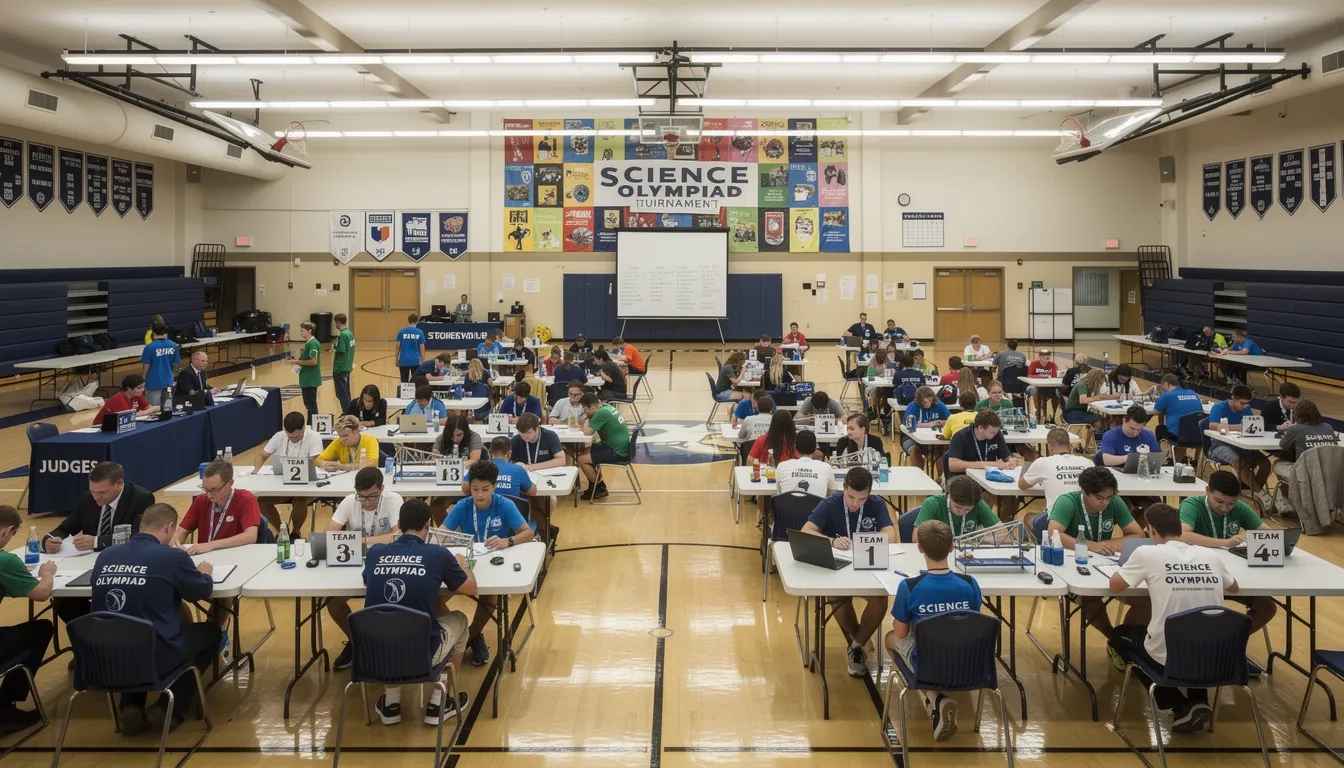
Most first-year Science Olympiad competitors make the same mistake: they show up to Regionals having studied hard but organized poorly. They've memorized plenty of facts, but when the proctor says "60 seconds," they can't find anything in their binder. The gap between finishing 4th and finishing 14th at a regional is often not knowledge. It's execution.
How Science Olympiad Actually Works
Science Olympiad runs three tiers before Nationals: Invitational tournaments (practice, non-qualifying), Regionals (qualifying), and State (where top teams earn a shot at Nationals). Over 7,000 teams compete nationally each year, split between Division B (middle school) and Division C (high school).
A team fields up to 15 members across 23 events. Most events require exactly two competitors, so most members handle 3 to 4 events total. That means the competition rewards both individual depth and team coordination — you can't win alone.
Rules manuals drop in September. Nationals takes place in May at a university campus. That gives you roughly eight months, which sounds like plenty of time until January hits and you realize your tower has never survived a test load.
The Three Event Types (and Why You Prepare for Each Differently)
Not all Science Olympiad events are the same, and treating them as if they are will cost you points. There are three distinct types, each demanding a different preparation mode:
| Event Type | Examples | What Actually Wins |
|---|---|---|
| Study (written exam) | Anatomy & Physiology, Astronomy, Dynamic Planet | Fast retrieval from a well-organized binder |
| Build (construction) | Wright Stuff, Tower Building, Scrambler | Reps, iteration, and a test log |
| Lab (hands-on) | Forensics, Experimental Design, Fermi Questions | Practiced process, not just content knowledge |
Study events reward depth AND speed. You're not just learning material; you're building a reference system you can navigate in under 10 seconds per query. Depth without speed is a liability on a 30-minute clock.
Build events are a different animal entirely. The teams that win don't necessarily have the cleverest design. They have the most test runs. A team that built and broke 23 tower prototypes before competition day will beat the team that built one "perfect" tower almost every time.
Lab events punish overthinking. Experimental Design gives you a scenario and asks you to design, run, and write up a controlled experiment in under 30 minutes. Winning teams have practiced the format so many times that setup is automatic. There's no time for creativity under that kind of pressure.
Building a Binder That Actually Helps You
For study events, your binder is your cheat code — but only if you can navigate it under pressure. Most teams at the novice level make binders that are technically thorough and practically useless. Twenty densely printed pages with no tabs is not a resource. It's a stack of anxiety.
The approach that works: organize by topic, not by source. Pull from textbooks, Scioly.org, class notes, and free materials from .gov and .edu sites, then synthesize everything into one unified section per topic. Color code sections however makes sense to your brain — the system only matters if you'll remember it at 11am with adrenaline running.
Two rules that save real time at competition:
- Put two pages per sheet protector, back-to-back. You get twice the content in half the space.
- Build a one-page quick-reference index at the front of each event binder. List major topics and the tab they're under. Five seconds consulting that page saves 45 seconds of frantic page-flipping.
The binder you build three weeks before the tournament is probably not the one you should bring. Use invitational results to find gaps, then rebuild. Teams that treat the binder as finished before they've competed with it are leaving points on the table.
Practice That Actually Matters
Here's an unpopular observation: most Science Olympiad preparation is passive. Students read notes. They review diagrams. They feel ready. Then competition day hits and timed pressure is completely different from anything they practiced in.
Scioly.org is the single best free resource in the ecosystem. It hosts archived tests from past invitationals and national tournaments going back years. These aren't practice worksheets — they're actual competition tests from top programs, and using them is the closest thing to a real rehearsal.
The right way to use them:
- Set a timer for the exact competition window for that event.
- Use only the materials you'd actually bring to a tournament.
- Score yourself afterward and flag every question you missed or guessed.
- Those gaps define next week's study list.
For build events, keep a trial log. Date, design specs, result, what failed, what changed. After 15 trials, patterns appear that aren't obvious run-to-run. That log also demonstrates process thinking — something judges sometimes ask about.
Invitational tournaments deserve more credit than they get. Many invitationals share tests and written feedback after the event, giving you free diagnostic data on exactly where your preparation is weak. Entering two or three invitationals before your qualifying regional isn't resume padding. It's the fastest way to find out what you don't know before it counts.
Team Dynamics and Event Assignment
A 15-person team has very different strengths across those 15 people. The best teams figure this out in September. The worst teams let everyone pick whatever sounds interesting, then scramble to cover gaps in November.
A balanced team needs both builders and test-takers. A squad stacked with strong test-takers will get wiped in build events. A team of brilliant engineers may fall apart during a Fermi Questions written exam. Be honest about who's who.
A few assignment principles that hold across seasons:
- Pair a stronger competitor with a developing one in each event. The stronger competitor keeps the score floor up; the developing one learns faster than they would solo.
- Alternates aren't bench players. Designate backups for events where your primary competitor has a scheduling conflict — regional and state tournaments often stack events back-to-back.
- Assign an event captain for each of the 23 events. This person tracks prep progress, finds resources, and flags rule changes. It doesn't have to be the strongest competitor. It should be the most reliable.
One thing coaches in competitive states swear by: run a full trial tournament before Regionals. All 23 events, one day. It surfaces logistical problems — room transitions, timing conflicts, fatigue — that no amount of individual event practice reveals.
Your Season Roadmap
Start in September; finish strong in May. Here's how serious teams break it down:
September – October: Rules drop. Every event captain reads their event's rules the week they're released. Assign partners and event captains by October 1st. Order build materials immediately — supply chain delays have derailed more than a few teams, and some specialized materials (like specific balsa wood grades for Wright Stuff) sell out at popular suppliers.
November – January: Your first invitational in this window is diagnostic. Treat it seriously, but don't panic over the score. The point is to find out what breaks under pressure. Binders get rebuilt. Build designs get scrapped. This is supposed to be uncomfortable — that's the signal that it's working.
February – March: Regionals season. Preparation is essentially done, so the focus shifts to execution: logistics, mental prep, and making sure every competitor knows their role cold. Walk the event rooms during the pre-event period when you can.
April – May: State and Nationals for qualifying teams. This is when marginal gains matter. Shaving 4 seconds off a binder lookup time or adding 17 more grams of tower capacity before States is exactly the kind of refinement that moves placements by one or two spots.
The best Science Olympiad teams aren't the ones that study the most — they're the ones that practice efficiently, find weaknesses fastest, and rebuild around them before it counts.
Bottom Line
Science Olympiad rewards teams that treat preparation as a system, not just a study habit. The evidence points toward a few high-leverage actions:
- Read the rules manual first. Every event's scoring, allowed materials, and format is in there. Teams that skip this step create problems no amount of studying can fix.
- Differentiate your prep by event type. Build events need reps and logs. Study events need binders you can navigate in 10 seconds. Lab events need format repetition above all else.
- Use Scioly.org and invitationals as diagnostic tools, not just extra practice. The feedback they generate is more actionable than another hour of passive reading.
- Assign events with team balance in mind, early. Fix coverage gaps in October, not February.
The single most important thing? Start in September and use your first invitational as a stress test. The teams that go deep into the bracket have usually already had their "this is way harder than we thought" moment by November. Getting there early is the whole game.
Frequently Asked Questions
How many events should each Science Olympiad team member do?
Most members handle 3 to 4 events per season. With 15 members and 23 events, spreading the load evenly matters less than matching events to strengths. Some events, like Experimental Design or Astronomy, benefit from pairing two people who've both studied the topic deeply rather than splitting attention across too many areas.
Is Science Olympiad worth it for college applications?
It's a strong activity, not because colleges love the name specifically, but because it shows sustained commitment to science, real teamwork, and the ability to compete at a high level in specialized subjects. State or National placement gives you a concrete achievement to discuss. Regional-level participation is still meaningful when paired with leadership roles — event captain, team captain — or measurable improvement across multiple years.
Myth vs. reality: Does having smarter teammates guarantee a win?
Not even close. Teams full of individually brilliant students routinely lose to squads with better coordination and preparation systems. Science Olympiad scores 23 events combined — a team that excels in 10 events but DNFs (does not finish) in 5 build events will lose to a balanced team that places solidly across all 23. Consistent execution across events beats peak performance in a few.
What's the difference between Division B and Division C?
Division B is middle school (grades 6–9) and Division C is high school (grades 9–12). Events overlap somewhat, but Division C runs considerably deeper. Topics like Fermi Questions and Experimental Design appear in both divisions, but the expected knowledge base and scoring difficulty scale up sharply in Division C. Competing in Division B for two or three years before transitioning gives students a real foundation in both content and competition mechanics.
What should I do if my team is starting preparation late (January or later)?
January is late for a February or March regional, but it's not hopeless. Focus on high-leverage moves: read the rules manual for each event, pull archived tests from Scioly.org to understand the question format, and identify two or three events per person where focused work can move the score fast. Study events with narrow topic scopes are often more improvable in 6 to 8 weeks than broad-scope ones where competitors are starting from scratch.