Study Techniques Backed by Science: What the Research Actually Shows
In 2006, Henry Roediger and Jeffrey Karpicke ran a simple experiment. One group of students read a passage twice. Another read it once, then took a recall test. One week later, the testing group remembered roughly 50% more material than the rereaders. Same time invested. Dramatically different results.
The kicker? Students predicted the rereaders would do better.
Why Popular Study Habits Fall Short
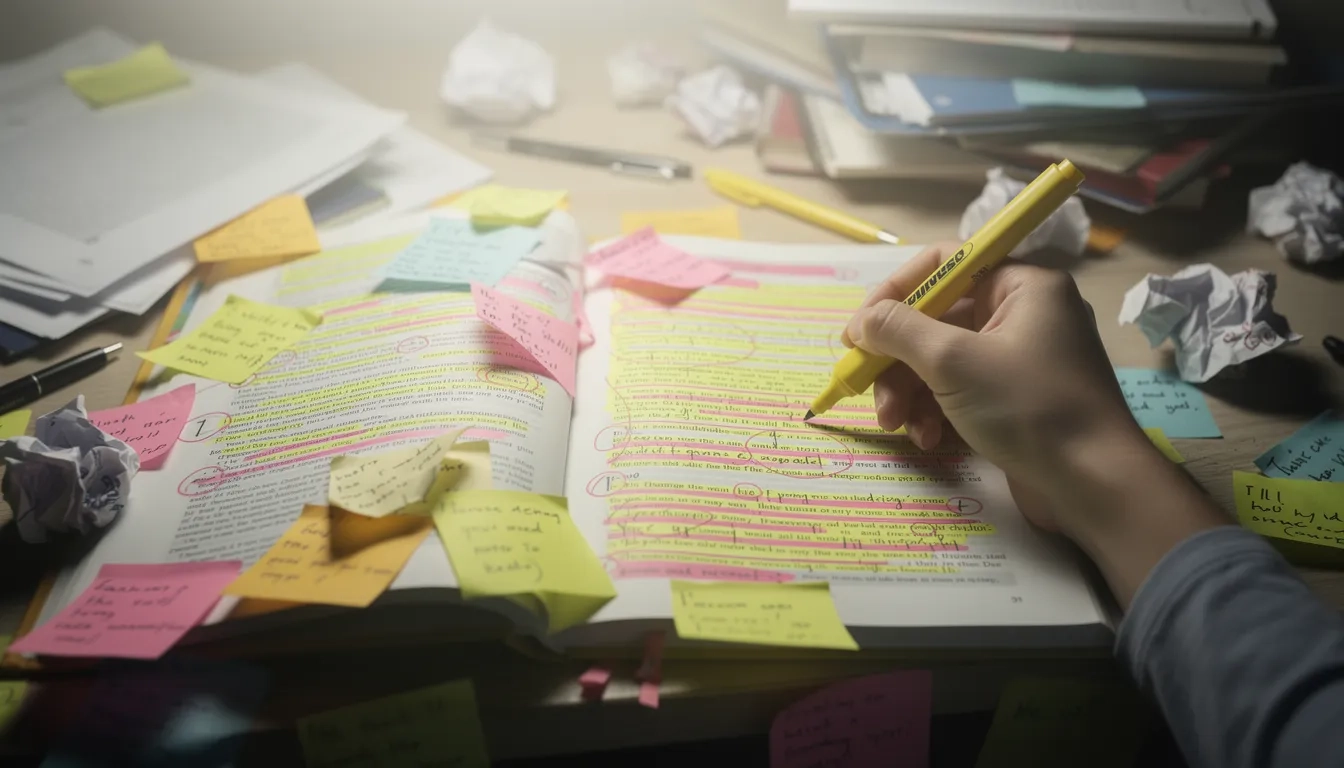
Rereading and highlighting are the most widespread study habits among students. They're also two of the least effective for building lasting memory.
The trap is called the fluency illusion: when you reread familiar material, it feels easy to understand. Your brain registers that ease as mastery. But recognizing information on the page is entirely different from retrieving it on demand during an exam.
Dunlosky et al.'s 2013 review — one of the most-cited papers in educational psychology — rated rereading and highlighting as "low utility" strategies. They produce short-term familiarity that evaporates quickly. Students keep using them anyway because they feel productive, and feeling productive is a terrible proxy for actually retaining anything.
Retrieval Practice: The Testing Effect
This is the single most research-supported technique available. Retrieval practice means actively pulling information from memory without your notes — through self-quizzing, properly used flashcards, or writing down everything you recall after finishing a section.
"Every time you work hard to recall a memory, you actually strengthen it." — Robert Bjork, summarizing decades of memory research at UCLA
Bjork & Bjork (1992) showed that successful retrieval physically alters a memory trace, making it more accessible later. The harder the retrieval — meaning more cognitive effort required — the stronger the effect.
Here's something that surprises most students: self-testing reduces exam anxiety. Agarwal et al. (2014) studied retrieval practice in real middle and high school classrooms and found it not only boosted scores but made students feel more confident going into tests. Regular low-stakes self-testing desensitizes the brain to retrieval demands. Students who only encounter recall conditions during the actual exam face memory challenges and anxiety simultaneously for the first time.
How to use retrieval practice:
- After reading, close the book and write down everything you just learned (blank page test)
- Use flashcards — but make yourself recall the answer before flipping; passive two-sided review misses the point entirely
- Do practice tests timed, without notes, before any exam
- Answer end-of-chapter questions without looking back, to see where your gaps actually are
Spaced Practice: When You Study Matters as Much as How
Cramming works. Temporarily. If your exam is tomorrow, five hours in one session will get you through it. But ask those same questions six days later and most of that information is gone.
Agarwal and Carpenter (2020) put it plainly: five one-hour sessions spread across five days beat a single five-hour session for long-term retention, with identical total study time. Hermann Ebbinghaus described the spacing effect in 1885, and 140 years of subsequent research hasn't dented it.
Hattie and Donoghue's 2021 meta-analysis synthesized 242 studies involving 169,179 participants. Their conclusion: distributed practice and practice testing are the two most effective learning interventions. Not the flashiest finding — just the most consistent.
Spacing schedule for new material:
| Time After Learning | What to Do |
|---|---|
| Same day (end of session) | 5-minute recall test |
| 1–2 days later | Review + self-quiz |
| 5–7 days later | Practice test or explain it aloud |
| 2–3 weeks later | Full spaced review session |
| Monthly (well-mastered) | Light recall check |
For brand-new material, the first 48 hours are most critical. Memory traces are most fragile right after encoding — a same-day review catches them before significant fading begins.
Interleaving: The Technique That Feels Backwards
Students who use interleaved practice consistently report feeling less confident during study sessions. They get more answers wrong. It's messier and slower than grinding through one topic at a time.
They also perform better on tests. Interleaving flies in the face of what feels efficient, and that gap between feeling and results is the whole point.
Blocked practice — mastering Topic A completely before touching Topic B — trains you to apply a solution you already know you need. Interleaved practice (mixing A, B, and C) forces you to first identify which solution applies. That identification step is exactly what exams require and what blocked practice never develops.
One series of experiments found students using interleaved math practice outperformed blocked-practice peers on a later test despite performing worse during the learning phase. The blocked group felt better about their progress throughout. They were wrong about their own progress.
How to interleave:
- Mix problems from different chapters in the same study session rather than working chapter by chapter
- In language learning, cycle through vocabulary, grammar, and reading comprehension in one sitting
- In any subject with multiple problem types, pull questions randomly rather than in topic clusters
The core insight: difficulty during practice is a signal that learning is happening. Struggling to identify which tool to reach for is the practice — not an obstacle to it.
Elaborative Interrogation: Ask "Why" Until It Sticks
Elaborative interrogation means asking "why is this true?" about every new fact instead of accepting it and moving on. One study found that students using this method answered roughly 72% of test questions correctly, compared to about 37% for students using conventional study methods on the same material with the same time.
Pressley et al. (1987) showed that students who generate their own explanations substantially outperform those who receive explanations from textbooks or teachers. When you produce the connection yourself, it encodes more deeply than when you passively receive it.
There's a real limitation worth knowing: elaborative interrogation works best when you already have background knowledge. For complete beginners with no foundation, asking "why?" can lead to confident but incorrect explanations — which then get encoded as fact. Build a basic factual scaffold first, then interrogate it.
What this looks like in practice:
- Learning that mitochondria produce ATP? Ask: why does the cell need a dedicated structure for this rather than producing energy diffusely?
- Studying the French Revolution? Ask: why did food prices specifically trigger unrest rather than economic inequality alone?
- Working through a math theorem? Ask: what problem does this actually solve, and why does this approach work instead of alternatives?
Self-Explanation: Teach It to Learn It
Self-explanation is closely related to elaborative interrogation but different: instead of asking why a fact is true, you narrate your reasoning as you work through a problem.
Chi, de Leeuw, Chiu, and LaVancher (1994) found this technique effective across diverse subjects and ability levels. The key detail: explaining during the process is more effective than explaining afterward. Post-hoc narration gives you too much opportunity to reconstruct a tidy story that doesn't reflect what you actually understood while working.
The Feynman Technique (named after physicist Richard Feynman, who was notorious for this approach) operationalizes it directly: explain a concept on paper as if teaching a complete beginner. Where your explanation breaks down, gets vague, or requires unexplained jargon — that exact spot marks where your understanding is thin.
My view: most students confuse familiarity with understanding. Self-explanation exposes that confusion faster than any other method, because you cannot explain what you don't actually understand.
Chunking and Metacognition: The Supporting Layer
Chunking organizes information into meaningful units rather than isolated fragments. George Miller's (1956) research argued working memory handles roughly 7 items at once; more recent work puts the figure closer to 4 meaningful chunks. What matters isn't the exact number — it's that how you organize material directly affects how much you can hold and how reliably you can retrieve it.
Expert chess players don't memorize more squares than novices. They see configurations and patterns that the novice experiences as 32 individual pieces. Chunk size — built through repeated exposure and meaningful organization — is a significant part of what separates expert from beginner performance.
Metacognition, thinking about your own thinking, acts as an oversight layer for everything else. Before studying, ask: what do I already know, and where are my real gaps? After a session, ask: what did I genuinely understand, and what do I only think I understood? That second question is the harder one to answer honestly. That honesty is the whole point.
Students who actively monitor their own comprehension during study — rather than reviewing uniformly — achieve better outcomes in less total time. They stop spending hours on mastered material and redirect to actual gaps.
| Technique | Effort | Best For | Trap to Avoid |
|---|---|---|---|
| Retrieval Practice | Medium | All subjects | Passive flashcard review |
| Spaced Practice | Low | All subjects | Irregular, unminded intervals |
| Interleaving | High | Math, problem-solving | Switching before any foundation exists |
| Elaborative Interrogation | Medium | Fact-heavy subjects | Using with zero prior knowledge |
| Self-Explanation | High | Complex reasoning | Explaining after the fact |
| Chunking | Low | Memorization tasks | Groups without meaningful connection |
Bottom Line
The research points one direction: the most effective study methods are also the most cognitively demanding during practice. Rereading feels like work. Self-testing, spaced sessions, and interleaving feel like struggling. That discomfort is not a bug — it's how durable memory gets built.
What to change starting now:
- After every lecture or reading, do a blank page recall test before reviewing your notes
- Space your sessions: three 45-minute sessions across a week will outperform one three-hour block for anything you need to retain beyond next week
- Mix topics within sessions, especially in subjects with multiple problem types
- Ask "why?" about new facts; explain concepts aloud until you hit the places you can't explain
- If you use Anki or any spaced repetition tool, insist on genuine recall before revealing the answer
The core shift is this: treat studying as retrieval practice, not content review. The goal is training your brain to find information on demand — not re-exposing yourself to material you already recognize.
Frequently Asked Questions
Is cramming ever actually a good strategy?
Cramming can improve performance on an exam within 24 hours — material is temporarily accessible even if it won't persist. But if you'll need to build on that knowledge in future courses or on cumulative exams, massed last-minute studying creates weaker, more poorly organized memories than distributed practice would have. It's essentially borrowing against future learning capacity.
How is Anki different from regular flashcard review?
Anki uses a spaced repetition algorithm (based on Piotr Woźniak's SM-2 algorithm developed in the 1980s) that schedules each card for review at the optimal moment — just before you'd likely forget it. This maximizes the memory-strengthening effect of each session. Regular flashcard review without attention to timing is closer to rereading: better than nothing, but not exploiting the spacing effect.
Doesn't testing yourself just increase anxiety before exams?
This is a genuine myth. Agarwal et al. (2014) found retrieval practice reduced exam anxiety and increased confidence — not the opposite. Regular low-stakes self-testing desensitizes the brain to retrieval demands. Students who only encounter recall conditions for the first time during a high-stakes exam face both memory challenges and anxiety simultaneously. Frequent practice separates those two stressors.
Does interleaving work better for some subjects than others?
Interleaving shows the strongest gains in subjects requiring strategy selection: mathematics, physics, foreign language grammar. The benefits are less dramatic in subjects primarily built on conceptual understanding, like history or literature. A reasonable rule: start with short blocked sessions when a concept is completely new, then begin interleaving once basic competence is established.
How does sleep factor into how well these techniques work?
Sleep is when memory consolidation happens. Material gets replayed and encoded into long-term memory during slow-wave and REM sleep stages. Studying new material in the evening before sleep puts it into the consolidation window faster. Pulling an all-nighter cancels much of this benefit even if the study session itself was efficient — you're encoding into a fatigued system that hasn't yet processed the previous day's learning.
What's the minimum viable version of these techniques for someone pressed for time?
The highest-impact, lowest-overhead combination: blank page recall immediately after studying, followed by one spaced review session two days later. That two-session protocol, done with genuine retrieval rather than passive review, will outperform multiple rereading sessions. Add interleaving and elaborative interrogation when your schedule allows and the material is worth the deeper investment.
Sources
- Six research-tested ways to study better — American Psychological Association
- 5 scientific study techniques: Interleaving, spaced repetition, retrieval practice, metacognition, chunking — Cognition Today
- Strategies for Making Learning Last: Retrieval Practice, Spaced Practice and Interleaving — CIRL, Eton College
- Retrieval and Spaced Practice: Study Strategies That Must Be Combined — Evidence Based Education
- The Power of Self-Explanation — Northeastern University Center for Advancing Teaching and Learning
- The Effectiveness of Spaced Learning, Interleaving, and Retrieval Practice in Radiology Education — Journal of the American College of Radiology