Studying for the SAT While Working: What Actually Works
Working a job and studying for the SAT is genuinely hard. Not impossible. Hard. You come home, dinner happens, maybe the gym, and by 9 p.m. you're supposed to open a math prep book with a brain that already put in eight hours. The thing is, the data cuts through a lot of that anxiety. College Board's research, drawn from nearly 250,000 students, found that 20 hours of personalized practice on Khan Academy's Official SAT Practice produced an average 115-point score gain. Twenty hours. That's roughly 37 minutes a day over a month.
The catch — and there's always a catch — is that those 20 hours have to be intentional.
What You're Actually Preparing For
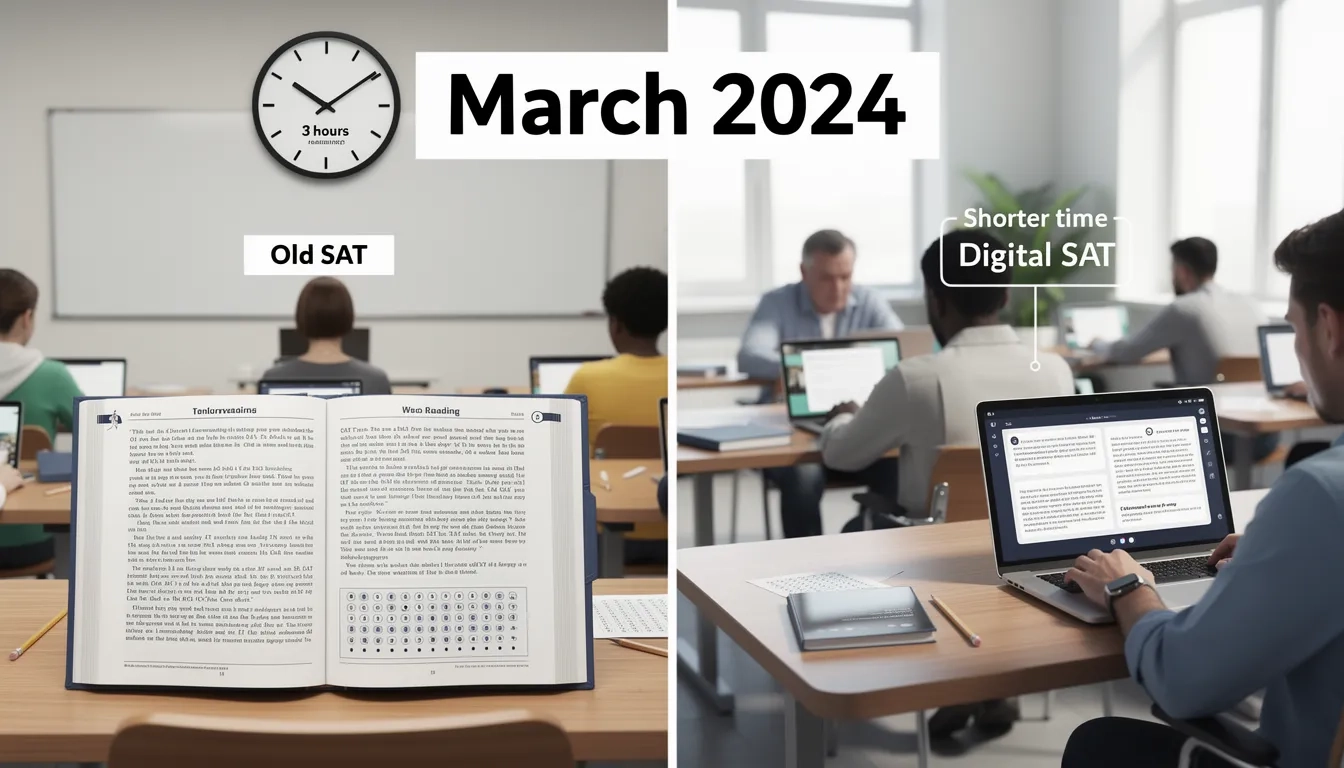
The SAT changed dramatically in March 2024, and if any advice you've found mentions long reading passages or a three-hour test, it's outdated. The current digital SAT runs just 2 hours and 14 minutes and is taken on a laptop or tablet through College Board's Bluebook app.
The test has two sections: Reading and Writing, and Math. Each section splits into two modules, and your performance on the first module determines the difficulty of the second. Score well on Module 1 and you unlock harder (but higher-scoring) questions in Module 2. A built-in calculator is available throughout the entire Math section — no memorizing arithmetic shortcuts required.
For working adults, this is good news. Shorter test means less mental stamina required. You're training for a hard 5K, not a marathon. And since Bluebook runs on most laptops and tablets, you can run practice modules during a lunch break (on your personal device, not a work-monitored one).
The Honest Math: How Many Hours Do You Need
Before building any schedule, take a diagnostic test first. The Bluebook app includes free, full-length practice tests. Take one before you study anything. Your score gap from your target determines the actual time required.
Based on PrepScholar's analysis of score improvement data, here's how study time maps to improvement:
| Target Improvement | Estimated Hours | At 5 hrs/week |
|---|---|---|
| +30–70 points | 20 hours | ~4 weeks |
| +70–130 points | 40 hours | ~8 weeks |
| +130–200 points | 80 hours | ~16 weeks |
| +200+ points | 150+ hours | 30+ weeks |
Five hours per week is realistic for a working adult. Most people targeting a 100-point gain can get there in about 8 weeks.
One caveat: these are focused hours, not calendar hours. Studying while half-distracted by a phone counts for maybe half. Protect the time you commit.
Building a Schedule Around Your Job
The biggest mistake working adults make is trying to study every single day. That schedule collapses after the first rough week. Pick 3–4 fixed study days and treat them like work meetings — non-negotiable.
Three schedules that hold up in practice:
Morning-heavy (best for early risers)
- 60 minutes on 3 weekday mornings before work
- One 2-hour weekend session
- Total: ~5 hours/week
Weekend-heavy (best for unpredictable evenings)
- 2.5 hours Saturday morning
- 2.5 hours Sunday morning
- One 30-minute weekday lunch session
- Total: ~5.5 hours/week
Lunch-and-evening split (for smaller score gaps)
- 30 minutes during lunch on 3 weekdays
- One 1.5-hour evening session
- Total: ~3 hours/week
Morning sessions tend to outperform evening ones for most adults. Decision fatigue after work is real, and SAT math doesn't care that you had a brutal afternoon.
Tell someone about your schedule. When a partner or roommate knows you're studying Saturday mornings, competing plans stop getting booked. That's the whole elephant in the room with SAT prep accountability — most people skip this step entirely.
Studying in Stolen Time
On days when a full session isn't possible, micro-sessions add up faster than you'd expect. Ten to 20 minutes of focused practice is worth doing on a busy day — not as a replacement for real sessions, but as a genuine supplement.
Good spots to steal time:
- Morning commute on transit (not while driving)
- Lunch break, away from your desk
- The 15 minutes between getting home and starting dinner
- While waiting for a meeting to actually start
For these windows, use the College Board's free SAT Question Bank or Khan Academy's mobile app. Both let you drill 5–10 questions on a specific skill without opening a full practice test. Khan Academy works offline once content is downloaded, which helps on spotty subway connections.
One trap: don't count distracted micro-sessions at full value. Track your deep-focus hours separately and be honest about what actually happened.
What to Study First
Random practice is the slowest path to a better score. After your diagnostic, focus on your second-weakest areas before your absolute weakest ones.
This sounds backward, but the return on time is radically different across skill areas. Your weakest area might require 20 hours of work for a 40-point gain. Your second-weakest area — grammar and punctuation rules, say — might need only 6 hours for a 30-point gain. Same points per hour? No. The second-weakest area wins by a mile.
For most working adults returning to standardized tests after a few years away, this priority order holds up:
- Grammar and usage rules in the Reading and Writing section — rule-based, memorizable, fast gains
- Problem-solving and data analysis in Math — the "easier" math category that most prep materials rush past
- Algebra and advanced math — higher ceiling, steeper time investment
College Board's free SAT Question Bank organizes questions by skill domain. After your diagnostic, work through 30–40 targeted questions per weak domain before you touch full practice tests. Khan Academy's personalized practice, linked directly to your College Board account, adjusts difficulty based on your performance. It's not glamorous software, but the data behind it is real.
Taking Practice Tests Without Losing Your Weekend
Full-length practice tests take about 2 hours and 45 minutes with breaks. For a working adult, that means one thing: block a Saturday or Sunday morning completely. Squeezing a practice test into a weekday evening produces rushed, stressed results that don't reflect how you'll perform under real conditions.
College Board's data shows that students who take one practice test score an average of 25 points higher than those who take none. Two tests: 45 points higher. Three or more: 60 points. The curve flattens after three, but that's a solid target across your prep period.
Here's where most people leave serious points behind: they skip the review. A practice test without a thorough review is worth half a practice test that gets reviewed. After every test, block an equal amount of time to go through every missed question — not just to see the right answer, but to understand specifically why you got it wrong. Content gap? Time management issue? Consistent careless-error pattern? Each diagnosis needs a different fix.
The practice test is just a diagnostic. The review session is where the learning happens.
No practice test gets taken without a same-day or next-day review. Make it a rule.
Keeping Your Head in the Game
Working adults face something most high school students don't: daily cognitive drain from the job. Eight hours of decisions, emails, and meetings burns through mental fuel that SAT prep needs.
A few things that genuinely help:
- Study before opening email. Your brain is sharpest in the first two hours after waking. Email starts consuming that bandwidth immediately.
- Cap sessions at 90 minutes. Past that, error rates on practice problems climb. Practicing while fatigued doesn't build skills — it reinforces bad habits.
- Space out study days. Monday, Wednesday, and Saturday beats three days in a row. Sleep consolidates what you learned.
There's an honest advantage working adults have over 17-year-olds that rarely gets mentioned: discipline. Years of showing up on time, meeting deadlines, and producing under pressure are exactly the mental muscles SAT prep requires. A 45-minute focused session from someone who's been working for years is worth more than a two-hour distracted session from someone who's never had to be accountable to a clock. Don't count yourself out just because the test is marketed toward high school seniors.
Bottom Line
- Start with a full diagnostic test in Bluebook before studying anything. Your score gap tells you exactly how many hours to budget — don't guess.
- Pick 3–4 fixed study days per week and protect them. Morning slots outperform evening ones for most adults with full-time jobs.
- Use Khan Academy's Official SAT Practice linked to your College Board account. It's free, adaptive, and the 115-point average gain from 250,000 students is legitimate data, not a marketing claim.
- Take 3 full practice tests under real conditions (morning, no interruptions, Bluebook app) and review every missed question before your next session.
- Front-load your content work on high-ROI areas — grammar rules and data analysis before advanced algebra.
The SAT doesn't reward the person who studied the most hours. It rewards the person who studied the right things, consistently, and actually went back and reviewed their mistakes.
Frequently Asked Questions
How many hours a week should I realistically study for the SAT while working full-time?
Three to six hours per week is both realistic and effective. At five hours a week, a 100-point improvement takes roughly 8 weeks of consistent work. The bottleneck isn't volume — it's protecting those hours from schedule creep without exception, week after week.
Is Khan Academy actually effective for SAT prep, or is it just College Board marketing?
The data isn't marketing. College Board's study of nearly 250,000 students found that 20 hours on Khan Academy's Official SAT Practice produced an average 115-point gain — nearly double the improvement seen without it. The personalized practice adjusts to your weak spots, works on mobile, and costs nothing. Use it.
Can I prepare for the SAT in just one month while working?
Yes, if your target improvement is under 100 points and you can commit 10–12 hours per week. Magoosh's one-month SAT plan structures sessions at 60–90 minutes per day, five to six days a week — doable, but demanding. For gains larger than 100 points, two to three months with a more sustainable pace produces better retention and less burnout.
Does the digital SAT require different preparation than the old paper version?
A few specific things changed. The adaptive format means Module 1 performance sets the difficulty of Module 2 — don't bail on hard Module 1 questions hoping to skip them. Practice should happen inside Bluebook, not just on paper, so the interface feels natural on test day. The built-in calculator is available throughout Math, which changes how you approach timed problem-solving.
Should I hire a tutor if I'm already working full-time?
For a target improvement under 150 points, probably not. The free resources are strong enough that a tutor would mostly replicate what Khan Academy and Bluebook already provide. Where a tutor earns their fee: you have a specific content gap (advanced geometry, complex reading inference questions) that you want addressed in three to four targeted sessions rather than diagnosing over weeks of solo practice.
What's the single biggest mistake busy adults make when preparing for the SAT?
Skipping the diagnostic and jumping straight into prep materials. Without a baseline score, you'll spend time on content you already know while neglecting the areas that would actually move your score. Take the full practice test in Bluebook first — all 2 hours and 45 minutes of it. That data tells you exactly where your time should go.
Sources
- New Data Links 20 Hours of Personalized SAT Practice to 115-Point Score Gains — College Board Newsroom
- How to Build an SAT Study Plan: 4 Sample Schedules — PrepScholar
- How to Study for the SAT in One Month — Magoosh
- Build Your Study Plan — SAT Suite, College Board
- Digital SAT 2025 Format and Scoring Guide — KeySkillSet