How to Calculate Your Target SAT Score by College
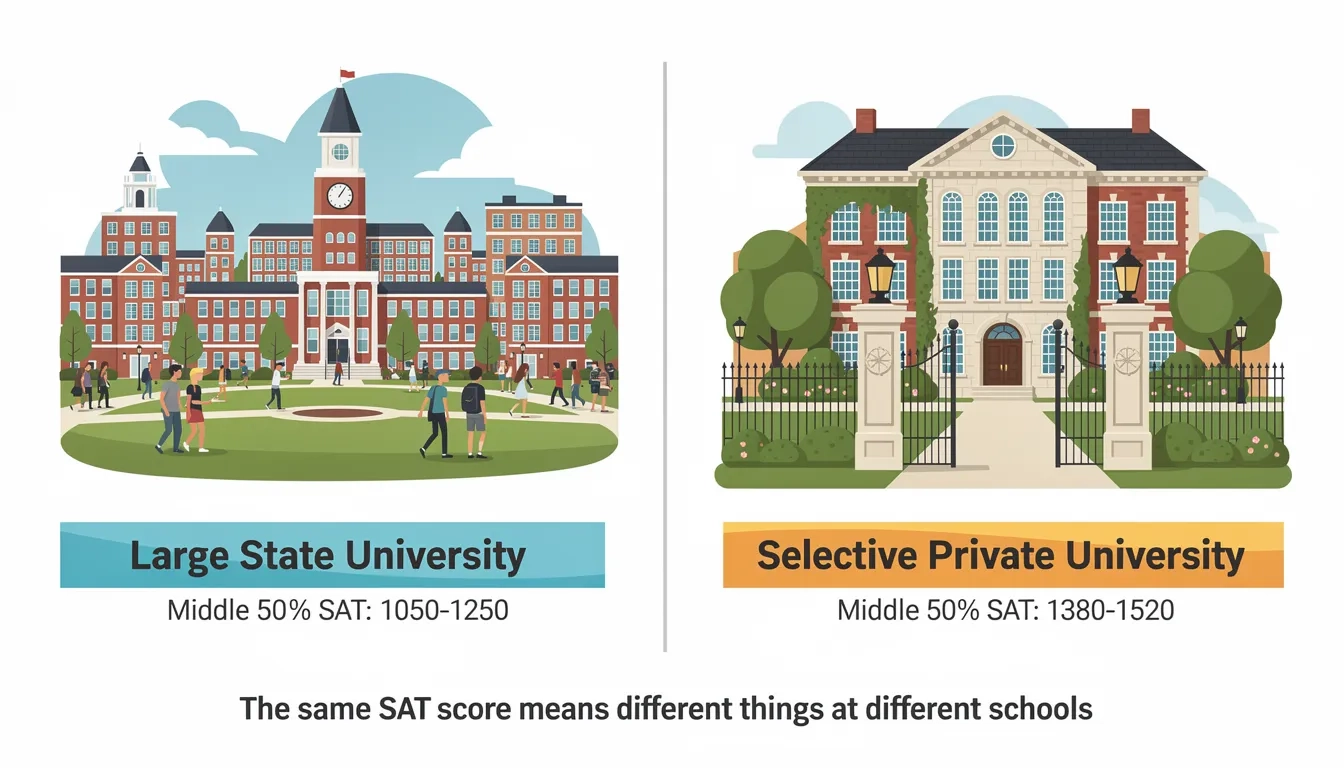
The national average SAT score for the class of 2025 was 1029. That number is almost completely useless for figuring out whether you're on track for your colleges. What actually matters is something far more specific: your target school's middle 50% score range, and where your current score falls inside it.
Why "A Good SAT Score" Depends Entirely on Your College List
When a student asks whether a 1350 is "good," my first question back is: good for what? A 1350 puts you above the 75th percentile at Michigan State (middle 50%: 1110–1320). At Georgia Tech (middle 50%: 1370–1530), that same score falls below the 25th percentile. Same number. Opposite implications.
Generic benchmarks mislead more than they help. The framing that works in admissions is the middle 50% range: the 25th to 75th percentile SAT scores of a school's enrolled freshman class. Every school publishes this in their Common Data Set, and it tells you more about your realistic odds than any "what's a good score" article ever will.
Think of it like a job salary range. Knowing a position pays "$70,000–$100,000" tells you something real about whether your expectations fit. Knowing the "average American salary" tells you almost nothing about whether your specific offer is competitive.
College Board's BigFuture tool aggregates this data across thousands of schools. You don't have to hunt through individual PDFs.
How to Calculate Your Target Score: A Step-by-Step Process
This is a back-solving exercise. You start from the colleges, not from a vague aspiration.
- List every college you're seriously considering — dreams, targets, and likely admits all included.
- Pull the 25th and 75th percentile SAT scores for each school. Search "[school name] Common Data Set" and look for Section C9, or use BigFuture for a faster lookup.
- Find the highest 75th percentile score across your entire list. That number becomes your primary target. Hit it, and you're in the top quartile of applicants at every school simultaneously.
- Note the lowest 25th percentile as well. Falling below any school's 25th percentile doesn't immediately disqualify you, but scores will likely work against you rather than for you.
- Set two targets, not one: an aspirational goal (the highest 75th percentile) and a conservative floor (the lowest 25th percentile you need to clear). Study toward the aspirational one while making sure you pass the floor first.
This process takes about 45 minutes to run properly. Students who skip it spend months aiming at an arbitrary number with no real connection to their actual college list.
SAT Score Ranges by College Tier (2025–2026 Data)
The ranges below reflect recently published Common Data Set and admissions profile data. Always verify directly on each school's website — score ranges shift year over year.
| School | 25th Percentile | 75th Percentile |
|---|---|---|
| Harvard | 1510 | 1580 |
| MIT | 1520 | 1570 |
| Princeton | 1500 | 1560 |
| Stanford | 1510 | 1570 |
| Yale | 1480 | 1560 |
| Cornell | 1510 | 1560 |
| Brown | 1510 | 1560 |
| Carnegie Mellon | 1510 | 1560 |
| Rice | 1510 | 1570 |
| Georgetown | 1400 | 1540 |
| Georgia Tech | 1370 | 1530 |
| University of Michigan | 1360 | 1530 |
| Vanderbilt | 1510 | 1560 |
| Northeastern | 1450 | 1520 |
| Boston College | 1460 | 1520 |
| University of Florida | 1320 | 1470 |
| UNC Chapel Hill | 1270 | 1450 |
| Rutgers | 1250 | 1430 |
| Michigan State | 1110 | 1320 |
| University of Alabama | 1090 | 1370 |
Notice the gap between tiers. The jump from Michigan State's 75th percentile (1320) to Georgetown's 25th percentile (1400) is 80 points — roughly 8 weeks of focused preparation for most students starting from a solid baseline.
The 75th Percentile Rule, and When to Break It
PrepScholar popularized what's now called the 75th percentile rule: target the 75th percentile of your most selective school, and you're positioned competitively across your full list. Solid advice.
"To have a decent shot at your target college, aim to score in the higher range of the middle 50% SAT scores of that college." — Prep Maven's strategic prep guidance
But at the most selective schools, the rule softens considerably. At Harvard (25th: 1510, 75th: 1580), admissions weighs so many factors that a 1535 versus a 1570 rarely determines outcomes. Harvard's acceptance rate is under 4%. Nobody is getting rejected there for a 35-point differential while holding a perfect transcript and compelling essays.
Where the 75th percentile rule really earns its keep is at schools that use scores more systematically. State flagship honors programs, merit scholarship cutoffs, and some public universities with algorithmic admission thresholds will filter on your score before a human ever reads your file.
Merit scholarship thresholds are where students most consistently leave money on the table. At the University of Alabama, their highest merit tier is tied to a specific score cutoff. Missing it by 10 points can mean a difference of $23,847 in cumulative aid over four years, based on a standard four-year package differential. That's not a holistic judgment call. It's arithmetic.
Turning Your Target Score into a Study Plan
You can't build a meaningful plan without knowing your starting point. Take a full-length Digital SAT practice test using official College Board materials before doing anything else. That baseline is your anchor.
Once you have both numbers — current score and target — the gap tells you what's ahead.
Quick math for Digital SAT scoring:
- Each math question is worth roughly 10 points.
- Each Reading & Writing question is worth roughly 6 points.
- A 100-point improvement means answering about 7 more math questions correctly, or 17 more reading/writing questions correctly.
Break your target improvement down that way, then match study hours to what you need:
| Score Gap | Study Hours | Expected Gain |
|---|---|---|
| Under 80 points | 20 hours | 50–70 points |
| 80–150 points | 40 hours | 80–120 points |
| 150–220 points | 80 hours | 130–200 points |
| 220+ points | 120+ hours | Exceeding initial targets |
These are focused hours — structured, timed, reviewed. Passive reading of prep books without timed practice sections barely moves the needle.
Khan Academy's Official SAT Practice is worth using specifically because it's built on College Board data. College Board's own research, conducted with Princeton Review analysts, found that students who spent 20 or more hours on the platform gained an average of 115 points. The platform has since been updated for the Digital SAT adaptive format, and the personalized recommendations pull from your actual diagnostic performance, not a generic curriculum.
Superscoring, Test-Optional Schools, and How Policy Changes Everything
The test-optional era that peaked during COVID has been unwinding. Dartmouth became the first Ivy League school to reinstate test requirements for the 2025–2026 admissions cycle (a move that signals the broader direction several schools are likely heading). MIT and Caltech never dropped their requirements. A handful of University of California schools remain test-blind, meaning they won't consider scores regardless of what you submit.
This fragmented environment means your score strategy depends on each school's policy individually.
When to submit a score at a test-optional school:
- Score at or above the school's 50th percentile (midpoint of their middle 50% range): submit.
- Score between the 25th and 50th percentile: evaluate whether your GPA and coursework make submission a net positive.
- Score below the 25th percentile: withhold. The application reads stronger without a below-range score creating friction.
Superscoring changes the calculation entirely. If a school combines your best section scores across test dates, you're not trying to have one perfect sitting. You're maximizing Math on one date and Reading/Writing on another.
Here's what that looks like in practice. A student who scores 680 Reading/Writing and 720 Math in October, then 710 Reading/Writing and 690 Math in December, ends up with a superscored composite of 1430 (710 + 720). Neither test date produced that result on its own. Check each school's superscoring policy on their admissions FAQ page (buried, but it's there) before committing to another test date.
Bottom Line
- Your target SAT score is school-specific, not national. Pull the 25th and 75th percentile data from the Common Data Set for every school on your list. Set your primary target at the highest 75th percentile across all of them.
- Take a full practice test before planning anything. Your baseline determines the timeline. Without it, you're guessing at how much time you actually need.
- Score gaps translate directly to study hours. A 200-point gap needs roughly 80 focused hours. Map that against your testing calendar before signing up for your first sitting.
- Merit scholarship cutoffs matter as much as admission thresholds. At many schools, missing a scholarship score cutoff is just as costly as missing admission — and costs more in the long run.
- Know each school's superscoring and test-optional policies before your last test date. These policies change whether retesting makes financial and strategic sense at all.
Frequently Asked Questions
What is the middle 50% SAT range and how do I use it?
The middle 50% range covers the 25th to 75th percentile SAT scores of admitted freshmen at a given school. Scoring above the 75th percentile strengthens your application; below the 25th percentile, scores can actively hurt you. Find each school's range in Section C9 of their Common Data Set, or search through College Board's BigFuture tool for a quicker lookup.
How do I find my specific target SAT score?
Build your full college list first. Pull the 25th and 75th percentile SAT scores for each school from their Common Data Set. Your aspirational target is the highest 75th percentile score across your entire list. Your floor is the lowest 25th percentile you need to clear. This back-solving approach gives you a real, data-grounded number rather than an arbitrary benchmark.
Is a 1400 a good SAT score?
It depends entirely on your list. A 1400 sits above the 75th percentile at Rutgers (1250–1430), right at the 25th percentile at Georgetown (1400–1540), and well below MIT's 25th percentile of 1520. The score means nothing without knowing which schools you're applying to.
Should I submit my SAT score to test-optional schools?
If your score is at or above the school's midpoint (roughly the center of their middle 50% range), submit it. If it falls below the 25th percentile, withhold it — below-range scores create friction without adding value. For scores in between, consider whether your GPA and coursework already tell a strong enough academic story on their own.
How does superscoring change my test prep strategy?
If a school superscore, you're optimizing each section independently across test dates instead of trying to peak on a single day. Focus preparation on whichever section has the most room to improve, knowing the stronger section from a prior sitting is already locked in. Always verify a school's policy before committing to another test date.
How much can I realistically improve my SAT score?
Prep Maven's research links study intensity to expected gains: roughly 50–70 points with 20 focused hours, 80–120 points with 40 hours, and 130–200 points with 80 hours. College Board's own data shows an average 115-point gain for students who complete 20 or more hours of personalized practice on Khan Academy. Structured, diagnostic practice outperforms passive studying by a wide margin.
Sources
- What Are Good SAT Scores for Colleges? 101 Schools and Advice — PrepScholar
- SAT and ACT Policies and Score Ranges for Popular Colleges — Compass Prep
- Setting a Target Score — College Board SAT Suite
- SAT Goal Setting: Your Ultimate Guide — Prep Maven
- How to Use SAT Scores Strategically in College Admissions — Sparkl