Turning Hobbies Into Activities: How to Make It Stick
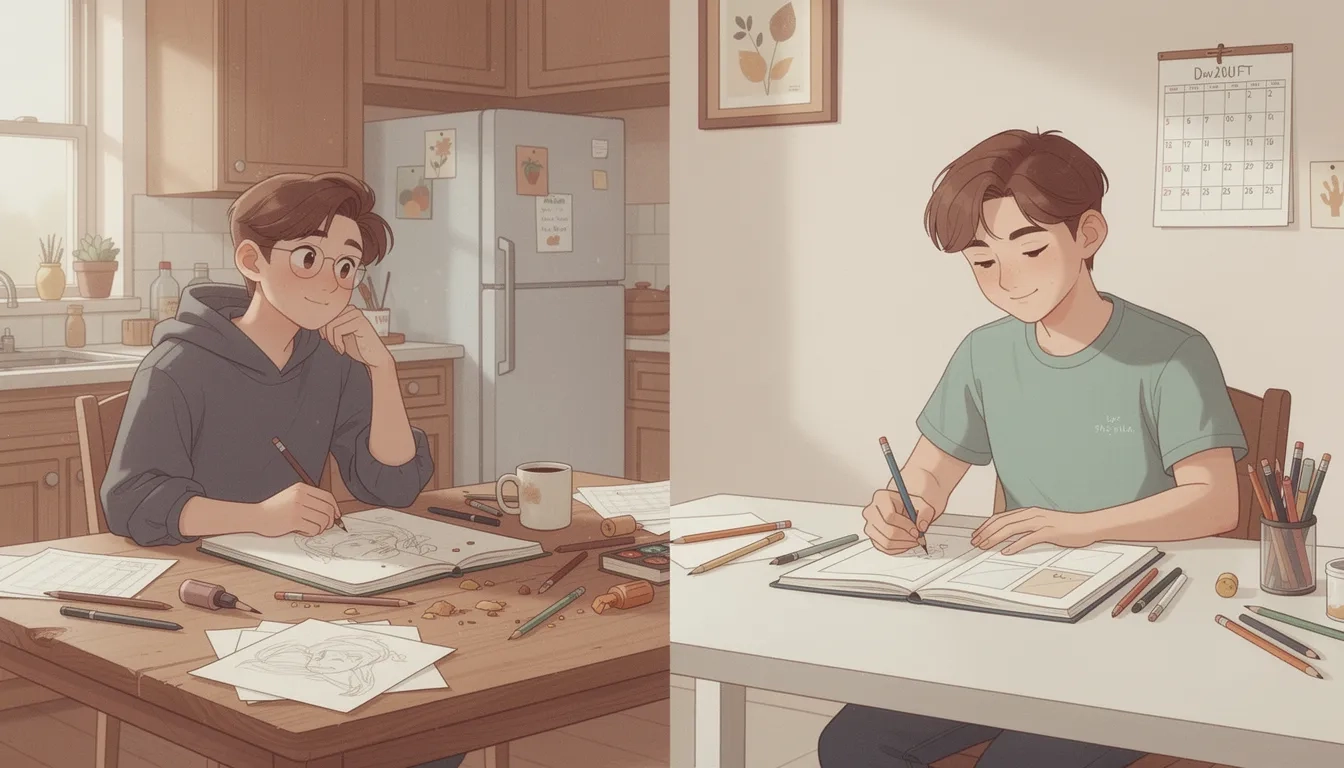
There's a specific kind of frustration that comes from owning a hobby rather than doing one. You have the sketchbooks. You own the guitar. You've spent more on running shoes than you'd care to admit — but when someone asks if you're a runner, you hesitate.
Most people read this as a motivation problem. It isn't. It's a structure problem. And the fix has less to do with willpower than with understanding how your brain responds to different kinds of leisure.
The Gap Between Dabbling and Doing
A hobby is anything you do during spare time for pleasure. That definition sounds freeing. In practice, "whenever I feel like it" translates to "rarely" for most of us, and the hobby stays permanently in its warm-up phase.
The research draws a real line between hobbies and structured activities. A 2025 scoping review published in Issues in Mental Health Nursing found that hobbies produce their strongest wellbeing effects when they involve progressive skill-building — not just repeating familiar patterns. The activity itself matters less than how you approach it.
A PMC-published study comparing hobbies and organized activities found that roughly 75% of participants with the best wellbeing outcomes engaged in both types simultaneously. The hobby gave them pleasure. The structured activity gave them growth, accountability, and social connection. Not one or the other — both.
The same research noted that hobbies tend to be more accessible than organized activities because they require fewer resources and no formal enrollment. That makes them the natural starting point. But accessibility has a ceiling. Without a built-in mechanism to push you past what's already comfortable, progress stalls.
Why Your Brain Needs the Right Challenge
Psychologist Mihaly Csíkszentmihályi spent decades studying what he called "flow" — that state of deep absorption where effort feels effortless and outside distractions fall away.
"Nothing else seems to matter; the experience is so enjoyable that people continue doing it even at great cost." — Mihaly Csíkszentmihályi
Flow depends on a specific challenge-to-skill ratio. When a task is too easy, you drift. Too hard, and anxiety shuts things down. The sweet spot is when the challenge just outpaces your current ability — which means you need to know what your current ability actually is.
In a study of 188 junior tennis players, athletes who focused on personal improvement rather than winning reported significantly more flow states during matches. The variable wasn't talent. It was intentionality.
Unstructured practice rarely stays in that productive band. Paint using the same techniques for three years and you're not growing — you're maintaining. That doesn't feel bad, exactly, but it explains the creeping sense that the hobby isn't going anywhere.
Research cited by The Conversation found that flow suppresses the brain's default mode network, the system behind mind-wandering, rumination, and the inner critic. Hobbies and sports produce flow more reliably than almost any other activity. But the condition is active, progressive engagement. Watching tutorials counts for something. Actually doing the thing, with deliberate intent, counts for significantly more.
Four Stages of the Transition
The process of turning a hobby into a structured activity is simpler than most people expect. Most people stall because they skip Stage 3.
Stage 1: Define a concrete skill marker. Not "get better at guitar." Instead: "Play a four-chord progression cleanly at 90 BPM within 90 days." A vague goal gives your brain nothing to aim at. A specific one creates feedback loops that make practice feel purposeful rather than arbitrary.
Stage 2: Set a session floor, not a ceiling. The floor is the smallest session that still counts — for most hobbies, 15 to 20 minutes. It should feel almost insultingly easy to hit. You're not training for an event. You're building a chain. One long unbroken chain motivates far more than a single heroic session followed by two weeks of nothing.
Stage 3: Add external accountability. This is the step most people skip, and it's where sustained practice separates from eventual abandonment. Accountability doesn't need a paid coach. A practice log shared with one friend works. A weekly community check-in works. Publicly committing to a goal on a forum works.
Utah State University Extension research found that group-based and team-oriented hobbies reduce depression and anxiety symptoms noticeably more than solo ones. The social element isn't decoration — it amplifies everything else.
Stage 4: Run a monthly review. Every four weeks, check your Stage 1 marker. Is the skill moving? If not, adjust the method, not the motivation. This is where an outside perspective — someone further along in the activity — often becomes genuinely useful.
Good structure shouldn't feel like homework layered onto something you enjoy. If it does, the structure is wrong.
The Social Multiplier
Joining a community around a hobby can feel like inviting pressure into something previously pressure-free. Most people find the opposite.
The PMC study identified a key split: organized activities expand social networks, while solitary hobbies tend to deepen personal emotional regulation. Both outcomes matter. But when structure and community combine, you capture both at once.
Here's what this looks like in practice:
- A solo knitter joins a craft circle, gets direct technique feedback, and ends up knitting three times as often as before
- A weekend runner joins a local club, commits to a group route, and finally follows through on a half-marathon they'd been "almost ready for" since 2022
- A home cook posts weekly to a subreddit, gets focused critique from a professional cook, and improves more in eight weeks than in the previous two years combined
The community isn't just social glue. It's a skill accelerator.
| Approach | Skill Growth | Social Benefit | Motivation Source |
|---|---|---|---|
| Casual hobby, solo | Slow or flat | Minimal | Internal mood |
| Structured hobby, solo | Moderate | Minimal | Personal goals |
| Casual hobby, community | Slow | Moderate | Social connection |
| Structured activity, community | Fast | High | Goals + accountability |
The best outcomes cluster at the bottom right. Getting there requires both elements.
The Passive Consumption Trap
There's a failure mode that catches a lot of people, especially in hobbies with rich online communities: consuming content about the hobby instead of actually practicing it.
Utah State University Extension research draws a firm line between active engagement and passive leisure. Only the active kind shows consistent mental health benefits. Passive activities — scrolling, watching, reading endlessly — feel like rest. They're not the same thing.
Your brain's default mode network keeps running in the background regardless. It processes anxieties, replays conversations, generates self-critical commentary. Active engagement is one of the few things that genuinely suppresses it. That's why you feel genuinely refreshed after an hour of focused making in a way you don't after an hour of YouTube.
Utah State research found that approximately 75% of participants had measurably lower cortisol after an art-making session, regardless of prior experience level. The act of focused creation was enough. That effect doesn't replicate from watching someone else create.
Three signs your hobby has drifted toward passive consumption:
- Your skill level hasn't changed meaningfully in over a year
- You consume more about the hobby than you actually practice it (multiple books on watercolor technique, no recent paintings)
- You feel motivated to "get back to it" constantly, but rarely feel energized after a session
That second sign is the most telling. Buying gear, saving tutorials, planning future projects — none of that is practice. It's procurement.
When to Monetize — and When to Think Twice
Here's a position worth stating plainly: most hobbies shouldn't be monetized early. Not because the opportunity isn't real, but because money changes the psychology of an activity in ways that often work against you.
Psychologists call it the overjustification effect — when external rewards are introduced for something someone already enjoys intrinsically, internal motivation tends to shrink. You start making ceramics for joy, add custom orders, and every blank piece of clay starts feeling like a fulfillment queue.
That said, some transitions work well. A 2025 Entrepreneur.com piece followed several people who built side ventures from hobbies — guided hiking, boxing instruction, dog walking. The ones who kept their joy had a pattern in common: they built community and structure before charging. Airbnb Experiences taps into a global hiking community of over 118 million participants. The dog walking industry reached $1.7 billion in 2024. Real markets exist.
The question isn't whether the market is there. It's whether adding money would make you do more of the thing or less.
A practical test: run the activity as a free community offering for three months. You can always add money later, but you can't un-ring the bell once client expectations have reshaped what the work feels like. If it still feels like the thing you love, charge for it. If it already feels like an obligation, you have your answer before anything is hard to reverse.
Bottom Line
Turning a hobby into a structured activity isn't about manufacturing discipline from scratch. It's about installing three conditions your brain needs to stay engaged: a clear skill target, a consistent minimum, and at least one other person who knows you're doing it.
- Pick one measurable skill marker and give yourself 90 days to move it — specific beats vague every time
- Set a session floor so small it's impossible to skip ("20 minutes counts")
- Add one social layer — a group, a forum, a single friend; anything with mild external accountability
- Review monthly: is the skill moving? If not, change the method, not the effort
- Hold off on monetizing until the activity has real momentum — then decide with actual experience whether income helps or hurts it
Structure isn't the enemy of enjoyment. Done right, it's what turns occasional enjoyment into something that actually lasts.
Frequently Asked Questions
What's the actual difference between a hobby and an activity?
A hobby is informal, self-directed leisure with no external accountability or formal progression. A structured activity carries goals, scheduled sessions, and often other people. The line isn't rigid — many great hobbies gradually become activities as the practitioner adds intention. Research consistently shows the structured version produces stronger outcomes for both skill and wellbeing.
How long does it take to build a consistent hobby routine?
Most people need four to six weeks to establish baseline consistency. Behavioral research on habit formation suggests full automaticity takes anywhere from 18 to 254 days depending on the person and activity. The fastest path: start with a floor so low that skipping feels stranger than showing up.
Can adding structure kill the joy of a hobby?
It can, if the structure is mismatched to the activity or person. Rigid schedules with high-stakes performance goals strip out the playfulness that made the hobby worth doing. Good structure preserves autonomy — you choose the targets, the session length, the community. The 2025 review in Issues in Mental Health Nursing found intrinsic motivation to be a key ingredient in hobbyist wellbeing; structure should support it, not replace it.
Is monetizing a hobby always a bad idea?
No, but timing matters. Research on the overjustification effect shows external rewards can crowd out internal motivation when introduced before the activity has its own stable identity and momentum. The safer pattern is to build structure and community first, then charge once the activity stands on its own — as the case studies in Entrepreneur.com's 2025 coverage illustrated.
What types of hobbies convert most naturally into structured activities?
Skill-based hobbies with clear progression paths work best: music, visual arts, martial arts, coding, running, language learning, woodworking. Hobbies with active online or local communities also transition more easily because the accountability infrastructure already exists. The common thread is measurability — if you can tell whether you're getting better, you can structure the practice around it.
Is passive engagement with a hobby — watching videos, reading books — worthless?
Not worthless, but limited as a substitute for practice. Passive consumption can inspire and inform, but it doesn't produce the physiological benefits of active doing. Utah State University Extension research found measurable cortisol reduction from active creative sessions — an effect that doesn't appear in passive engagement with the same material. Think of it as useful context, not a replacement for the actual work.
Sources
- Exploring the Impact of Hobbies on Mental Health and Well-Being: A Scoping Review
- Feeling distracted? How hobbies can help you find 'flow state' and save your brain
- A Comparison of Hobbies and Organized Activities Among Low Income Urban Adolescents
- How Hobbies Improve Mental Health
- Association of Enjoyable Leisure Activities With Psychological and Physical Well-Being
- How I Turned My Hobbies Into Profitable Side Businesses With My Friends