Volunteering That Actually Makes a Difference
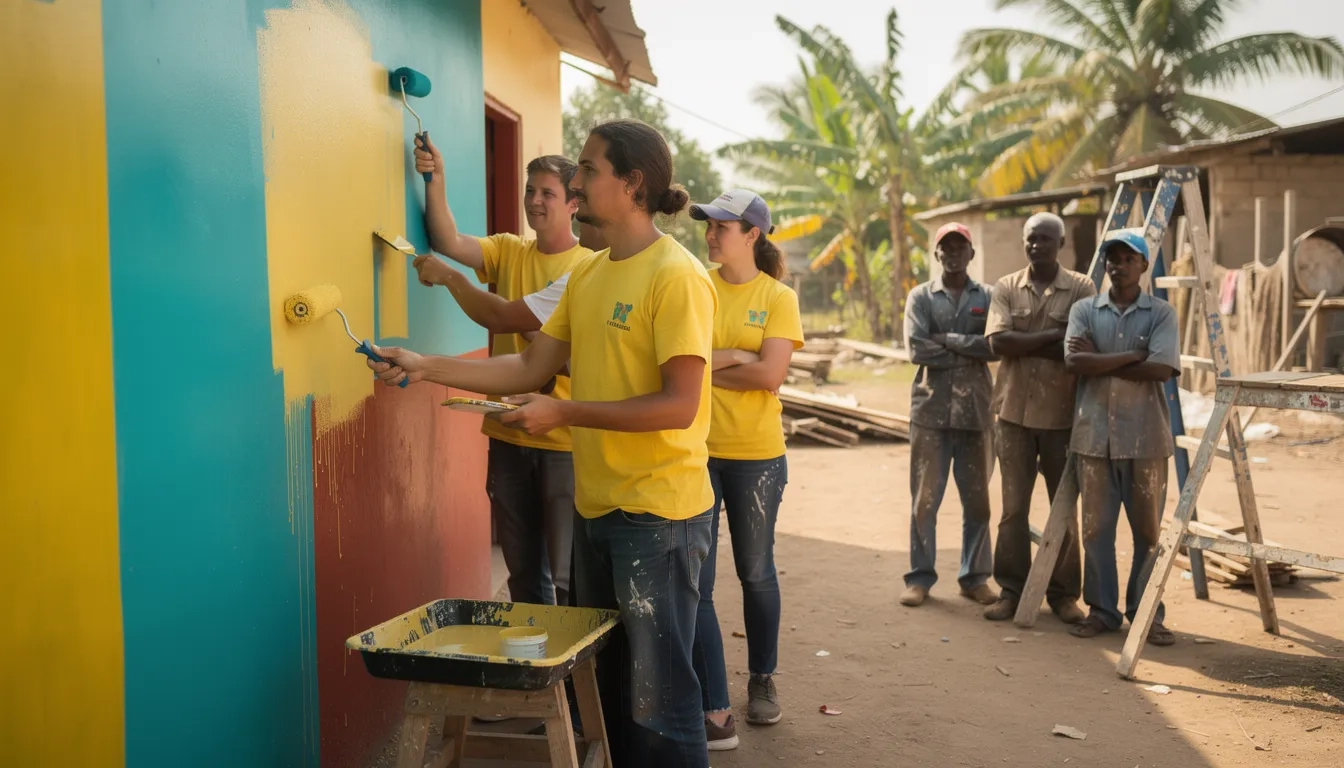
Every year, tens of thousands of people fly to orphanages in Cambodia, Guatemala, and Ghana to spend two weeks painting walls and playing with children. They come home with photos, a sense of purpose, and a story they'll tell at dinner parties for years.
The kids don't remember them. And in some cases, those communities are measurably worse off.
This is the uncomfortable truth about volunteering: good intentions are not the same as good impact. The gap between them can be enormous, and closing it requires thinking differently about what "helping" actually means.
Why Voluntourism Often Backfires
The global voluntourism industry generates an estimated $2 to $3 billion annually and draws more than 10 million participants. Those are large numbers for an enterprise that researchers increasingly describe as more beneficial to volunteers than to the communities they visit.
The core problem is skill mismatch. A dentist who builds homes, a marketer who digs wells, a teacher who "experiences" local culture. None of these people are doing work that requires their specific presence. A local worker could do the same job faster, cheaper, and with ongoing accountability to their own community.
The Ghana healthcare example is particularly stark. When outside volunteers flooded local health programs with free medical services, residents began opting out of purchasing health insurance. When the volunteers left, the local healthcare infrastructure had been quietly hollowed out. The help created dependency, not capacity.
Orphanage tourism runs a darker version of the same pattern. In several countries, facilities maintained a supply of children specifically to attract Western volunteers and donors — many of those children had living parents. UNICEF has documented this across Southeast Asia and sub-Saharan Africa.
The question to ask isn't "Am I doing something good?" It's "Would this community be better served if I donated the money I spent getting here instead?"
Sometimes the answer is yes. Acknowledging that takes honesty most volunteering programs don't encourage.
The Skills-Based Difference
Not all volunteering works this way. There's a version that generates genuinely outsized impact, and the gap in value is staggering.
Skills-based volunteering means donating professional expertise rather than general labor. The Taproot Foundation, which has partnered with over 100 Fortune 500 companies to connect professionals with nonprofits, estimates one hour of skills-based volunteering is worth $220 on average. One hour of traditional volunteering is valued nationally at $34.79.
That's not a rounding error. That's a categorically different kind of contribution.
A graphic designer building a nonprofit's annual report, a CFO constructing a small organization's financial model, an HR professional drafting an employee handbook for a food bank. These are contributions that would cost real money on the open market. Common Impact's research confirms that skills-based volunteering can generate multiple times the social value of hands-on work. And 92% of nonprofits report that skilled volunteers are a strong resource for building organizational capacity.
The distinction matters because most nonprofits face resource constraints in very specific ways. They can find people to sort donations. They struggle to find someone who will rebuild their database, advise on their grant strategy, or write their board policies.
A Framework for Choosing Where to Volunteer
Not everyone has a neatly transferable professional skill set, and that's fine. The key is matching what you actually bring to what's genuinely needed.
| Your Profile | Best Match | What to Avoid |
|---|---|---|
| Professional expertise (legal, finance, marketing, tech) | Skills-based consulting via Taproot, Catchafire, or Idealist | Generic one-day events that underuse your background |
| Physical capacity, local availability | Sustained local service (food banks, tutoring, habitat builds) | International voluntourism without long-term commitment |
| Specific lived experience | Peer support, mentorship, advocacy organizations | Organizations that don't value experiential knowledge |
| Limited time, high flexibility | Virtual, episodic roles via Catchafire or All for Good | Multi-year commitments you can't realistically sustain |
The "sustained local" category gets less credit than it deserves. A food bank or literacy program that can count on you every Tuesday for 14 months is worth more operationally than ten enthusiastic one-time volunteers. Consistency is what turns presence into progress.
And if you're still drawn to international work, the same logic applies. Organizations like Engineers Without Borders require months-long commitments in technical roles. That's not an accident.
What Nonprofits Actually Need From You
This is the section most volunteering guides skip. Nonprofits are polite. They'll thank you for whatever you give. But their honest wish list looks quite different from what most volunteers offer.
Reliability beats enthusiasm, every time. A volunteer who shows up consistently and sends a quick heads-up when they can't make it is worth far more than someone who arrives with enormous energy and disappears after three weeks. Volunteer managers (in organizations lucky enough to have them — only 65.2% of nonprofits using volunteers employ dedicated staff) spend enormous energy managing no-shows and retraining new people.
Orientation matters more than most volunteers realize. Organizations that invest 90 minutes in proper onboarding see significantly better retention and output quality. If you're offered training, treat it like a first week at a job, not a formality to rush through.
Clear roles help both sides. The research on what makes volunteer programs effective points consistently to specificity: volunteers who receive clear task descriptions with defined deliverables contribute more and burn out less. If an organization cannot tell you what you'll actually be doing on a given day, that's a signal about their capacity to use your time well.
Three questions worth asking before you commit
- What does a typical shift look like, hour by hour?
- How will you know if my contribution was useful?
- Who do I contact if something isn't working?
Organizations with good answers to all three are worth your time. Ones that stumble on question two often haven't thought hard enough about impact.
Making It Last
Volunteer burnout is real and under-discussed. The Center for Effective Philanthropy found in 2024 that 95% of nonprofit leaders identify burnout as a major concern. That's among paid staff. Volunteers face the same pressures without the accountability structure that keeps professionals showing up.
The burnout pattern is predictable. Someone starts with enormous motivation, takes on too much, gets no feedback on their impact, and quietly disappears six months in. The organization spends weeks trying to fill the gap.
A few approaches that actually prevent this:
- Set a bounded commitment upfront. Six months with an explicit option to renew. Not "I'll help as long as you need me" — that phrasing sounds generous but creates an open-ended drain.
- Ask for impact updates. Organizations that show volunteers the difference they're making retain them at higher rates. If your work disappears with no feedback, ask directly what happened to it.
- Match your intensity to your life stage. People with young children, demanding jobs, or heavy caregiving loads often do far better with episodic volunteering than with recurring weekly commitments.
The average American volunteer now gives 70 hours per year, down from 96.5 hours in 2017. That decline reflects time scarcity and burnout in roughly equal measure. Organizations adapting to shorter, more flexible commitments are seeing better participation and retention.
The New Shape of Volunteering
Something shifted between 2020 and 2025. Remote work normalized, and remote volunteering came with it. What was a niche option became a standard one.
Virtual volunteering now represents 18% of all formal volunteer activity in the U.S. Catchafire, which matches skilled professionals with nonprofits for time-limited projects, grew from 2,700 engagements in November 2020 to over 14,000 by November 2024. That growth didn't happen because remote volunteering is easier. It happened because geography no longer limits access to expertise. A nonprofit in rural Mississippi can now work with a UX designer in San Francisco.
Gen Z has driven this shift. They prefer virtual, hybrid, and project-based roles, and they contribute more total hours through these formats than through traditional in-person arrangements. The assumption that younger people don't volunteer is simply wrong. They volunteer differently.
For organizations still resistant to virtual participation, this represents a real missed opportunity. Across the sector, 38% of funders actively want nonprofits to expand remote volunteering options. The field is moving, whether individual programs are ready or not.
What the best volunteer platforms look like now
- Catchafire: Project-based, skills-matched, time-limited (5 to 40 hours per project)
- Taproot+: Professional services for nonprofits, vetted applications on both sides
- Idealist: Broad listings including virtual and hybrid roles by specialty
- VolunteerMatch: Strong for local, in-person opportunities with verified organizations
- All for Good: Aggregates opportunities across multiple platforms by location and skill
Bottom Line
Effective volunteering isn't about doing more. It's about doing the right thing, in the right way, with the right organization.
- Match your skills to actual gaps. If you're a lawyer, don't sort cans. Help a nonprofit understand its employment law exposure. If you're a data analyst, help a food pantry figure out who it's not reaching.
- Commit long enough to matter. Three months minimum for any recurring role. Shorter than that, and you're mostly consuming organizational resources rather than building them.
- Choose organizations that can absorb your help. Clear onboarding, defined roles, and a named person accountable for the volunteer experience are the signals that matter.
- If you want to help internationally, send money first. Donate to organizations already embedded in the work. If you still want to go in person, commit to at least six months in a role that genuinely requires skills you have.
The elephant in the room is that volunteering often makes the volunteer feel better without doing much for anyone else. That's not a reason to stop. That's a reason to aim higher.
Frequently Asked Questions
Is it better to donate money than to volunteer?
It depends entirely on what you bring. If your professional skills are in high demand and genuinely transferable to a nonprofit's needs, your time can be worth more than a financial donation — Taproot Foundation's data suggests up to $220 per hour for skills-based work. But if the volunteering is largely unskilled labor, a financial contribution often generates more impact per dollar, especially for international work where local labor is cheaper and more contextually appropriate.
How do I know if a volunteer program is worth my time?
Look for three things: a clear description of what you'll actually do on a given day, evidence of impact measurement (what outcomes do they track and how?), and a defined volunteer management structure. Programs that can tell you what happened to last year's volunteers and what those volunteers helped produce are operating at a different level than ones that simply take whoever shows up.
Is short-term volunteering ever actually worthwhile?
Yes, with caveats. Short-term or one-day volunteering works when it's project-based and skills-matched, when it supports an organization's existing ongoing work rather than replacing sustained effort, and when it's part of a longer relationship (recurring giving, annual commitment). One-off events that exist primarily to generate photos and social posts are mostly for the volunteers.
What is skills-based volunteering, and how do I find opportunities?
Skills-based volunteering means donating professional expertise — legal, financial, marketing, technology, design, HR — to nonprofits that couldn't otherwise afford those services. Taproot Foundation, Catchafire, and Idealist are the main platforms in the U.S. where you can browse project-based opportunities matched to your professional background. Most projects run between 5 and 40 hours over several weeks, making them accessible to busy professionals.
Myth vs. Reality: Does volunteering make a meaningful difference, or is it feel-good activity?
Honestly, sometimes both — and the distinction matters. Volunteering that matches skills to organizational needs, maintains consistency, and operates within organizations with the capacity to use help well generates measurable impact. Volunteering that's disorganized, brief, or mismatched primarily benefits the volunteer's sense of purpose. Common Impact's research makes clear that intentional skill-matching and outcome measurement are what separate the two categories.
How many hours per week should I realistically plan to volunteer?
That depends on your life stage and the role, but research suggests treating it like a small part-time commitment rather than an open-ended gift of time. The most effective sustained volunteers tend to give 2 to 4 hours per week consistently rather than 10 hours one month and zero the next. For episodic or project-based roles, a single 15-hour project completed well beats three projects started and abandoned. Sustainability matters more than intensity.
Sources
- The State of Volunteering 2025: Trends & What to Expect in 2026
- What is Skills-Based Volunteering? - Taproot Foundation
- What Does the Future of Volunteering Look Like? - Johnson Center
- Insights & Impact 2020: Measuring the Social Impact of Volunteerism - Common Impact
- Doing Good or Doing Harm? A Critical Examination of Voluntourism in a Globalized World
- The Paradox of Voluntourism: How International Volunteering Impacts Host Communities - Michigan Journal of Economics