How to Write a Dissertation Proposal That Actually Gets Approved
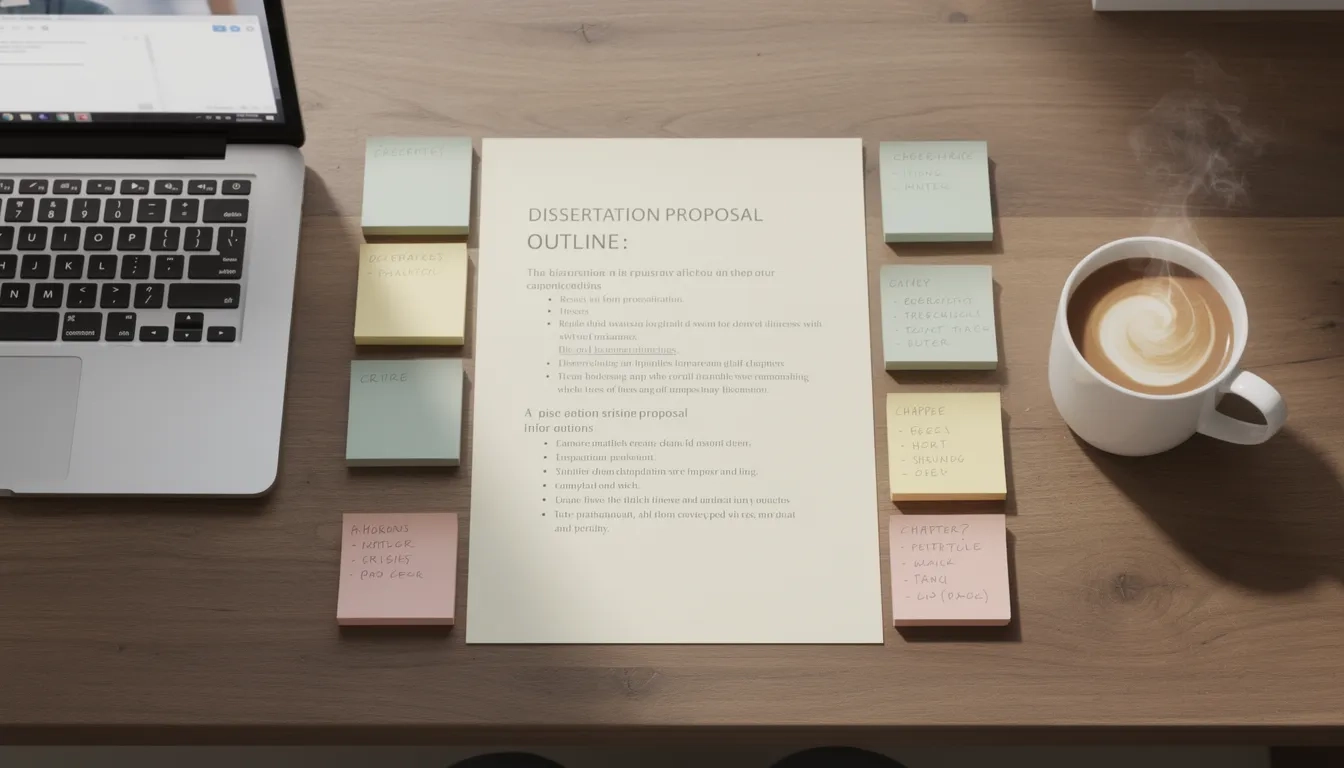
Most doctoral students treat the dissertation proposal like a warm-up exercise. It isn't. According to a Council of Graduate Schools study, only 56.6% of PhD starters finish their degree within ten years, and a shaky proposal is one of the earliest places that number gets decided.
Why So Many Proposals Bounce Back
A dissertation proposal has one job: prove your project is clear, worth doing, and doable before anyone lets you spend three to seven years on it. Not brilliant. Doable.
Committees reject far more proposals for fuzzy execution than for boring topics. A student can propose something modest and sail through if the plan is airtight, while a dazzling idea with no real method gets sent back for revisions, sometimes twice. Get the proposal wrong and you're rewriting it for months; get it right and the dissertation practically writes itself.
At Stanford's Graduate School of Education, the median time to a doctoral degree for students finishing between 2018 and 2023 was 5.7 years. That's the stopwatch your proposal starts. Treat it like a contract you're signing with your future self, not a formality your advisor skims.
Three questions decide whether a proposal survives committee review, and you should be able to answer each in one sentence before you write a word:
- What exactly are you asking, and why should anyone care?
- What data will answer it, and can you actually get that data?
- Can you finish this within the time and budget you actually have?
If you're hedging on any of those, stop drafting and go answer the question first.
Pick a Question That Can Survive a Committee
The single most common proposal failure isn't a bad idea. It's an idea sized for a book when the student has funding for a chapter. Narrow beats ambitious, every time, at the proposal stage.
Say you want to study "social media and teen mental health." That's a dissertation topic for someone else, someone with a research team and five more years. Narrow it: Instagram use among 14- to 16-year-olds in a specific school district, measured against a specific validated anxiety scale, over one semester; suddenly it's fundable and measurable, not just interesting.
Run your topic against a short checklist before you fall in love with it:
- Feasible: can you get the data with the time, access, and money you actually have?
- Narrow: specific enough that the literature review has an edge to it, not a fog?
- Relevant: does it matter to your field, not just to you?
- Approved by your chair: has your advisor actually signed off, or are you guessing at their taste?
One tradeoff nobody mentions enough: the safest, most feasible topic is rarely the most exciting one. That's fine. A finished dissertation on a modest question beats an unfinished one on a fascinating question, and nobody on the job market asks how thrilling your topic was.
The Literature Review Should Argue, Not Summarize
Here's a stance worth taking: a literature review that lists studies in chronological order is not a literature review, it's an annotated bibliography wearing a costume. Committees can tell the difference in about two paragraphs.
The University of Rhode Island's English department, in its own PhD proposal guidelines, names insufficient familiarity with existing scholarship as the single most common weakness reviewers flag. Not weak writing, not a boring topic. Just not knowing the field well enough to say where it stops.
Your literature review has exactly one job: show the gap your dissertation fills, and show that you found that gap by actually reading the field, not skimming abstracts. Group sources by argument or theme, not by publication year. Then say, plainly, what nobody has yet answered, and why that matters.
A quick gut check: if you deleted your own commentary and just left the citations, would a reader know what you're arguing? If not, you're still summarizing.
Methodology Is Where Committees Actually Dig In
Proposed methods and analysis are typically the central focus of proposal defense discussions, according to the University of Washington Information School's own defense policy — more than the topic, more than the literature review. This is the section your committee will interrogate line by line.
Quantitative, Qualitative, or Mixed
Each choice comes with a real tradeoff, not just a vibe:
| Approach | Strength | Limitation |
|---|---|---|
| Quantitative | Replicable, generalizable results | Weak at explaining why something happens |
| Qualitative | Rich context, captures meaning | Harder to generalize beyond the sample |
| Mixed-methods | Covers both angles | Doubles the work and the justification burden |
Justify your choice explicitly. Don't just say you're "doing a qualitative study." Say why a survey couldn't answer your question and interviews could.
The Mistake That Sinks This Section
Students write methodology sections that describe activities ("I will conduct interviews") instead of decisions ("I will conduct 20 semi-structured interviews with X population, coded using Y framework, because Z"). Vague methods invite an hour of committee questions you can't answer cleanly. Specific methods, even imperfect ones, signal you've actually thought it through.
Don't forget ethics. If your study touches human subjects, your committee wants to see you've at least sketched an IRB plan (not filed it yet, necessarily) and thought through consent and data storage.
Length and Structure Depend Heavily on Your Field
There's no universal proposal template, whatever your program's handbook implies. Compare two real departmental guidelines and the differences are stark.
| Element | STEM / social science example (UW Information School) | Humanities example (URI English) |
|---|---|---|
| Typical length | Not strictly capped; scope-driven | 15 double-spaced pages max, 12-point font |
| Submission deadline | At least 2 weeks before defense | At least one semester before final defense |
| Core sections | Problem statement, grounding/rationale, research plan | Statement of problem, justification, methodology, resources, works cited (appendix) |
| What's emphasized | Research design and analysis plan | Theoretical framework and command of primary/secondary sources |
If you're in a program that hasn't handed you a template, ask your director of graduate studies for last year's approved proposals. Reading two or three tells you more about local expectations than any general guide, including this one.
Build a Timeline You Can Actually Hit
Add 30% to whatever timeline feels reasonable. Every graduate student who has ever finished a dissertation will tell you the same thing, usually with a tired laugh.
Doctoral research goes beyond just summarizing or reporting on the work of others, and that extra layer is exactly what blows up timelines nobody padded.
Break your project into phases with actual dates attached, not vague seasons:
- Proposal defense and revisions
- IRB approval or access negotiations
- Data collection
- Analysis
- Draft chapters, one at a time
- Committee review rounds
- Final defense and formatting
A Gantt chart in your appendix does double duty: it forces you to think through dependencies (you can't analyze data you haven't collected), and it gives your committee something concrete to push back on before it becomes a real problem.
Take the mental-health math seriously too. Research cited in graduate-guidance materials puts the share of PhD students at risk for a diagnosable psychiatric condition at nearly one in three. A padded, realistic timeline isn't just project management; it's the difference between a sustainable three years and a brutal seven.
What Happens at the Defense
The defense tests something the written document can't: whether you can explain your own research out loud, under pressure, to people who are paid to find holes in it. That's a different skill than writing, and it's worth practicing separately.
At UW's iSchool, outcomes are decided by simple majority vote among the committee, and land in one of a few buckets: accept, accept with minor revisions, accept with revisions (often due within three months, extendable to a year), or reject. Rejection usually means a second defense, not automatic dismissal, though repeated failure can end a program.
Committees at institutions like Rutgers and the University of Chicago describe the same core expectation across disciplines: candidates must "cogently and clearly explain their research and how it fits with other scholarship," standing up, without a script. Practice defending your weakest section out loud with a peer before you face the real panel; that's the section they'll circle.
One more thing nobody tells first-years: your proposal is not a contract carved in stone. It's closer to a travel itinerary than a legal document — the destination stays fixed, but you're allowed to reroute around washed-out roads once you're actually in the field.
Bottom Line
- Treat the proposal as a feasibility test, not a formality: committees fail methods far more often than they fail ideas.
- Narrow your research question until it's boring enough to actually finish; ambition is cheap, completion isn't.
- Write your literature review as an argument for the gap you're filling, not a list of who said what and when.
- Justify every methodology choice explicitly, and pad your timeline by 30% before you show anyone.
- Find your department's actual template (ask for last year's approved proposals) instead of trusting any general guide, including this one, to match your local rules.
Frequently Asked Questions
How long should a dissertation proposal be?
It depends entirely on your field and program. There's no universal standard: some humanities departments, like URI's English program, cap proposals at 15 double-spaced pages, while STEM and social-science programs often scope length to the complexity of the methodology instead of enforcing a page limit. Always check your specific department's handbook first.
Is a dissertation proposal the same as a research proposal?
They're close cousins but not identical. A "research proposal" is the broader academic term used across masters and PhD work; a "dissertation proposal" specifically refers to the milestone document a doctoral committee formally reviews and votes on before you can begin data collection.
What's the biggest misconception about the proposal stage?
That the topic is what gets scrutinized. In practice, committees spend most of their energy on methodology and feasibility, not the novelty of the idea. A modest, well-designed study clears committee review faster than an ambitious one with a shaky plan.
How do I know if my research question is too broad?
If you can't state it in one sentence without an "and," it's probably too broad. Try narrowing by population, timeframe, or a single variable: a topic like "burnout among nurses" becomes defensible once it's "burnout among ICU nurses in rural hospitals during their first two years post-licensure."
How far in advance should I submit my proposal to my committee?
Most programs require at least two weeks before an oral defense, though some, like URI's English department, require a full semester of lead time before the final dissertation defense. Check your program's specific policy. Submitting late is one of the easiest, most avoidable ways to delay your own timeline.
Can I change my methodology after the proposal is approved?
Minor adjustments are normal and expected as fieldwork reveals what's actually feasible. Major changes (switching from qualitative to quantitative, for instance) usually require checking back with your chair and sometimes the full committee, since the approved proposal is the agreement they're holding you to.
Sources
- How to Write a Research Proposal (With Examples) - Grad Coach
- Proposal Defense Policy & Procedure - University of Washington Information School
- Ph.D. Dissertation Proposal Guidelines - University of Rhode Island
- Step-by-Step Dissertation Guide - National University
- PhD Completion and Attrition - Council of Graduate Schools
- Dissertation Proposal and Defense - Rutgers Anthropology