AMC and AIME Math Competition Guide: From First Steps to AIME Qualification
Every year, roughly 300,000 American students sit the AMC 10 or AMC 12. Most walk out thinking they did okay. Then the AIME invitation lists post, and the reality lands: only about 2.5% of AMC 10 takers and 5% of AMC 12 takers qualify. In the 2025-26 season, the AMC 10A cutoff settled at 105 out of 150 — which works out to answering 15 problems correctly with zero wrong answers. Not 20. Fifteen. That gap between expectation and reality is exactly why most students need a fundamentally different approach to preparation.
This guide covers the full pathway: how the system is structured, what the scoring actually means for your strategy, where the real cutoffs are, and how to build toward them.
The Competition Ladder
The Mathematical Association of America runs a structured, multi-level system. Knowing where you stand on it shapes everything about how you should prepare.
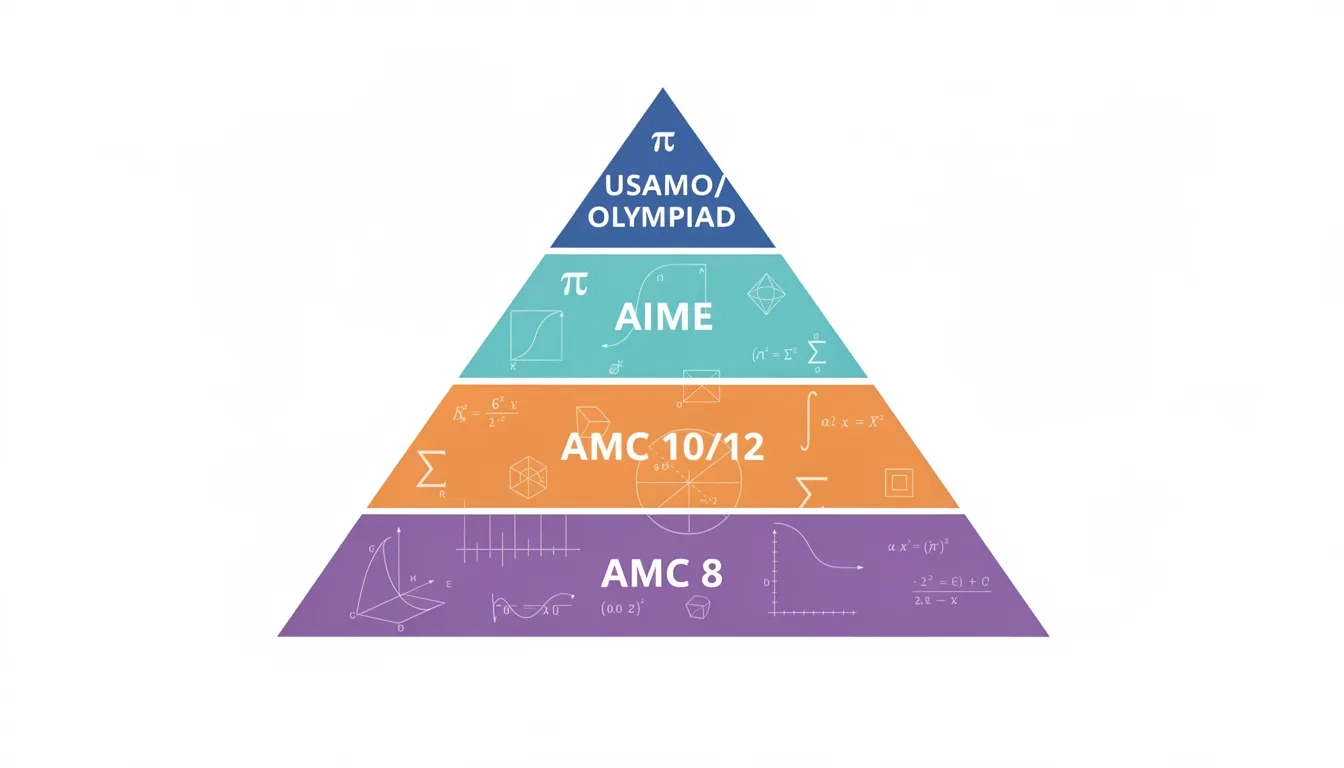
The pathway from first competition to international stage:
- AMC 8 — 25 questions, 40 minutes, grades 8 and below (max age 14.5)
- AMC 10 — 25 questions, 75 minutes, grades 10 and below (max age 17.5)
- AMC 12 — 25 questions, 75 minutes, grades 12 and below (max age 19.5)
- AIME — 15 questions, 3 hours, invitation only
- USAJMO / USAMO — by combined AMC + AIME index score
- USA IMO Team — 6 students selected each year
The AMC 10 and 12 each run twice annually: the "A" version typically in November, the "B" in February. You can take both versions in the same year — and many students do, treating the "B" as a second qualification attempt if the "A" didn't break through.
One thing that trips people up: AMC 10 and AMC 12 are separate tracks, but they feed into the same AIME pool. You can take AMC 10A in November and AMC 12B in February. Qualify on either one, and you're in. The invitation doesn't care which exam you came through.
The AMC 8 is worth treating as more than a warm-up. Students who've worked through AMC 8 problems systematically tend to internalize the reasoning patterns — working backwards, recognizing structure, logical elimination — that scale directly to AMC 10 problems. Starting there isn't losing time.
How AMC Scoring Actually Works
The scoring system has a quirk that most students don't account for until it costs them.
On the AMC 10 and AMC 12:
- Correct answer: 6 points
- Left blank: 1.5 points
- Wrong answer: 0 points
- Maximum score: 150 (all 25 correct)
Notice that blank beats wrong. A skipped problem is worth 1.5 points; an incorrect answer is worth zero. Every wrong answer costs you 1.5 points compared to leaving it blank. Over five borderline problems where you guess randomly, that's 7.5 points lost — which can easily be the difference between qualifying and not.
The math on guessing: if you eliminate two of five choices and guess among the remaining three, your expected score per problem is 6 ÷ 3 = 2 points, which beats the 1.5 from skipping. So the rule is: eliminate at least two choices before guessing. If you can only eliminate one, you're indifferent. If you can't eliminate anything, skip it.
The AIME is completely different. No multiple choice, no partial credit. Answers are integers from 000 to 999. One point per correct, zero for wrong. Three hours, 15 problems. A score of 7 out of 15 is genuinely respectable — the national median among qualifiers historically sits around 5 to 6.
What Qualifying Actually Requires
Cutoffs shift year to year based on exam difficulty and participant distribution. The trend over the past five years has been upward, reflecting a more prepared and competitive field.
Here's the 2025-26 season data (fall 2025 exams, for AIME in February 2026), per the Mathematical Association of America:
| Exam | AIME Cutoff | Distinction (Top 5%) | Honor Roll (Top 1%) |
|---|---|---|---|
| AMC 10A | 105 | 112.5 | 136.5 |
| AMC 10B | 99 | 105 | 133.5 |
| AMC 12A | 96 | 127.5 | 150 |
| AMC 12B | 100.5 | 127.5 | 145.5 |
And historical AMC 10 cutoffs over five years, showing the upward trend:
| Year | AMC 10A | AMC 10B |
|---|---|---|
| 2020 | 102.0 | 103.5 |
| 2021 | 103.5 | 105.0 |
| 2022 | 105.0 | 108.0 |
| 2023 | 111.0 | 109.5 |
| 2024 | 112.5 | 115.5 |
| 2025-26 | 105.0 | 99.0 |
Targeting at least 10 points above the expected cutoff isn't paranoia — it's insurance against a harder-than-average exam and any careless errors on the day.
My take: AMC 12 is often the smarter route to AIME qualification for students who've covered precalculus. The cutoff is roughly 10-15 points lower than AMC 10, and even though the problems are harder, that math frequently works out in your favor once you've seen logarithms, trigonometric identities, and basic complex numbers.
The Four Core Topics
AIME and AMC problems aren't random. They draw from a well-defined set of mathematical areas, and knowing which ones appear most often — and where your gaps are — is the fastest way to improve.
Algebra. Polynomial manipulation, function composition, logarithms, inequalities, sequences and series. AMC 10/12 problems lean on clean algebraic manipulation. AIME pushes further into clever substitutions and systems where the right variable choice collapses the problem.
Geometry. Similar triangles, circle theorems, area ratios, and coordinate geometry dominate the AMC. AIME geometry frequently involves 3D figures, trigonometric area formulas, and problems where coordinate methods are both obvious and slow — the better approach is usually synthetic. Knowing when not to use coordinates is a real skill.
Number Theory. Divisibility rules, modular arithmetic, prime factorization, Chinese Remainder Theorem, Diophantine equations. These problems are disproportionately frequent on the AIME and notoriously opaque to students who haven't specifically studied them. Mod arithmetic intuition takes time to build — it doesn't click overnight.
Combinatorics and Probability. Counting problems, permutations, combinations, expected value, and inclusion-exclusion. These are the most accessible topics for strong students who haven't done formal contest training, but also the most dangerous. The most common mistake is over-counting; the second most common is missing an edge case entirely.
Most AMC problems combine two of these areas. A classic example: geometry plus number theory, asking for integer-valued side lengths satisfying some constraint. Recognizing the combination quickly — and knowing which toolset applies — only comes from volume.
A Realistic Study Timeline
Students who consistently qualify for AIME share one trait: they started at least 18 months before their target exam. October prep for a November AMC is not preparation. It's scrambling.
A phased approach that actually works:
Phase 1 — Foundation (Months 1-6)
- Work through the Art of Problem Solving Introduction series: algebra, counting & probability, geometry, and number theory. These books were written specifically for contest math and build exactly the intuitions these exams test. Nothing else (not Khan Academy, not school textbooks) comes close.
- Solve AMC 8 problems and AMC 10 problems 1-15 from recent years. Check every solution, not just the ones you missed.
Phase 2 — AMC-level preparation (Months 7-12)
- Full AMC 10/12 practice exams under timed conditions: 75 minutes, no calculator, no interruptions
- After each exam, read every solution — including problems you got right. There is often a faster method, and seeing it trains you to recognize better approaches under pressure.
- AoPS Intermediate Algebra and Intermediate Counting and Probability for depth
Phase 3 — AIME preparation (Months 13-18)
- AIME problems organized by topic (the AoPS wiki has a reliable categorized archive through 2023)
- Problems 1-8 from old AIME exams as timed drills
- Full 3-hour AIME practice exams toward the end
The AoPS community forums (artofproblemsolving.com) are worth bookmarking as a standalone resource. Solutions posted there are often more elegant than official ones, and the discussion threads around alternate approaches are where real learning happens for difficult problems.
AIME-Specific Tactics
Qualifying for AIME and doing well on AIME are genuinely different challenges. The AMC is 3 minutes per problem. The AIME gives you 12 minutes per problem on average, and problems 11-15 routinely require 20+ minutes of sustained work.
Three habits that separate strong AIME scorers from students who just qualified:
Don't rush problems 1-5. Early AIME problems are designed to be solvable, but they reward clean setup over speed. A student who rushes problem 3 and drops a sign introduces an arithmetic error that takes the problem from certain to zero. Methodical beats fast on easy problems.
Know when to abandon a problem. If you've spent 18 minutes on a problem and made no real progress, move on. A student who correctly solves six problems scores 6. A student who spent two and a half hours juggling four problems and finished two of them also scores 2. The 180-minute clock rewards allocation.
Budget 15-20 minutes at the end for verification. AIME answers are specific integers; a correct approach with one arithmetic error scores exactly the same as a blank. The highest-scoring students treat the final stretch as error-checking time, not problem-solving time.
For students targeting a score of 7 or below: spending significant effort on problems 11-15 is usually a poor trade. Getting problems 1-10 consistently right is the more efficient path to that range. Problems 11-15 are where competition math genuinely diverges from anything that can be systematically drilled — those insights tend to arrive from breadth of exposure, not targeted prep.
Bottom Line
- Start 18 months out. The AMC/AIME pathway rewards sustained practice far more than last-minute intensity. One year of consistent work beats three months of cramming every time.
- Understand the blank-vs-wrong tradeoff. Eliminate at least two choices before guessing on the AMC. Blind guesses actively hurt your score.
- Target 115+ on AMC 10, or 105+ on AMC 12 to build real buffer above typical cutoffs.
- AoPS books and the AoPS problem archive are the foundation. No other resource consistently builds the specific reasoning skills these exams test.
- On AIME, clean execution over speed. A reliable 6 beats a chaotic attempt at 10.
The math you build preparing for these competitions — comfort with abstraction, creative problem decomposition, working under uncertainty — doesn't stay behind when the test ends.
Frequently Asked Questions
Can I take both AMC 10 and AMC 12 in the same season?
Not on the same test date — you pick one per sitting. But you can take the "A" version of one exam (say, AMC 10A in November) and the "B" version of the other (AMC 12B in February) in the same school year. Since qualifying on any single exam earns the AIME invitation, many students use this approach to give themselves two chances with different exam formats.
Is AMC 10 or AMC 12 easier to qualify through?
This is genuinely closer than most students think. AMC 12 includes precalculus material, but its AIME cutoff runs roughly 10-15 points lower than AMC 10. For a student who has studied logarithms, trigonometric identities, and complex numbers, AMC 12 is often the more efficient qualification path. If you're in 9th grade and haven't seen precalculus yet, AMC 10 is the obvious choice. But "AMC 10 is easier to qualify through" is a myth worth questioning.
What AIME score should I realistically target?
For a first-time qualifier, 3-5 is a common range. Scoring 7+ is genuinely competitive. Double digits (10+) puts you in USAMO contention territory for most years. The national median among AIME participants historically sits around 5-6, so a score of 4 your first year is not a failure — you're already in the top 2.5% of AMC 10 takers.
How many practice exams should I do to prepare?
Five to ten full timed exams with serious post-exam review will do more than thirty exams where you just check the answer key. The review is the learning: understanding why a method works, recognizing where you would have been faster, catching the conceptual gap that led to the wrong approach. Volume without review is just reinforcing whatever habits you already have.
Do I need to know calculus for the AIME or AMC?
No. Neither exam requires calculus. The AMC 12 covers precalculus (logarithms, trigonometry, complex numbers), but calculus itself never appears. Some problems can be solved with calculus if you know it, but there's always a non-calculus path. The AIME rewards algebraic creativity and mathematical maturity, not the most advanced techniques.
Sources
- Areteem Institute: AIME Cutoffs and AMC 10/12 Awards
- Mathematical Association of America: 2025-26 AIME Thresholds Are Now Available
- AwesomeMath: AMC 10/12 Historical AIME Cutoff Scores & Qualification Guide
- Indigo Research: How to Prepare for the AIME Math Competition
- IMACS: AMC Math Competition Guide
- Gonit: What Is a Good AMC Math Competition Score?