AP Calculus BC: Complete Study Guide and Score Tips
44% of AP Calculus BC test-takers score a 5. No other high-enrollment AP exam comes close — most sit around 15–20%. What explains it? The course self-selects for students who have already cleared several math hurdles, and the material, while genuinely hard, follows predictable patterns once you know what the exam actually rewards. If you're preparing for the May 2026 exam, this guide covers everything from the exact structure to the series convergence traps that sink otherwise-strong students.
What's Actually on the Exam
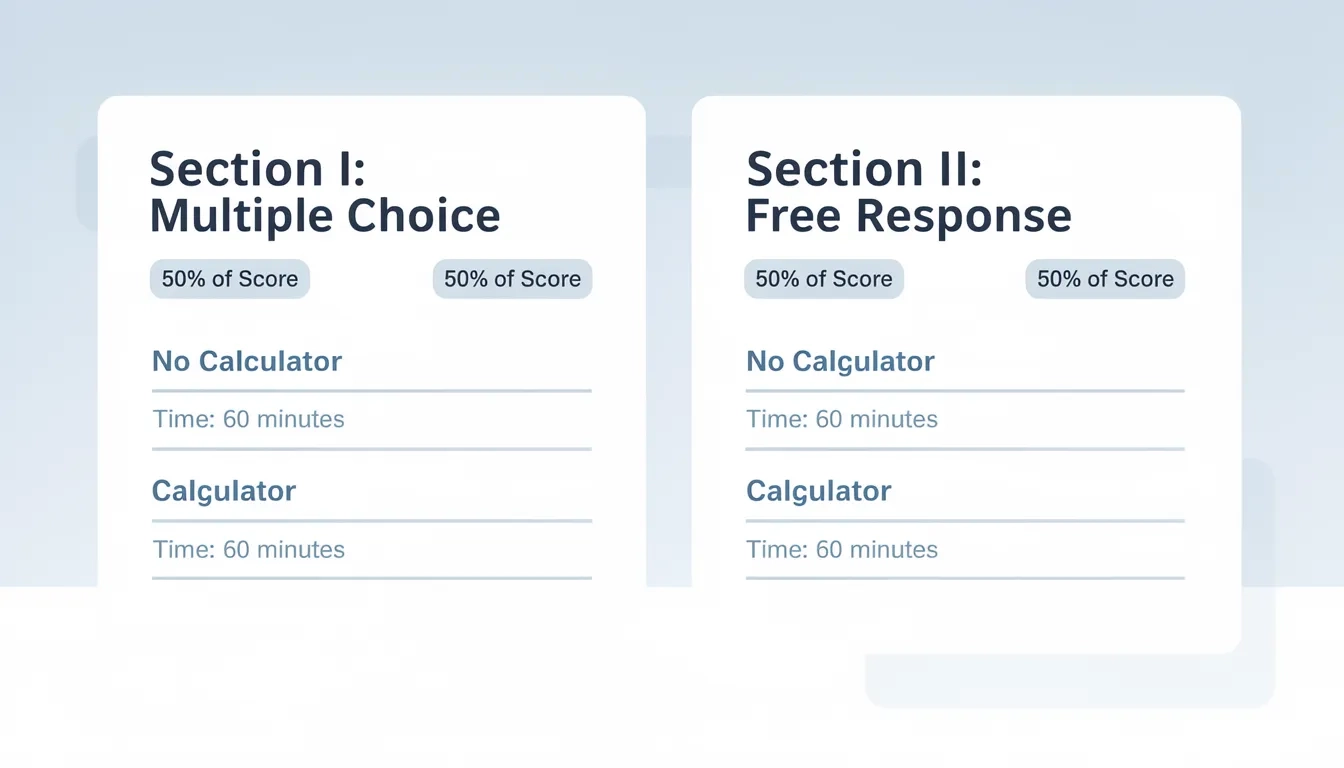
The AP Calculus BC exam runs 3 hours and 15 minutes. Two sections, each worth exactly half your score.
Section I is multiple-choice. 45 questions across 1 hour 45 minutes. The first 30 questions give you 60 minutes and no calculator — mental math speed matters here. The final 15 questions allow a graphing calculator, and you get 45 minutes. The College Board designed that Part B for problems where technology can save time, not replace reasoning.
Section II is free response. 6 questions across 1 hour 30 minutes. Part A (2 questions, 30 minutes) requires a graphing calculator. Part B (4 questions, 60 minutes) does not.
One format detail for 2026: multiple-choice answers go into the Bluebook app on a device, while free-response answers are handwritten in paper booklets (a hybrid setup worth practicing before test day).
| Section | Questions | Time | Calculator |
|---|---|---|---|
| MC Part A | 30 | 60 min | No |
| MC Part B | 15 | 45 min | Yes |
| FRQ Part A | 2 | 30 min | Yes |
| FRQ Part B | 4 | 60 min | No |
Each FRQ is worth 9 points. The final answer earns only 1 or 2 of those. The rest come from showing work, setting up equations, and writing justification language — which is the entire skill the exam is testing.
BC vs. AB: The New Territory
AP Calculus BC covers everything in AB, then adds a substantial second layer. Shaky AB foundations will hurt you on BC questions, so don't treat the AB review as optional.
Parametric and polar calculus extend derivative and integral concepts to new coordinate systems. For parametric equations, dy/dx = (dy/dt)/(dx/dt) needs to be automatic. The polar area formula — (1/2)∫r² dθ — appears almost every year, and arc length formulas for both parametric and polar curves come up regularly in free response.
Integration techniques expand meaningfully. Integration by parts and partial fraction decomposition are both BC-only and show up in FRQ Part B with notable consistency.
Sequences and series are the real beast. This chunk accounts for roughly 17–18% of your BC score and is completely new for students who only took AB. The exam tests whether you can identify which convergence test fits which series structure — not just whether you can execute a test mechanically.
Approximate BC-only topic weight breakdown:
- Series and convergence: ~17–18% of exam weight
- Parametric calculus and vector-valued functions: ~11–12%
- Polar functions: ~6–9%
- Integration by parts and partial fractions: folded into integration units (~17–20% total)
That distribution tells you where extra study hours pay off.
The FRQ Is Where Students Leave Points on the Table
Here's the scenario that plays out every May: a student who genuinely understands the calculus writes a clean final answer with minimal work shown, then gets a 2 out of 9. The AP scoring rubric does not care if your answer is correct. It cares whether you earned each of the 9 individual points by demonstrating specific mathematical steps.
Show every intermediate step. Solving ∫sin²(x) dx? Write out the trig identity substitution explicitly before integrating. Using the Fundamental Theorem of Calculus? Write F(b) − F(a) before substituting numbers. Scorers award credit at each checkpoint; they do not award points retroactively for a correct final value that appeared without process.
"The final answer is typically worth only 1–2 of the 9 available points. Earning the other 7 is a writing problem as much as a math problem."
Justification language is not optional. When asked whether a function is increasing, writing "because f′(x) > 0 on (a, b)" is what earns the point — not just "yes." When determining convergence, state the test, show the limit or comparison that satisfies the conditions, then state the conclusion. Graders follow that exact sequence on the rubric.
Units matter. If the problem involves distance in meters and time in seconds, an answer of "47.3" with no unit loses a point. Write "47.3 meters per second." It takes two seconds.
According to PrepScholar's FRQ analysis, on calculator-permitted questions the College Board expects four specific capabilities: plotting functions in an arbitrary window, solving equations numerically, calculating derivatives numerically, and evaluating definite integrals. If any of those four requires menu-hunting on your calculator under pressure, practice them before the exam.
Series and Convergence: Your Highest-Impact Topic
Most BC students find series to be the hardest new material. It's also the most heavily tested BC-only topic. Solid performance here is the single clearest path to a 4 or 5 for a student who already has AB content locked in.
The six convergence tests you must know cold:
- Geometric series — converges when |r| < 1; sum = a/(1 − r)
- p-series — converges when p > 1; diverges when p ≤ 1
- Ratio Test — compute lim|aₙ₊₁/aₙ|; converges if < 1, diverges if > 1
- Alternating Series Test — converges if terms decrease monotonically to zero
- Direct Comparison Test — compare to a known convergent or divergent series
- Limit Comparison Test — take the limit of the ratio; series share behavior if the limit is finite and positive
The most common BC series mistake, flagged by MathHub's 2026 guide: applying a convergence test that doesn't fit the series structure. Ratio Test is almost always correct when factorials or exponentials appear in the terms. p-series and comparison tests work better for algebraic expressions like 1/n² or 1/√n.
Lagrange error bounds appear on the FRQ with striking frequency. APScoreHub identifies this as one of the highest-frequency BC topics across recent exams. The formula is |Rₙ(x)| ≤ M|x − c|ⁿ⁺¹/(n + 1)!, where M bounds the absolute value of the (n+1)th derivative on the interval. It looks dense but follows one consistent template every time.
Taylor and Maclaurin series require memorizing four base series: sin(x), cos(x), eˣ, and 1/(1 − x). From those, you can build most others through substitution, differentiation, or multiplication. The exam rarely asks for a series that can't be derived from those four starting points.
A 9-Week Study Plan That Works
MathHub's 2026 guide structures prep as two distinct phases: content mastery for the first six weeks, then exam simulation for the final three. That separation matters — students who skip straight to practice tests before mastering the content just rehearse their gaps.
Weeks 1–2: Cover limits, derivatives, and AB-level integration. Don't rush this. Shaky foundations in implicit differentiation, related rates, the Fundamental Theorem, and u-substitution will undermine every BC topic that follows.
Weeks 3–4: Move to AB applications — optimization, curve sketching, area between curves, basic differential equations. These are relatively accessible points on the BC exam and worth locking in early.
Weeks 5–6: Attack BC-only content head-on. Series and convergence deserve their own full week. Parametric, polar, and integration by parts can share a week if your AB base is solid.
Weeks 7–9: Exam simulation. Complete at least two full released exams under strict timed conditions. After each one, categorize every wrong answer: conceptual misunderstanding, calculation error, or time management failure. Each type requires a different fix — more content review, more arithmetic practice, or better pacing strategy.
The College Board has released 20+ years of past free-response questions on AP Central at no cost. Work through FRQs from at least the past five years and self-grade against the official rubrics. Reading the model solutions for questions you got wrong is more instructive than re-doing problems you already understand.
Calculator Strategy and the Scoring Curve
Spend about 37 minutes before your first timed practice session doing nothing but calculator mechanics — find zeros, evaluate definite integrals, compute numerical derivatives, and plot a function in a custom window. If any of those four actions takes more than 10 seconds of menu navigation, do it again until it's automatic.
The scoring curve is more forgiving than most students realize. Earning a 5 on AP Calculus BC typically requires roughly 65–70% of total available points in a given exam year, according to APScoreHub's score data. You can miss a meaningful number of questions and still hit the top score.
This should change how you triage during the exam. Stuck on a subpart? Write what you know. State the relevant formula. Set up the integral even if you can't evaluate it. Name the convergence test even if you can't finish the limit. Partial credit is real — graders award each individual rubric point independently.
Notation errors are quiet point killers. Forgetting dx inside an integral, omitting limit notation when taking a limit, writing the derivative symbol incorrectly — each one can cost a point without feeling like a big deal in the moment. Build the habit of clean notation in every practice problem, not just on timed exams.
One last detail worth knowing: the BC exam generates a separate AP Calculus AB subscore based only on the AB-relevant questions. Some colleges award AB credit based on a strong BC subscore (the TI-84 Plus CE, by the way, handles all four required calculator tasks natively and is the most widely supported device). Check each target school's AP credit policy — it can affect whether you need a placement exam in college.
Bottom Line
- FRQ points come from process, not answers. Show every step, write justification language, and include units. Final answers earn 1–2 of 9 points at most.
- Series convergence is your highest-impact BC topic. Six convergence tests, four base Taylor series, and the Lagrange error bound formula cover the vast majority of what the exam asks.
- Use the two-phase study structure. Six weeks of content mastery, three weeks of timed exam simulation. Categorize wrong answers by type — conceptual, calculation, or pacing.
- You don't need perfection for a 5. Roughly 65–70% of available points earns the top score. Triage strategically and collect every partial credit point you can.
- Calculator fluency is a time asset. The four required tasks should take under 10 seconds each before you sit down for the real exam.
Frequently Asked Questions
Is AP Calculus BC significantly harder than AP Calculus AB?
BC adds roughly 30–35% more content on top of AB, concentrated in series and convergence, parametric calculus, polar functions, and additional integration techniques. The AB content is the same difficulty level — BC is harder because of volume and the conceptual jump required for sequences and series. Students who genuinely mastered AB tend to find the transition manageable with 4–6 weeks of focused BC prep.
Can I score a 5 if I struggle with series questions?
Yes, though it's harder. Series account for roughly 17–18% of total exam weight, so strong performance elsewhere can compensate. But series and Taylor polynomials appear in both multiple-choice and free-response sections, so leaving the topic entirely alone is a real risk. Prioritize at minimum the Ratio Test, Geometric series formula, and Lagrange error bound — those three alone cover the majority of series points on most exams.
What's the myth about needing to answer every question?
Many students believe leaving a question blank is always safer than guessing. On the AP Calculus BC multiple choice, there's no penalty for wrong answers (the old quarter-point deduction was removed years ago), so guessing on questions you're uncertain about is always correct strategy. On FRQs, attempting a subpart — even incorrectly — can earn partial credit, while a blank earns nothing.
What's the most common mistake on the no-calculator FRQ section?
Running out of time. Four questions in 60 minutes sounds reasonable until you're writing out full justifications, checking notation, and including units by hand. Students consistently underestimate how long thorough written solutions take. Budget roughly 15 minutes per question, move on if stuck, and return to incomplete parts at the end. Practice writing out complete solutions — not just circling answers — during your prep.
How should I use the official College Board resources?
AP Central's past FRQ archive is the single most valuable free resource available — 20+ years of actual exam questions with official scoring rubrics. Work a question, then grade it against the rubric line by line. The rubric language shows exactly what phrases earn each point. Released full exams from 2012 and 2017 both have complete answer keys available and are worth completing under timed conditions.
Does the AB subscore matter?
It depends on the college. Some schools award credit for AP Calculus AB based solely on the AB subscore from a BC exam attempt, which means your BC registration gives you two chances at credit in a single sitting. Check each school's AP credit policy directly — the difference between "AB credit awarded" and "no credit" can affect whether you're placed into a higher-level course or have to take a placement exam after arriving on campus.