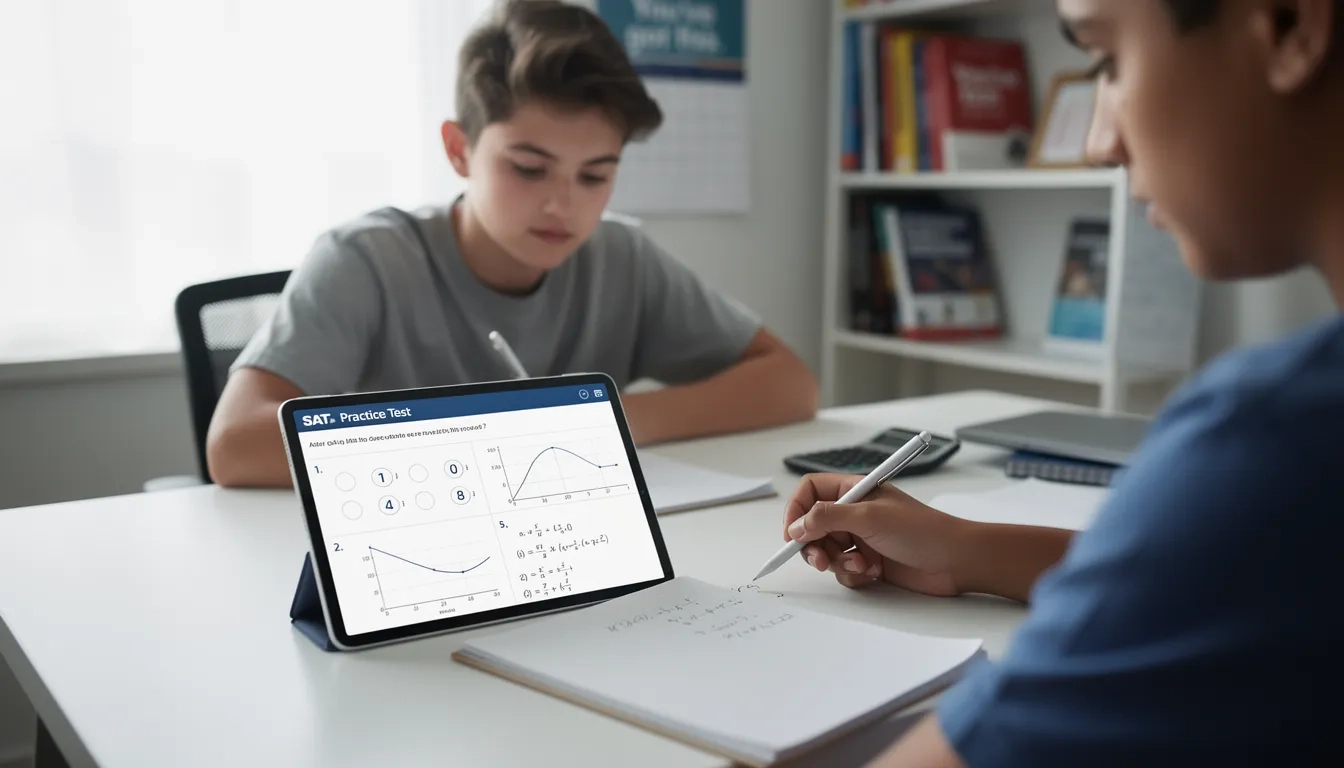
SAT Math Strategies and Practice Tips That Actually Move Your Score

Here's the thing nobody tells you about digital SAT Math
Missing eight questions in the first half of the test can quietly cap your score before you even reach the second half. That's not a scare tactic — it's how the adaptive format works. The digital SAT splits Math into two 22-question modules, and your accuracy on Module 1 decides whether Module 2 hands you harder questions worth more points, or an easier set with a lower ceiling.
Most students still prep like it's the old paper SAT: memorize formulas, grind timed sections, hope for the best. That approach worked in 2015. It leaves points on the table now, because the test itself has changed shape — and most prep advice floating around online still describes a test that no longer exists.
The average Math score for the Class of 2025 sat around 528, according to College Board data, roughly where it's hovered since the digital format launched in 2024. That average tells you something important: most test-takers aren't adapting their strategy to an adaptive test. Here's how to actually do that.
Understand the module math before you touch a practice question
You cannot out-study an adaptive test if you don't know its scoring mechanics. So let's get concrete.
Each Math module has 22 questions. Based on current reporting, you generally need around 70% correct in Module 1 — missing roughly 8 or fewer — to route into the harder, higher-ceiling version of Module 2. Land in the easier module and your maximum possible score drops, no matter how well you perform afterward.
The single highest-leverage move on digital SAT Math isn't a formula or a calculator trick. It's protecting your Module 1 accuracy above everything else.
That reframes how you should spend your effort:
- Module 1 is not the place to burn 3 minutes on a question you're unsure about. Mark it, guess your best answer, move on.
- A wrong guess and a blank answer cost you the same — zero points, no penalty for guessing — so never leave a bubble empty.
- If you're aiming for an 800, some estimates suggest you can't afford to miss more than 2 questions total across both modules combined. That's a different prep intensity than aiming for a 650.
One common misconception: students assume "adaptive" means the test is trying to trick them into a low score. It's the opposite — it's trying to find your ceiling efficiently. Treat Module 1 like a placement test, not a trap.
The borderline case: what if you're right on the edge?
The riskiest zone isn't "I bombed Module 1" or "I aced it" — it's the murky middle, missing 7 or 9 questions where you genuinely don't know which module you'll get. Two students both around 60–65% correct can end up in different modules depending on which questions they missed, since harder questions carry more weight in the routing decision than easier ones.
The practical takeaway: don't try to game the threshold by counting misses in your head mid-test. You have no visibility into the routing algorithm while you're testing, and second-guessing yourself over "have I missed too many yet?" burns time you need for the actual math. Play every question in Module 1 like it's the one that matters, because from a routing standpoint, it might be.
Use the two-pass method to control time, not just answer questions
You get roughly 35 minutes per module for 22 questions — that's about 95 seconds per question on average, though the real distribution is lopsided (some questions take 20 seconds, others take three minutes).
The fix is a structured two-pass sweep instead of working straight through in order:
- Pass one (speed sweep): Answer every question that clicks within 30–45 seconds. If it doesn't, hit "Mark for Review" and move immediately — don't let a stubborn question anchor you.
- Pass two (cleanup): Return to marked questions with whatever time remains, tackling the ones that look most solvable first.
- Final two minutes: Fill in a guess for anything still blank. An educated guess beats a blank every time, given there's no wrong-answer penalty.
This matters more on the digital SAT than the old paper version, because Bluebook's question navigator shows you exactly how many questions remain and which ones you flagged — a UI advantage that rewards a deliberate pass structure and punishes linear, heads-down solving.
A concrete example
Say you're 12 minutes into Module 1 and stuck on a quadratic word problem. On paper SAT logic, you might grind it out since skipping meant losing your place. On digital SAT logic, you mark it, move to question 14, and come back with fresh eyes at minute 30. That's not procrastination — it's triage.
The edge case: marking too much
There's a failure mode on the opposite end, too. Some students get so attached to the "mark and move on" habit that they flag 10 or more questions in pass one, then arrive at pass two with no real time left to solve any of them properly. If you're marking more than a third of the module, that's a signal your speed-sweep threshold is too aggressive, or that you have a genuine content gap you haven't addressed yet — not a timing problem you can pace your way around. Practice tests are where you calibrate this ratio, not test day.
Master Desmos like it's a weapon, not a backup
College Board built a full Desmos graphing calculator directly into the Bluebook testing app, available for the entire Math section — no more mental math on the no-calculator portion, because that portion doesn't exist anymore. And the numbers back up using it aggressively: College Board's own data indicates students who use Desmos effectively score 20 to 40 points higher on Math than similar students relying only on a handheld calculator.
Here's where it earns its keep on actual problem types:
| Problem Type | Manual Approach | Desmos Shortcut |
|---|---|---|
| Circle equations (x−h)² + (y−k)² = r² | Solve for center/radius by hand | Type the equation directly — center and radius display instantly |
| Systems of equations | Substitution or elimination | Graph both lines, click the intersection point |
| Quadratic roots | Factor or use the quadratic formula | Graph the parabola, read x-intercepts directly |
| Tables of values | Plug in each x by hand | Use the built-in table feature to generate outputs instantly |
| Percent/exponential growth | Compute year-by-year by hand | Use a slider on the growth-rate variable and read the curve directly |
The trap: students who only pull up Desmos when they're stuck. By then you're improvising under pressure. Spend 30 minutes drilling each core technique — circles, systems, tables, regressions, sliders — until typing the equation is automatic. On test day, your brainpower should go toward interpreting the problem, not remembering which button does what.
One more thing worth noting: Desmos preserves exact values (fractions, radicals) instead of rounding, so you dodge the rounding-error trap that catches students doing decimal approximations in their head.
When Desmos actually slows you down
Not every problem benefits from opening the calculator. Simple one-step arithmetic, basic percent calculations, and questions that test whether you understand a concept (not whether you can compute it) are often faster solved mentally or on scratch paper. Typing an equation into Desmos takes 10–15 seconds even when you're fast — on a question you could solve in 5 seconds of mental math, that's a net loss repeated over 22 questions. The skill worth building isn't "always use Desmos," it's rapid triage: glance at a problem and decide in 2 seconds whether it's a calculator problem or a scratch-paper problem.
Build a practice routine that mirrors real score gains
Here's a number worth sitting with: Khan Academy's research on the Official SAT Practice platform, drawn from data on nearly a quarter million Class of 2017 students, found that 20 hours of practice correlated with a 115-point average score increase, and even 6 hours correlated with a 90-point gain. That held steady across income, GPA, and demographic lines — meaning the gain came from the practice itself, not from who was doing it.
That's the elephant in the room for most students: they think they need hundreds of hours before they see any lift. The data says otherwise. Diminishing returns exist, sure, but the first 20 hours are disproportionately valuable if you spend them correctly.
A routine that actually converts hours into points:
- Keep a weekly error log. Not just "got it wrong" — write down why: sign error, misread the question, forgot a formula, ran out of time. Patterns emerge fast.
- Take full-length practice tests under real conditions, timed, on the actual Bluebook app if possible, not a PDF printout.
- Target high-frequency topics first: linear equations, functions and function notation, ratios/proportions, and quadratics dominate the question bank. Nail those before chasing rare topics like matrices or complex numbers.
- Review immediately after each session, not days later. The Khan Academy data ties gains to structured, diagnostic-driven practice — not just volume for its own sake.
A mistake I see constantly: treating every wrong answer as equally important. A silly arithmetic slip on an easy question and a genuine conceptual gap on a hard one require completely different fixes. Log them differently.
A sample week, if you're starting from zero
If 20 hours is your near-term target, here's one way to structure it rather than cramming it into a single weekend (which tends to produce fatigue-driven errors that look like content gaps but aren't):
- Days 1–2 (2 hours): Diagnostic full module under timed conditions, then a full review pass logging every miss by cause.
- Days 3–5 (3 hours): Targeted drills on whatever two topics generated the most errors in your log — not everything, just the top two.
- Day 6 (1.5 hours): Second timed module, ideally the same topics revisited, to check whether the drilling closed the gap.
- Day 7 (1 hour): Desmos technique drilling — circles, systems, tables — completely separate from content review, since calculator fluency and math fluency are different skills that fail independently.
Repeat that cycle three times and you've logged the 20 hours the Khan Academy data associates with a 115-point average gain — with each cycle targeting whatever your error log says is weakest, instead of re-drilling what you already know.
Know what "good" actually means for your target schools
Scores are relative, and chasing a number without context wastes prep time. A 1200 total lands around the 75th percentile nationally; a 1400 sits near the 93rd; a 1500 is close to 98th, per current College Board percentile data.
For Math specifically, since the average sits near 528, even modest above-average performance (around 600–650) already clears most state flagship schools. But if you're targeting selective private universities, you're likely competing in the 700+ range, where the margin for Module 1 misses shrinks to almost nothing.
The tradeoff here is real: grinding for a 750 when your target schools' middle 50% tops out at 650 is time you can't get back. Check your target schools' Common Data Set before deciding how many prep hours to invest — it's the single most underused planning document in this whole process.
There's a second-order decision worth naming too: whether to retake the test. Many schools superscore, meaning they take your best Math score and best Reading/Writing score across separate sittings, even if they came from different test dates. If your Math score is well below your target range but your Reading/Writing score already clears it, a second sitting focused entirely on Math prep is often a better use of time than re-taking the whole test cold. Check each target school's stated policy before assuming superscoring applies — not all of them take it.
Bottom Line
- Protect Module 1 accuracy first. Aim for roughly 70%+ correct — missing 8 or fewer — to unlock the higher-scoring Module 2, and don't try to count misses mid-test.
- Run a two-pass timing strategy: speed-sweep everything under 45 seconds, mark the rest, clean up in the final minutes, and never leave a blank — but watch for over-marking, which signals a content gap, not a pacing problem.
- Drill Desmos on specific problem types — circles, systems, tables — until it's automatic, and learn to recognize the simpler questions where mental math is actually faster.
- Log every practice mistake by cause, not just outcome, and structure your hours around your weakest two topics rather than re-drilling strengths.
- Check your target schools' score ranges and superscoring policy before setting a goal number — a 1500 isn't worth the hours if your reach schools admit at 1350.
Frequently Asked Questions
Does guessing hurt my SAT Math score?
No. The digital SAT has no penalty for incorrect answers, so a wrong guess scores the same as a blank — zero. Always fill in an answer, even a rushed guess, before time runs out on a module.
Is the digital SAT Math section harder than the old paper SAT?
Not harder in content, but different in structure. The adaptive format means your Module 1 performance directly caps or unlocks your Module 2 difficulty and score ceiling, which the old linear paper test never did.
How many hours of SAT Math practice do I actually need?
Khan Academy's research found 20 hours correlated with a 115-point average score gain and 6 hours with a 90-point gain, based on data from roughly 250,000 students. Quality matters as much as quantity — structured, diagnostic-driven practice with an error log outperforms unfocused hour-grinding.
Can I use my own calculator on the digital SAT, or only Desmos?
You can bring an approved handheld calculator, but Bluebook includes a built-in Desmos graphing and scientific calculator available for the entire Math section. Most test-prep data suggests students who lean on the embedded Desmos tool score 20–40 points higher than those using a handheld alone.
What SAT Math topics show up most often?
Linear equations and systems, functions and function notation, ratios and proportional relationships, and quadratics make up the bulk of the question bank. Master these four areas before spending time on lower-frequency topics like complex numbers or matrices.
Is it true you need a perfect score to get into a top school?
No — that's a common myth. Percentile data shows a 1400 already lands near the 93rd percentile nationally, and most selective schools' middle 50% ranges fall well below a perfect 1600. Check your specific target schools' Common Data Set before assuming you need max points.
Should I retake the SAT if my Math score is lower than my Reading/Writing score?
Often yes, especially if your target schools superscore — combining your best section scores across different test dates. In that case, focused Math-only prep before a second sitting can be more efficient than retaking the full test, but confirm the school's specific superscoring policy first since not all schools use it.
Sources
- Studying for the SAT for 20 hours on Khan Academy
- SAT Calculator Policy – SAT Suite | College Board
- Deep Dive: Digital SAT 2025-2026 Module 1 Module 2 Math English
- Average SAT Math Score: Percentiles, Score Ranges, and What Is Good
- SAT Math Guide 2026 — Strategies, Formulas & Calculator Tips
- SAT Adaptive Testing: What it Means for You