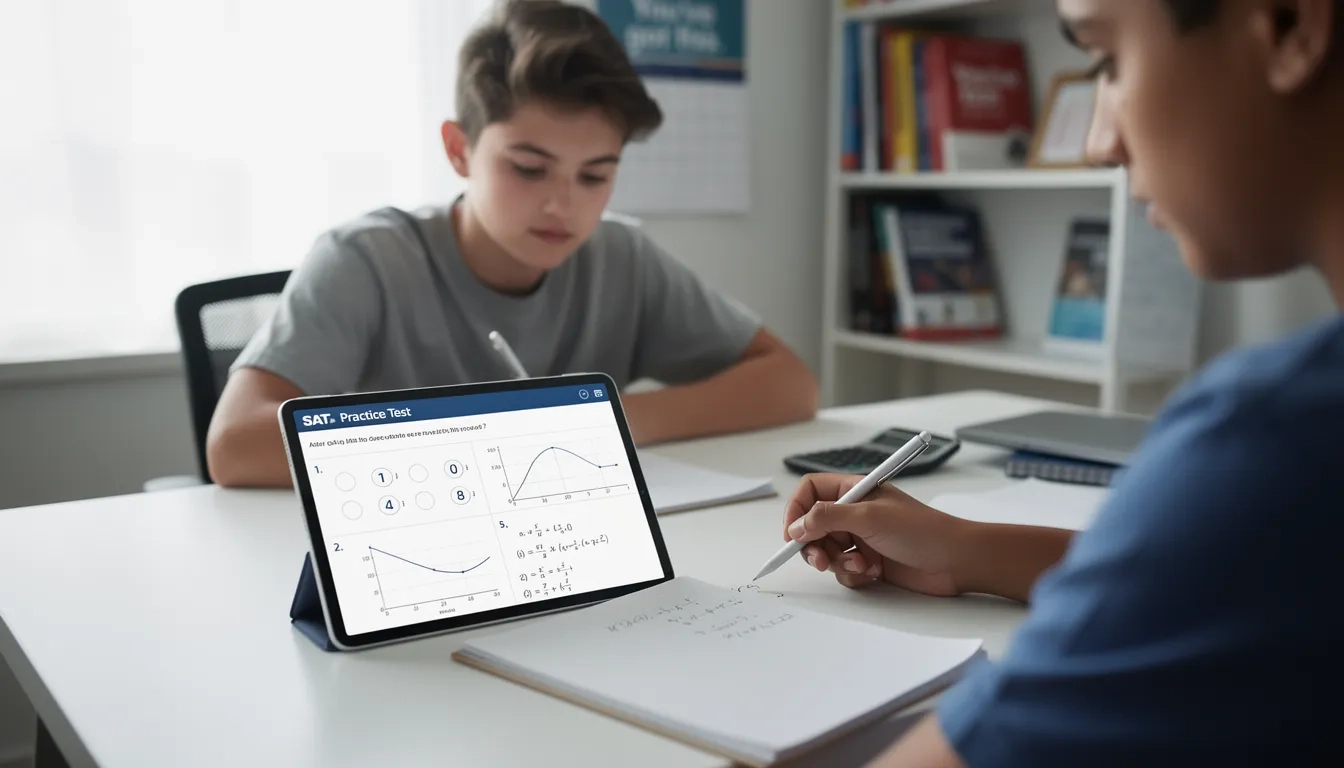
SAT Reading: How to Finish on Time Without Rushing
Here's the number that trips up most students before they've even opened a passage: 71 seconds. That's the average time per question on the digital SAT Reading and Writing section, and if you plan your whole test around that single figure, you'll run out of time on the questions that actually decide your score. The real pacing problem isn't the clock. It's treating a grammar fix and a rhetorical synthesis question as if they cost the same 71 seconds, when one takes 35 and the other can eat 90.
How the Clock Actually Works on the Digital SAT
The Reading and Writing section gives you 64 minutes split into two 32-minute modules, 27 questions each, delivered through College Board's Bluebook app. That's the whole section. No separate reading and writing timers like the old paper test, just one clock per module.
Here's the part people miss: the digital SAT is adaptive by module, not adaptive within a module. Your performance on Module 1 determines whether Module 2 skews harder or easier, but there's no mid-module reshuffling based on how you're doing question to question. So you're not pacing "the test." You're pacing two separate 32-minute sprints, and the first one has an extra job: it's the signal that sets the difficulty (and the score ceiling) of the second.
That changes the calculus. Rushing through Module 1 to "bank time" doesn't help you if it costs you accuracy, because a weak Module 1 routes you into an easier Module 2 with a lower maximum score, no matter how much time you have left over.
Pacing isn't about finishing fast. It's about protecting accuracy in Module 1, because Module 1 performance determines the ceiling you're even allowed to reach in Module 2.
The 71-Second Average Is a Trap
Divide 32 minutes by 27 questions and you get roughly 71 seconds a question. Useful for a rough budget. Useless as an actual strategy, because Reading and Writing questions are not interchangeable units of work.
A Standard English Conventions question, think comma placement, subject-verb agreement, is usually a 30-to-45-second task once you spot the rule being tested. A Craft and Structure or Expression of Ideas question, especially rhetorical synthesis (the ones with bulleted notes asking which sentence best accomplishes a stated goal), routinely needs 85 to 90 seconds because you're reasoning through logic, not applying a pattern.
Here's roughly how the module's 27 questions break down by time demand:
| Question type | Typical count per module | Target time | Why |
|---|---|---|---|
| Standard English Conventions (grammar/punctuation) | ~12-13 | 30-45 sec | Rule-based, pattern recognition |
| Craft and Structure / Expression of Ideas | ~14-15 | 85-90 sec | Requires inference, synthesis, logic |
| Rhetorical synthesis (subset of above) | 3-4 | up to 90 sec | Must evaluate against a stated goal |
Run the math and you'll notice something: if you spend flat 71-second chunks everywhere, you're overpaying on grammar and underpaying on reasoning questions — exactly backwards from where your time is actually needed. Budget unevenly on purpose. Grammar questions bank you time; reasoning questions spend it.
The Checkpoint System: A Real-Time Dashboard
An average tells you nothing mid-test. What tells you something is a checkpoint: a known question number paired with a known time-remaining target, so you can tell in real time whether you're on track.
Use these two markers:
- By question 9, you should have roughly 21 minutes left on the module clock.
- By question 18, you should have roughly 10 minutes left.
If you hit question 9 with only 15 minutes remaining, you're already behind by six minutes, and that's your cue to tighten your per-question ceiling immediately rather than hoping you'll magically speed up later. Waiting until question 22 to notice you're out of time is how students end up guessing on the last five questions of a module. Not because the questions were hard, but because nobody flagged the drift when it was still fixable.
Set this up in Bluebook before test day: use the Mark for Review flag on the first item that runs long, glance at the timer widget after every 5-6 questions, and treat the checkpoints like mile markers in a race, not suggestions.
The Skip-and-Return Method, Done Right
Most students already know they should "skip and come back." Where it falls apart is the threshold, people either skip too eagerly (bailing on questions they'd have solved in 20 more seconds) or too stubbornly (grinding 3 minutes into a single inference question while five easier ones sit unanswered).
A workable rule:
- If you're not making forward progress after 45-60 seconds, pick your best current guess, flag it, and move on.
- Finish every other question in the module first.
- Return to flagged items only with time remaining, in the order you flagged them.
- Never leave a bubble empty. The digital SAT has no penalty for wrong answers, so an unflagged guess still beats a blank.
This is sometimes called the Two-Pass Method: first pass for anything you can answer cleanly, second pass for the leftovers. The logic is simple but easy to abandon under pressure — an easy question answered on pass one is worth exactly as much as a hard one answered on pass two, so don't let a hard question early in the module block access to three easy ones later in it.
One caveat worth naming: don't confuse "flag and move on" with "guess randomly and move on." Eliminate at least one obviously wrong choice before you flag anything. It takes five extra seconds and meaningfully improves your odds if you never make it back to that question.
Reading Passages Without Wasting Time
The Reading and Writing section isn't built like the old SAT's 500-to-750-word passages with 10-11 questions attached. It's 27 individual short passages per module, each 25 to 150 words, each with exactly one question. That structure rewards a completely different reading habit than what most students default to.
Read Once, Not Three Times
The instinct under time pressure is to re-read the passage from the top every time you're unsure. Resist it. Read the passage once, identify precisely what the question is asking (main idea? a blank to fill? the author's purpose?), then answer. Re-reading from anxiety, rather than from a specific unresolved question, is the single biggest silent time drain in this section — it feels productive and mostly isn't.
Skim for Structure, Not Every Word
For longer Craft and Structure passages, skim for the shape of the argument first: what's the claim, what's the evidence, where does the passage pivot. Underline (digitally, using Bluebook's highlight tool) the sentence that seems to carry the main idea. That underline becomes your anchor when the question asks you to identify tone, purpose, or the best supporting evidence, so you're not scanning the whole passage cold a second time.
Don't Let Vocabulary Stall You
Unfamiliar words show up by design in Words in Context questions. Use the surrounding sentence structure to infer meaning rather than treating an unknown word as a hard stop. Students who freeze on vocabulary tend to lose 20-30 seconds per instance, which adds up fast across a 27-question module.
What Actually Burns Your Clock
Some habits look harmless in isolation but compound into real time loss across a module. Watch for:
- Second-guessing answered questions. Going back to "double check" a question you already answered confidently, without new information, mostly just re-spends time you don't have.
- Reading the answer choices before the passage. It feels efficient but usually means reading the passage twice: once cold, once hunting for the choice you half-remember.
- Perfectionism on Standard English Conventions. These are rule-based. If you've identified the grammar rule being tested, commit. Agonizing over a comma placement you already know the answer to costs you a Craft and Structure question later.
- Practicing exclusively untimed. You cannot build pacing instincts under conditions that never demand pacing. It's the SAT equivalent of training for a sprint by jogging.
Building Pacing Under Real Test Conditions
None of the above sticks without repetition under an actual clock. Take full-length practice modules in Bluebook (College Board's own practice tests run through the same interface you'll use on test day), and track your checkpoint times explicitly, question 9, question 18, every time.
After each practice module, do a quick audit: which question types ran over budget, and was it a comprehension problem or a pacing problem? A student who understood the passage but ran out of time has a different fix (drill the checkpoint discipline) than one who had time left over but missed the inference (that's a reading comprehension gap, not a pacing one). Conflating the two is a common misdiagnosis that wastes prep time on the wrong fix.
Bottom Line
- Budget unevenly: 30-45 seconds for grammar, 85-90 for Craft and Structure and Expression of Ideas — don't flatten everything to the 71-second average.
- Hit your checkpoints: 21 minutes left at question 9, 10 minutes left at question 18. Adjust your pace the moment you fall behind, not five questions later.
- Flag at 45-60 seconds, eliminate a wrong choice first, then move on — never leave a question blank since wrong guesses aren't penalized.
- Read passages once with purpose; re-reading from anxiety is the quiet time-killer in this section.
- Protect Module 1 accuracy above all else, since it sets the difficulty ceiling for Module 2 regardless of how much time you saved.
The single most important shift: stop thinking of pacing as "going faster." Think of it as spending your fixed 32 minutes where the return is highest, grammar questions on autopilot, reasoning questions given the room they need.
Frequently Asked Questions
How many minutes should I spend on each SAT Reading and Writing question?
There's no single number. Standard English Conventions questions should take 30-45 seconds once you spot the grammar rule, while Craft and Structure and Expression of Ideas questions, especially rhetorical synthesis, deserve 85-90 seconds because they require actual reasoning rather than pattern matching.
Is it true that skipping questions hurts your SAT score?
No, and this is a common misconception. The digital SAT has no penalty for wrong answers, so flagging a question, guessing your best current answer, and moving on costs you nothing extra as long as you actually fill in a bubble before time runs out on the module.
What happens if I run out of time in a module?
Any unanswered question is scored as incorrect, identical to a wrong guess, so an unfinished module with several blanks is strictly worse than one where you guessed on every remaining item in the final seconds. This is exactly why the checkpoint system matters: it catches the drift early enough to still finish.
Does finishing Module 1 faster help me on Module 2?
Not directly. The digital SAT is adaptive between modules based on accuracy, not on how much time you had left, so speeding through Module 1 at the cost of correct answers can route you into an easier, lower-ceiling Module 2 instead of helping you.
Should I read the questions before the passage?
For short Reading and Writing passages (25-150 words), read the passage first, then the question. These passages are short enough that reading the question first mostly just means you'll re-read the passage anyway, hunting for the relevant detail, which costs more time than it saves.
How do I know if my problem is pacing or comprehension?
Track it directly: if you understood the passage but ran out of time before answering, that's a pacing issue and the fix is checkpoint discipline. If you had time left over but still missed the question, that's a comprehension gap, and no amount of pacing practice will fix it, you need targeted reading work instead.
Sources
- Digital SAT Format & Timing in 2026 (Exact Breakdown)
- SAT Pacing Strategy: Time Management Guide 2026
- SAT Time Management Tips | The Princeton Review
- Digital SAT Pacing: Section-by-Section Strategies to Finish on Time
- SAT Reading Time: How Long Is the Reading Section? (2026)
- How the SAT Is Structured – SAT Suite | College Board